
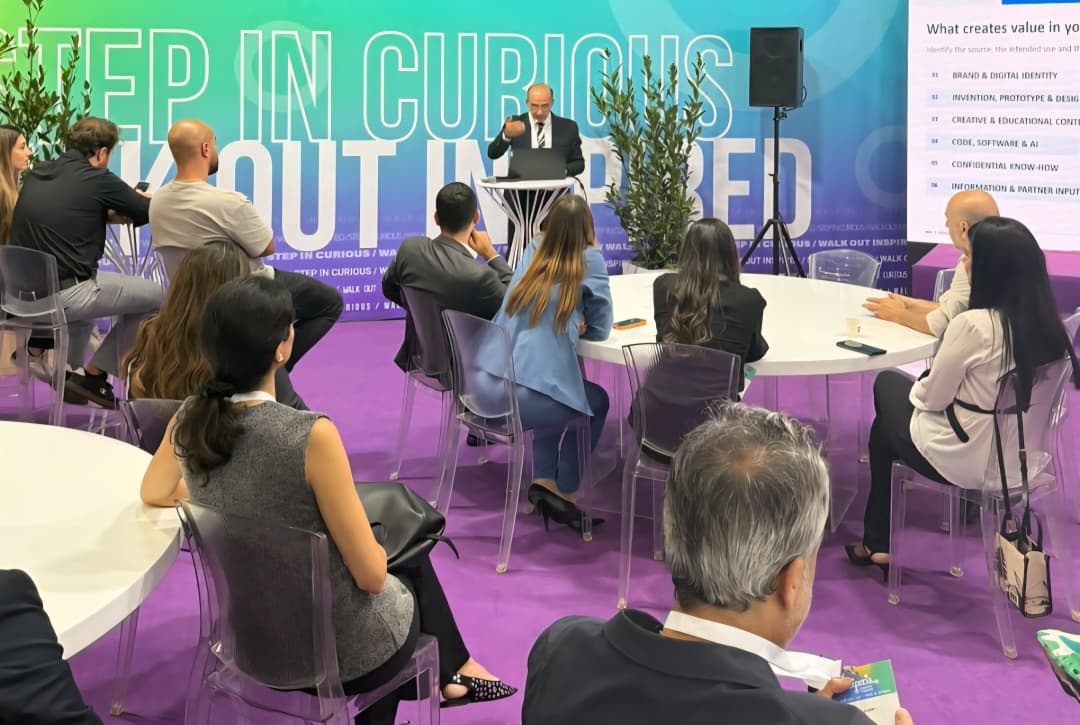
As part of Experia 2026, Dr. Pierre El Khoury, Dean, Faculty of Law and Political Science – Notre Dame University–Louaize & IP & ICT Legal Specialist WIPO (United Nations) and Council of Europe Consultant, delivered a hands-on workshop entitled “Digital Justice: Law meets Ai” on 8 October 2026 at the Forum de Beyrouth. Addressed to young Lebanese entrepreneurs and innovators working in artificial intelligence, fintech, medtech, edtech, renewable energy and the creative industries, the workshop aimed to give them a practical legal perspective on intellectual property and information and communication technology (ICT) law.
Dr. El Khoury opened his talk by recalling his experience in ICT law in Canada twenty-five years ago, when the law was struggling to keep pace with the internet revolution. The same scene, he noted, is playing out again today, only much faster, with the rapid development of artificial intelligence. He stressed that the legal framework must keep up with this growth rather than lag behind it, arguing that the core problem is that “we innovate first and ask the legal questions later”, whereas the law, when used at the right time, enables innovation rather than obstructs it. In this context, he called for AI tools to be used with legal awareness: protecting inputs, reviewing outputs, keeping a human accountable for decisions, and scrutinising the terms of service providers.
Dr. El Khoury also emphasised the importance of legally protecting an idea from its very first moment. He urged entrepreneurs to identify the sources of value in their projects, from the trademark and digital identity to inventions, designs, software, content and confidential know-how, and to distinguish between what they own, what is licensed to them and what is confidential. He also underlined the importance of clarifying ownership, decision-making authority and signing powers among founders from the outset, and of concluding clear contracts for every pilot, commission or partnership, reminding participants that a successful prototype does not automatically mean legal readiness for launch or for negotiations with investors.
On the practical side, Dr. El Khoury presented the tools entrepreneurs should adopt, foremost among them the “Seven Files” methodology for documenting a project’s legal evidence: trademark; domains and digital identity; technology and product; copyright and content; contracts and ownership; licences and third-party rights; and strategy and investor readiness. He paired it with an implementation timeline of 48 hours to inventory assets and gather documents, 7 days to review priorities, and 30 days for execution and follow-up. As a result, every participant left the workshop with a specific legal step and a clear deadline for completing it.
Dr. El Khoury affirmed that supporting young Lebanese people and guiding them legally from the earliest stages of their projects has become a national necessity, particularly as artificial intelligence and digital tools have opened up unprecedented opportunities for them. Today, Lebanese talent can shine and create from within Lebanon and export its ideas and innovations to global markets without having to emigrate, provided that these ideas are legally protected and ready for cross-border negotiation, licensing and partnership.
In this context, and in closing, Dr. El Khoury announced that they are developing the Legal Clinic at the Faculty of Law and Political Science of Notre Dame University–Louaize to support young Lebanese people in their start-ups and guide them in protecting their ideas, trademarks and innovations. The clinic’s team welcomed entrepreneurs at the university’s stand (B3-B4) throughout the exhibition.