
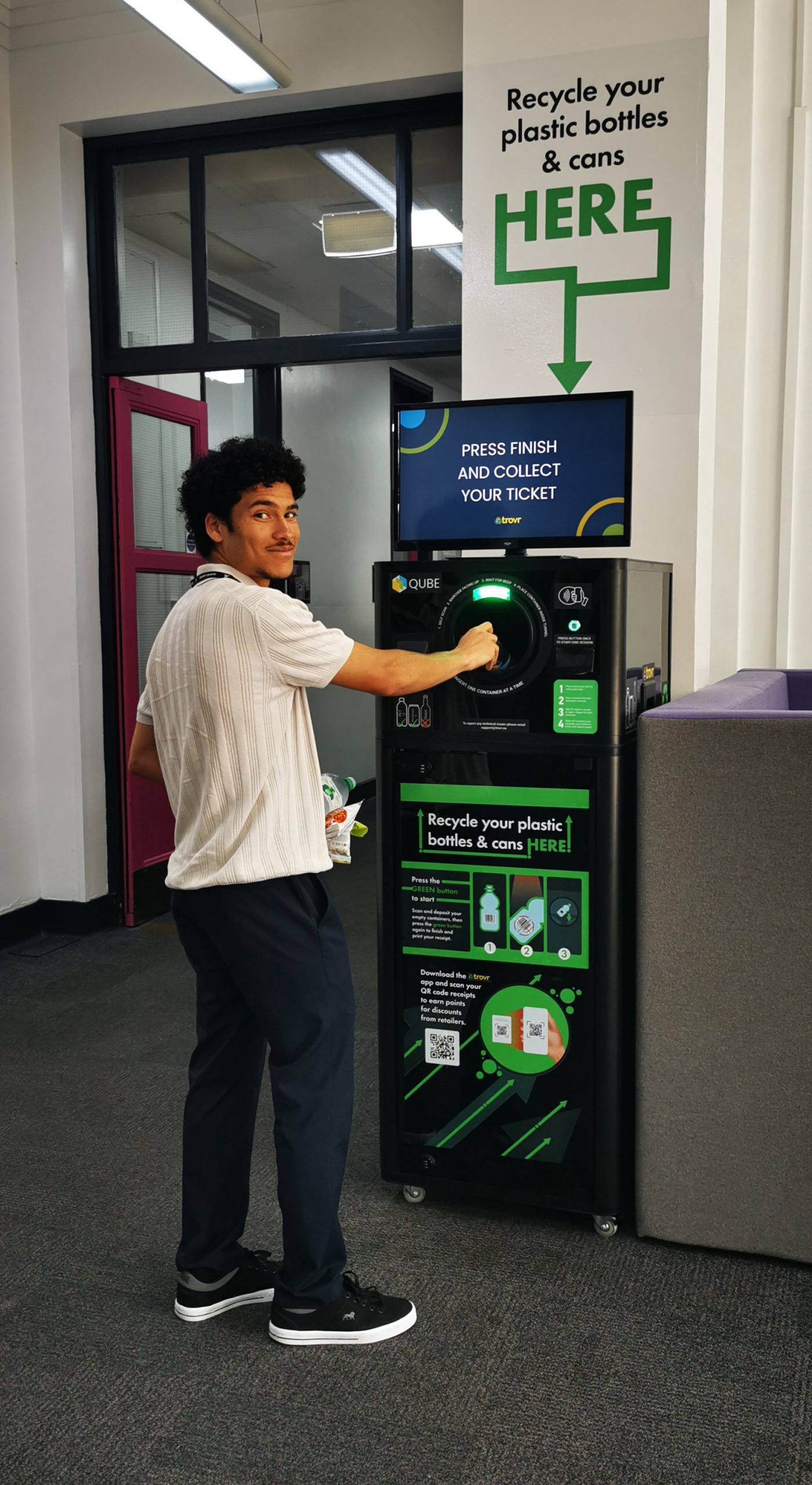
- The TrovrQUBE, a smart, semi-automated, self-service recycling unit for PET plastic bottles and aluminium cans, has been installed at Reading College and University Centre – the first educational establishment in the UK to deploy the TrovrQUBE
- The installation will provide students with hands-on experience ahead of the UK’s upcoming Deposit Return Scheme in October 2027
- Students deposit empty containers and receive a printed receipt – symbolic for now, but a hands-on rehearsal for the deposit return process they will encounter as consumers when DRS goes live
- The unit captures recycling data the college can use to track student participation, measure return rates, and calculate estimated CO2 savings
- Once DRS launches, colleges can register as voluntary return points and earn 3p per container in handling fees – creating a fundraising stream for college improvements or charitable giving
- The TrovrQUBE is already live across Malta, Romania, Poland, and Austria, and is now rolling out with UK independent retailers and community sites ahead of 2027
Reading, UK, 22nd July – Trovr, the recycling technology company behind the TrovrQUBE, has installed a unit at Reading College and University Centre – the first educational establishment in the UK to deploy the TrovrQUBE.
The installation forms part of Reading College and University Centre’s goal to champion sustainability across the Activate Learning group and familiarise students with the UK’s upcoming Deposit Return Scheme (DRS) ahead of its launch on 1st October 2027.
Education Before Legislation
When DRS launches, any retailer selling drinks in PET plastic bottles or aluminium cans will be required to add a 20p deposit to the price of each item at the till. Customers pay this upfront and reclaim it by returning the empty container to a registered return point, where it is scanned and verified against a national DRS database. The scheme is legally mandated – retailers who fail to participate face potential fines.
While DRS is not yet live, the TrovrQUBE at Reading College and University Centre lets students begin returning empty bottles and cans now. They receive a printed receipt in exchange – symbolic at this stage, as deposits are not yet redeemable, but designed to build the habit and familiarity that will matter when the scheme launches.
The TrovrQUBE is a semi-automated, self-service unit: students deposit their own containers, while the machine automatically scans each barcode, verifies eligibility, identifies the material type, and stores the container securely – with no staff handling required at any point. The data captured allows the college to track recycling activity, measure return rates against containers sold on site, and calculate estimated CO2 savings.
Nick Yeatman, CEO and founder of Trovr, said:
“DRS will be one of the most significant behavioural changes asked of UK consumers in a generation, and the habits people form now will determine how successful the scheme is at launch. Getting students recycling through a TrovrQUBE today means they’ll arrive at 2027 already knowing exactly what to do. But this isn’t just about compliance – colleges can earn from handling fees, build community engagement, and become part of the national recycling infrastructure. This is about turning a looming regulatory shift into something genuinely positive.”
A Commercial Model for Colleges
Colleges are not mandated to become DRS return points, but they can register as voluntary return points once the scheme goes live – and the financial case is compelling. Exchange for Change, the industry-led organisation responsible for delivering DRS across England, Scotland and Northern Ireland, has confirmed that return point operators will earn 3p per container returned. Because the TrovrQUBE automates the scanning, verification, and storage process once a student deposits a container, there is no operational burden on college staff.
Under the DRS framework, voluntary return points have a choice of how they operate. Sites running a fully automated Reverse Vending Machine (RVM) – the kind typically found in large supermarkets – qualify for the higher 5p handling fee. The TrovrQUBE sits in the manual return category, earning operators 3p per container, but at a fraction of the cost and complexity of an RVM installation. For a college, leisure centre, or independent retailer, that trade-off is straightforward: lower handling fee, no crushing machinery, no major infrastructure outlay, and a unit compact enough to sit in a foyer or staff room. The numbers add up quickly. A college with 2,000 students returning just ten containers each per month generates 20,000 containers and £600 in monthly handling fees – funds that can go back into college improvements or be donated to a charity of the institution’s choosing.
Janne Jarvis, West Suffolk District Councillor for Newmarket North, said:
“Getting local communities ready for DRS starts with education, and that means reaching people before the scheme launches – not after. Reading College and University Centre is exactly the kind of institution that can make a real difference here. Students who understand how deposit return works today will be the consumers and business owners who make the scheme a success in 2027.
“After Reading College and University Centre contacted me about the West Suffolk Council reverse vending scheme, I was pleased to introduce them to Trovr. It is exciting to see this technology being brought into another community setting, and I hope this installation encourages other educational institutions across the UK to follow suit.”
Philip Waddup, Group Director of Property, Environment and Sustainability at Activate Learning, said: “We believe this initiative can make a real difference to our college community and reinforce Activate Learning’s commitment to delivering green and sustainable college campuses. It’s a fantastic example of how collaboration can turn an idea into meaningful action, and of how we’re working with colleagues across the organisation to identify and deliver practical initiatives that reduce our environmental impact and engage our students and staff in positive sustainable behaviour.
“Small actions, when taken collectively, can make a significant impact on our environment and we hope this inspires our college communities to make recycling a regular habit while supporting a more sustainable future.”
Andrew Emberson-Poole, Group Designer and Sustainability Champion at Activate Learning, said: “This project demonstrates how a simple idea can grow into an innovative sustainability initiative. What started as an initial fact-finding conversation with Janne Jarvis, West Suffolk Councillor, has grown into the installation of our first TrovrQUBE at Reading College and University Centre, making us the first educational institution in the UK to introduce this technology.
“Introducing the TrovrQUBE is a practical way of encouraging positive environmental behaviours while helping learners understand the UK’s upcoming Deposit Return Scheme. It gives our students the opportunity to play an active role in reducing waste while preparing them for the changes that will become part of everyday life in the future.”
Setting the Standard for Community DRS Participation
European countries with established DRS programmes consistently achieve return rates above 90%, driven by dense return infrastructure that reaches beyond supermarkets into community spaces. The Reading College and University Centre installation makes the case for educational establishments as an important and underexplored category of return point – sitting alongside independent retailers, petrol forecourts, and leisure centres in building the network needed to hit national recycling targets.
The UK rollout is now underway. TrovrQUBE units are already installed at independent retailers in London, following a successful trial at leisure centres and colleges in partnership with West Suffolk Council. The technology is also live in Malta, Romania, Poland, and Austria.
About Trovr
Trovr is a pioneering company in the recycling technology sector, dedicated to transforming how the world manages single-use drink containers and waste. Its mission is to drive global recycling rates and promote a circular economy through innovative solutions that make recycling seamless, rewarding, and accessible.
At the core of the company’s innovation is the TrovrQUBE, a compact and energy-efficient device designed as a semi-automated, self-service DRS return solution for independent retailers and community sites. Powered by the Trovr Merchant App, the TrovrQUBE enables seamless integration for retailers and businesses, offering them the tools to manage recycling stations, set up custom rewards, and access detailed recycling data.
In addition, the Trovr Consumer App incentivises recycling by rewarding individuals for returning single-use drink containers, fostering community engagement and environmental responsibility. Together, these technologies empower communities, retailers, and businesses to take an active role in sustainability.
With €3M+ invested in research and development, Trovr is committed to creating cutting-edge solutions that benefit both the environment and our partners. By combining convenience, digital integration, and a focus on local impact, Trovr is shaping a future where recycling is a natural part of everyday life. Trovr operates out of the UK and Malta.