
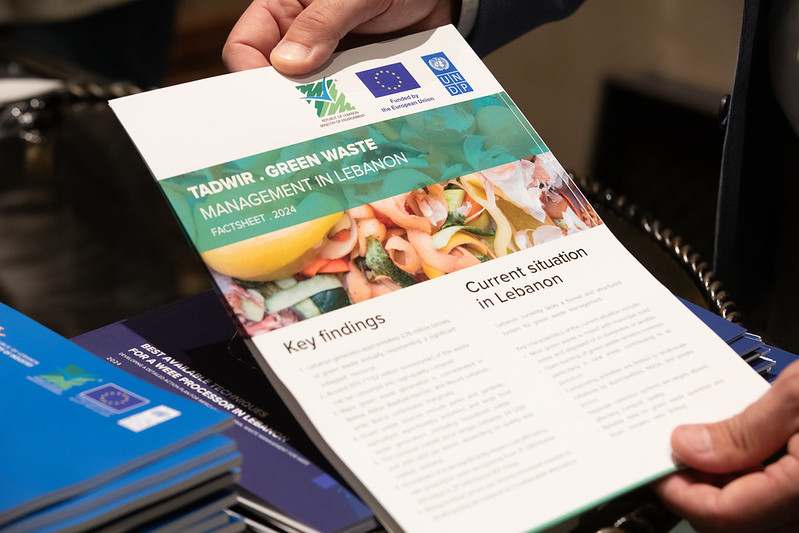
Beirut, Lebanon – 22 July 2026 – Today, Lebanon launched a comprehensive package of national studies and a Geographic Information System (GIS) platform* designed to strengthen waste management across the country. Funded by the European Union and implemented by the United Nations Development Programme (UNDP) in partnership with the Ministry of Environment, the package equips decision-makers with the data and tools needed to improve planning, prioritize investments, and advance more sustainable waste management solutions.
The launch took place under the High Patronage of H.E. Dr. Tamara El Zein, Minister of Environment, and brought together H.E. Ms. Sandra De Waele, Ambassador of the European Union to Lebanon; Mr. Adel Gerges Al-Shabab, Director General of the Lebanese Ministry of Industry, representing H.E. Eng. Joe Issa El Khoury, Minister of Industry; Ms. Blerta Aliko, UNDP Resident Representative in Lebanon; as well as representatives from government institutions, municipalities, the private sector, academia, and development partners.
Covering healthcare waste, e-waste, green waste, slaughterhouse waste, cardboard and paper waste, and waste-derived fuels, the package provides a comprehensive picture of Lebanon’s waste management sector. Together, the studies and the national GIS platform equip national and local authorities with evidence and tools to identify service gaps, monitor infrastructure, coordinate interventions, and guide future policies and investments.
“As Lebanon advances efforts to reform and modernize its waste management sector, access to reliable data, strategic planning tools, and sound technical evidence becomes increasingly important. The studies and GIS platform launched today will support improved governance, stronger institutional coordination, and more informed decision-making, helping national authorities including National Solid Waste Management Authority and Municipalities, prioritize investments and implement sustainable solutions that respond to both current needs and future challenges.” said H.E. Dr. Tamara Elzein, Minister of Environment.
“Lebanon’s waste sector represents an untapped investment opportunity. Every ton diverted from landfill into sorting, composting, or recycling becomes part of a value chain capable of generating revenue and attracting responsible capital that creates jobs, strengthens our export capacity, and reinforces the revival of Lebanon’s industrial sector. Let us modify our model from “waste treatment to waste industrialization,” added Mr. Adel Gerges Al-Shabab, Director General of the Lebanese Ministry of Industry, representing H.E. Eng. Joe Issa El Khoury, Minister of Industry.
“The European Union is proud to support Lebanon in developing the knowledge and tools needed to transform its waste management sector in light of the recent environmental reforms. Their real value, however, lies in how they are used. We encourage the Ministry of Env and the Solid Waste Authority to build on this evidence to guide policy decisions, prioritize investments, and implement the reforms needed to deliver sustainable waste management services for the benefit of all citizens,” said H.E. Ms. Sandra De Waele, Ambassador of the European Union to Lebanon.
“Investing in reliable data is one of the smartest investments we can make for sustainable development. These studies and the GIS platform provide the evidence needed to strengthen governance, guide investments, and accelerate Lebanon’s transition towards a more sustainable and circular approach to waste management,” said Ms. Blerta Aliko, UNDP Resident Representative in Lebanon.
Years of successive crises have placed increasing pressure on Lebanon’s solid waste sector, underscoring the need for better planning, stronger coordination, and more targeted investments. By providing a shared evidence base and modern planning tools, the initiative also strengthens collaboration among key stakeholders—including the Ministry of Environment, the Ministry of Public Health, the Ministry of Industry, municipalities, waste operators, and the newly established Solid Waste Management Authority—supporting a more integrated approach to waste management governance.
Notes:
The Geographic Information System (GIS) platform provides information on facility locations, operational status, treatment capacities, technologies, and service areas, offering government institutions, municipalities, development partners, and operators a centralized tool to support planning, investment prioritization, coordination, and emergency response.
The National Studies are publicly available and can be accessed here