
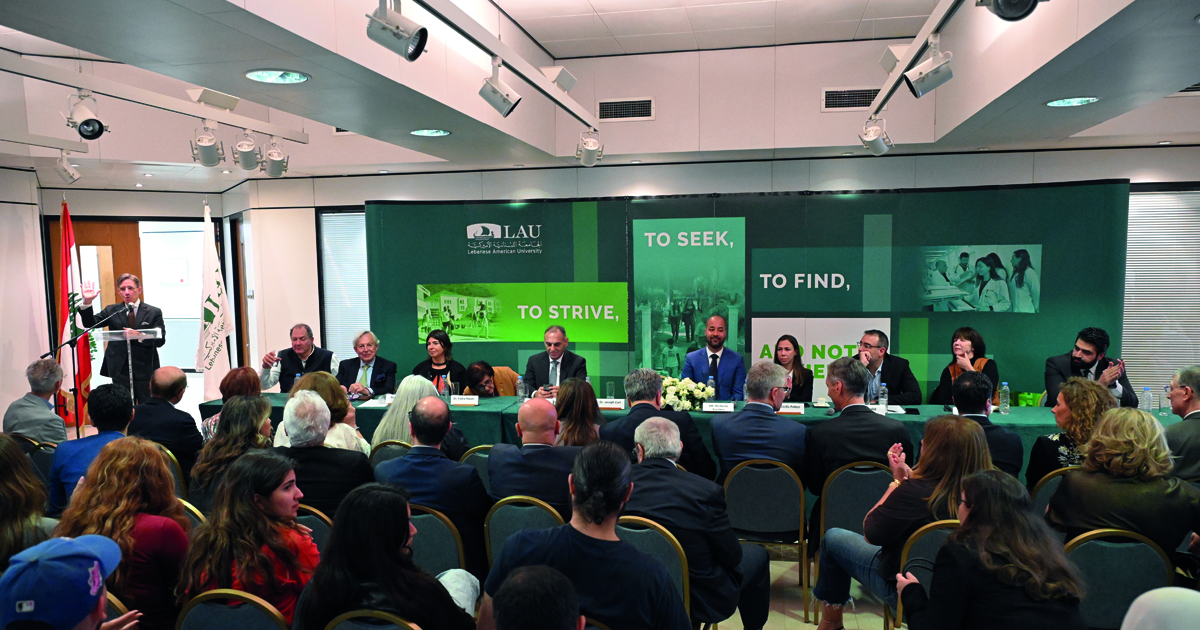
The Lebanese American University (LAU) held Conflict Resolution: Lessons Learned, a multidisciplinary symposium, on its Beirut campus on November 12, 2026. The event was organized by Joseph A. Cari Jr., visiting professor of political science at LAU and an expert in US policy and international affairs, in collaboration with Zeina Akar (BS ’87), LAU trustee and former minister of defense.
The symposium examined lessons from past and ongoing conflicts and their relevance to the continuing crisis in Lebanon. Its three panels addressed conflict settlement and disarmament, the role of women and youth in peacebuilding, and economic recovery and institutional reform, including the potential of technology to strengthen public institutions.
In attendance were the ambassadors of Australia and New Zealand, members of the LAU Board of Trustees, Chaouki T. Abdallah, president of LAU, vice presidents and members of the university’s administrative staff, deans of LAU’s schools, faculty members, students, and the participating experts.
In her address, Akar said the event was intended to move beyond discussing Lebanon’s problems toward learning how other countries resolved conflicts and rebuilt trust, as well as what failed and why. “We can learn from international experiences, but ultimately, the responsibility for Lebanon’s future rests with us—our leaders, institutions, and citizens,” she said, describing the symposium as a modest first step toward practical solutions.
Akar noted that, during her time in government, conflicting political and personal interests often paralyzed decision-making at the expense of the public interest. She cited the banking crisis, in which depositors are still awaiting answers years later, and the electricity sector as examples, adding that the Lebanese are asking not for miracles but for their basic rights. She called for constitutional guarantees and clear deadlines to keep state institutions functioning, and said universities “should encourage open dialogue without turning every disagreement into a political confrontation.”
Dr. Abdallah asked attendees to consider whether “we can take on responsibility for people beyond our own families, our own villages, and those who agree with us.” In practice, he said, this means “hearing from people whose memories of conflict differ from ours. It means building institutions people can trust to treat them fairly.”
He stressed the importance of giving young people a leading role in the decisions that shape their future, urging students to “keep asking the questions that make the adults uncomfortable” and calling on institutional leaders to “bring students into the room while their ideas can still change the decision.” He closed with a call to give Lebanon’s youth a reason to believe in their own future.
The first panel, on conflict settlement, was moderated by Dr. Cari and featured Geoffrey Van Orden, a retired British Army brigadier general, former Conservative member of the European Parliament, and specialist in the Northern Ireland peace process; Perfecto K. Sanchez, a conflict resolution expert and US Army veteran; and Imad Salamey, professor and chair of the Department of Political and International Studies at LAU.
Panelists discussed how armed groups divided along sectarian lines can be integrated into a sovereign state, noting that disarmament tends to follow long mediation backed by external actors and that parties negotiate when exhausted by conflict. Their recommendations for Lebanon included full implementation of the Taif Agreement—particularly Article 95 on deconfessionalization, a bicameral parliament, and equal citizenship—as well as adherence to UN Security Council Resolutions 425, 1559, and 1701, and the establishment of the state as the sole security provider.
“The task is now to turn these frameworks into credible and verified settlements that link full state sovereignty to constitutional reform, communal security, and shared economic recovery,” said Dr. Salamey.
The second panel, Women, Youth, and Inclusive Conflict Resolution, was moderated by Myriam Sfeir, executive director of the Arab Institute for Women (AiW) at LAU. Cecilia Polizzi, an international security strategist, founding CEO of Next Wave Center, and specialist in countering the use of children in violent extremism and terrorism, warned that armed groups increasingly exploit children, including through digital recruitment, and called for approaches that treat children as rights holders rather than security threats.
Patricia Shafer, executive director of NewGen Peacebuilders and Youth and Peace in Action, traced the evolution of universities from destinations for an educated elite to paths toward a degree and a career. She described peacebuilding as a blueprint for solving problems and urged universities to invest in student projects in the field, an approach she called “Peacepreneurship.”
Fadia Kiwan, professor of political science and director general of the Arab League’s Arab Women Organization, presented a six-country study on the lasting effects of conflict on women and girls, including early marriage, trafficking, displacement, and stigma. She called for sustained psychosocial support, economic opportunity, and a role for women in transitional justice. “Peacebuilding cannot be postponed until conflicts end. It must begin during conflict,” said Sfeir.
The third panel, Economic Recovery, Institutional Reform, and E-Government, was moderated by Nadim Shehadi, an economist. Panelists Makram Ouaiss, executive director of the Lebanese Center for Policy Studies; Marwan F. Abdallah, an expert in international relations, energy, strategic negotiations, and governance; and Walid Marrouch, professor of economics and assistant dean for graduate studies and research at LAU, argued that Lebanon is caught in a “conflict trap.”
They held that the Taif Agreement moved warlords into parliament, where armed actors shielded corrupt elites from accountability, that no modern economy can function unless the state alone controls the use of force, and that reliance on unconditional foreign aid delayed rather than prevented the 2019 collapse.
“We cannot rebuild the Lebanese economy without injecting new blood into a reformed political system, ending the addiction to unconditional aid that delays hard political choices, as well as transforming the state from a market player to an impartial regulator,” said Dr. Marrouch.
The symposium concluded with a session for students titled Youth, New Leaders, and the Future of Peacebuilding, presented by Tamara Mismar, a master’s student in human resources management at LAU. Dr. Salamey, Sfeir, and Dr. Marrouch summarized the findings of the three panels, followed by an open discussion with students, faculty, and friends of the university.