
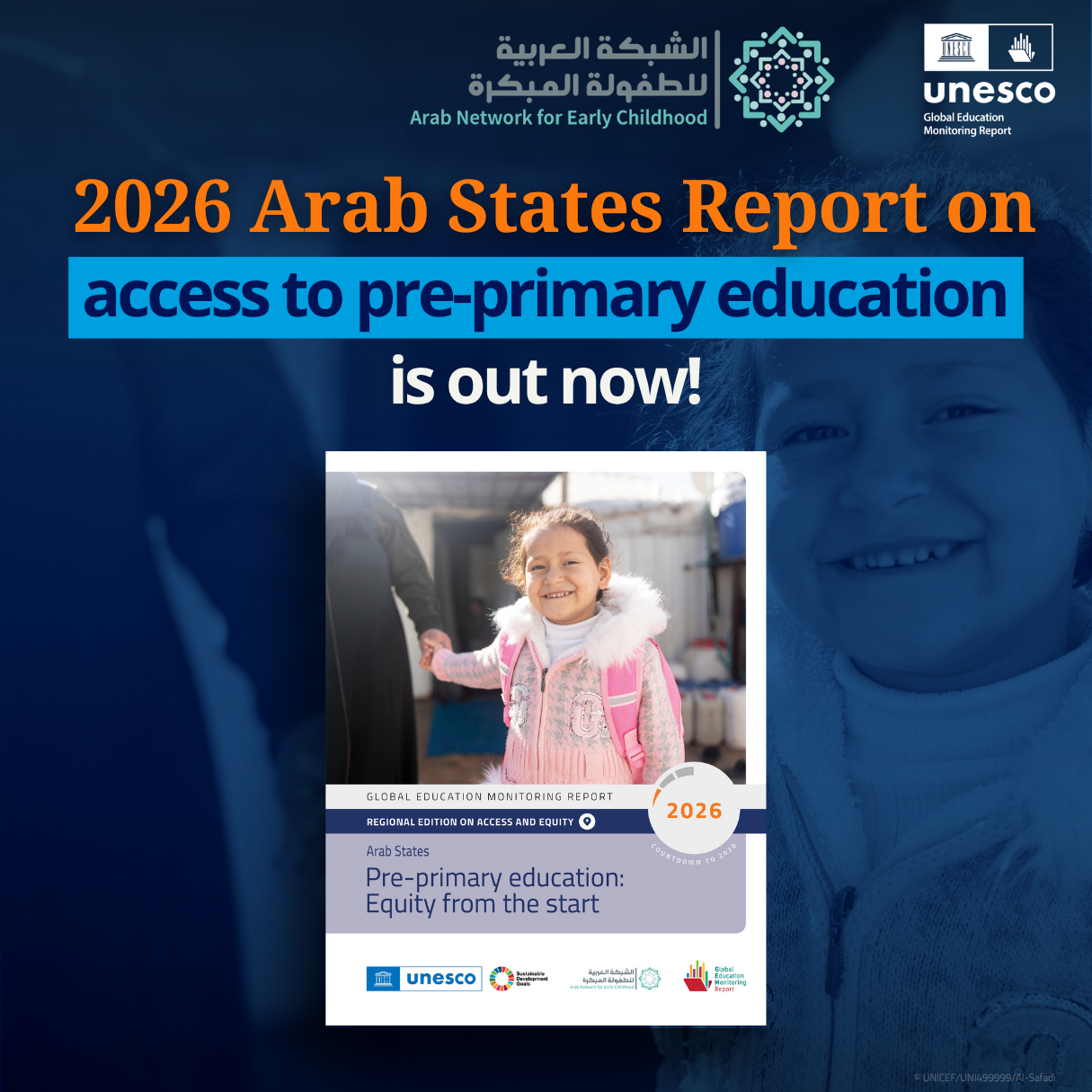
Beirut, 20 November – A new UNESCO Global Education Monitoring (GEM) Report on the Arab States shows that although governments are expanding preschool access across the region, fewer than half of 5-year-old children are enrolled in education. The report calls for clear commitments, sustained public investment and targeted support for pre-primary education in the region, particularly for children facing poverty, disability and displacement.
The regional edition of the 2026 GEM Report on the Arab States, Equity from the start, produced in partnership with the Arab Network for Early Childhood (ANECD) and released on the occasion of World Children’s Day, shows that the enrolment rate of 5-year-olds in the region increased from 26% in 2000 to 45% in 2024, due to public investment, shifting norms, and changing demographic conditions, such as urbanization and a lower role of extended families in child care and education. Despite this progress, the region remains below the global (75%) and sub-Saharan African (52%) average.
Drawing on six country case studies from Algeria, Lebanon, Morocco, Oman, the State of Palestine and the United Arab Emirates, the report shows that children’s opportunities depend heavily on their circumstances.
In Egypt, 65% of children whose mothers had higher education attended pre-primary education, compared with 20% of those whose mothers had no education. In Algeria, only 6.5% of children aged 3 and 4 with functional difficulties attended early childhood education, compared with 14.6% of children without functional difficulties in 2019. In Yemen, just 1% of children from the poorest households but 23% of those from the richest had attended preschool in 2022/3.
Expansion has also been heavily challenged by conflict, which destroys schools, turns them into shelters and makes journeys unsafe. Syrian refugee surges strained services in neighboring countries. In Lebanon, only 19% of Syrian children aged 3 to 5 attended preschool in 2023. In the State of Palestine, 70,000 children enrolled in pre-primary education in Gaza lost access, as a consequence of the ongoing conflict.
Countries have expanded free, public provision
The majority of children are enrolled in private preschools in at least 9 of 14 countries, exceeding 90% in Bahrain, Oman and the State of Palestine. Yet public provision has been growing. Among 14 Arab countries with trend data, the share of private institutions in total enrolment fell from 75% in the early 2000s to 34% in the early 2020s. Morocco tripled its public pre-primary budget between 2018/19 and 2024/25. Saudi Arabia doubled the number of public preschools between 2013/14 and 2021/22.
Data on public pre-primary education expenditure are scarce. Only four countries have reported internationally since 2016, which makes it difficult to assess the level of public investment, but the little evidence available – and the high level of private provision – suggests that the region spends well below the global median of 0.43% of GDP.
Among 20 Arab countries, 13 offer at least one year of free pre-primary education in policy or legislation. But commitments do not always translate into access. Lebanon offers tuition-free public provision, but only one in five enrolled children attends public preschools, a share that has also fallen slightly after 2020 in the aftermath of the financial crisis. The report warns that removing tuition fees alone is insufficient. Another challenge is that just 9 of the 20 countries regulate preschool fees charged by private providers.
Expansion must not threaten education quality
Expansion has exposed gaps in facilities and staffing. The report calls for investment in suitable facilities, qualified educators and play-based learning, highlighting Morocco’s distinct pre-primary curriculum framework introduced to protect appropriate pedagogy with guides and play materials, and training for teachers. Jordan also provided curriculum training, toys and learning materials alongside public kindergarten expansion.
In order to drive greater equitable expansion of pre-primary education in the region, the report calls on governments to:
- Sustain public investment to back commitments for free provision – and extend legislation for compulsory pre-primary education.
- Work with parents to raise their awareness of the benefits of early learning, strengthening links between homes and preschools.
- Coordinate and integrate early childhood services, connecting education with health, nutrition and family support, and respond to family needs.
- Target resources to excluded children, addressing barriers linked to poverty, location, disability, language and displacement – and offering better regulation of private provision.
- Protect quality as access expands, investing in staff, facilities and curricula to ensure an age-appropriate pedagogical approach based on play, interaction and exploration.
- Protect early childhood education services during conflict, funding safe learning spaces, educators, nutrition and psychosocial support.
- Improve monitoring, tracking participation by age and education level, quality indicators, and public spending to identify who is being left behind.
On World Children’s Day (20 November), UNESCO will also launch the 2026 Global Report on Early Childhood Care and Education, revealing that financing gaps and inequalities continue to deprive millions of children under 8 years old worldwide from quality education.
More information: 2026 Arab States Report | Global Education Monitoring Report