
1. What specific gap in Lebanon’s financial ecosystem led to the creation of Suyool, and how has that vision evolved since launch?
Suyool was born after Lebanon’s financial crisis, when trust in traditional banking was at an all-time low. People and businesses needed a better way to manage their money. Many turned back to cash, but cash isn’t a long-term solution for a modern economy.
We saw an opportunity to build something different: a financial platform designed around people’s everyday needs. One that gives them more control, more convenience, and more confidence in how they move, spend, and manage their money.
At the time, Lebanon was still heavily reliant on cash, fragmented payment methods, and slow financial processes. While the rest of the world was embracing digital finance, many consumers and businesses here were still struggling with basic financial transactions. We believed there was a better way.
That’s how Suyool started: as a simple, accessible alternative that makes financial services easier, faster, and more rewarding.
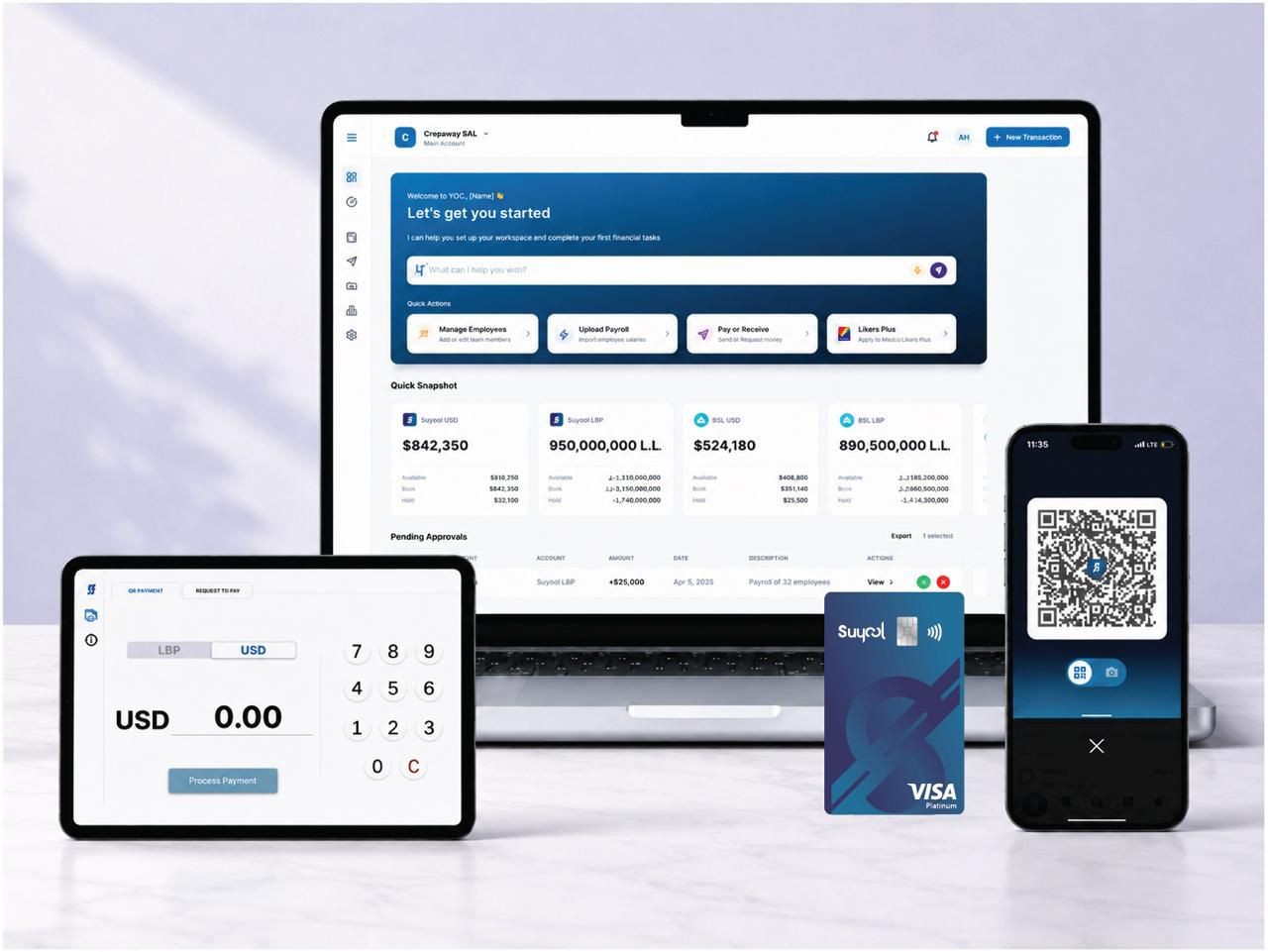
Today, our vision goes far beyond payments. Suyool has evolved into a complete financial ecosystem for both individuals and businesses. From everyday payments and international transfers to payroll, employee benefits, loyalty rewards, and business financial services, we’re building the tools people and companies need to manage their financial lives in one place.
Our mission remains the same as day one: to give people and businesses a modern financial experience they can actually trust and enjoy using.
2. How do you define Suyool today: a fintech infrastructure provider, a digital wallet, or something broader?
Suyool is broader than a digital wallet.
We see ourselves as a financial ecosystem that connects consumers, merchants, and businesses through a unified platform. On one side, individuals can pay, transfer money, access cards, receive international funds, and benefit from one of the country’s most rewarding loyalty programs. On the other side, businesses can manage payroll, corporate payments, employee benefits, and international transfers through a modern digital infrastructure.
Our goal is to become the primary financial operating platform for both consumers and businesses.
3. Operating in Lebanon’s unique financial environment, how has the crisis shaped your business model, risk appetite, and growth strategy?
The crisis accelerated the need for innovation.
It pushed consumers and businesses to look for alternatives that offered greater flexibility, transparency, and control over their finances. Rather than seeing Lebanon’s challenges as a limitation, we saw them as an opportunity to build solutions around real-world needs and adapt quickly as those needs evolved.
One example was during the recent conflict, when many people were unable or unwilling to leave their homes. Access to cash became a major challenge. In response, we launched our cash pickup and cash delivery services, allowing users to securely withdraw cash from their wallets or add cash to their accounts directly from their doorstep. It was a practical solution developed in direct response to what our customers were experiencing, and it demonstrated how technology can help maintain financial continuity even in difficult circumstances.
That mindset continues to shape our business today. Our strategy is focused on sustainable growth, strong compliance standards, and products that solve everyday problems. Whether it’s helping companies digitize payroll and employee benefits, enabling international transfers, rewarding customers through our loyalty ecosystem, or providing innovative cash services, every product we launch is designed to make financial services more accessible, resilient, and useful in people’s daily lives.
4. What lessons have you learned from building a fintech company in a market with limited trust in traditional banking?
The biggest lesson we’ve learned is that trust cannot be built through marketing campaigns or advertising alone; it has to be earned through experience.
In Lebanon, trust in financial institutions was deeply affected by the crisis. That’s why we were careful from day one to position Suyool not as a savings account, but as an everyday financial wallet designed to help people receive, manage, spend, and move their money more conveniently.
More importantly, we understood that access to funds is just as important as holding them. During periods of uncertainty, many people struggled to access cash through traditional channels. We focused on creating multiple ways for users to access their money, whether through their Visa card, our network of cash points, cash pickup services, or cash delivery directly to their doorstep.
One example that stands out was during the recent conflict, when many ATMs were either inaccessible or had limited cash availability. Despite these challenges, Suyool users were still able to access their funds through our alternative cash infrastructure. That reinforced an important principle for us: financial services must continue working when people need them most.
We’ve also learned that reliability becomes a competitive advantage in markets where trust has been challenged. Customers trust platforms that consistently work, provide responsive support, maintain transparency, and deliver real value.
Ultimately, people adopt new financial solutions when they make life easier. Whether it’s faster payments, easier access to money, rewarding loyalty programs, or a better customer experience, trust is built one positive interaction at a time.
5. What differentiates Suyool’s technology and user experience from both local competitors and regional fintech players?
Our differentiation comes from combining everyday utility with exceptional user experience.
Many financial apps focus exclusively on transactions. At Suyool, we focus on building long-term relationships with users through a complete ecosystem of services and rewards.
One example is our loyalty program. Instead of offering traditional cashback or isolated promotions, we created a platform where users earn points across their daily financial activities and redeem them for meaningful rewards, discounts, travel benefits, products, and experiences.
User experience is also at the core of everything we do. As a UX/UI Senior Lecturer at the American University of Beirut, I strongly believe that trust and adoption are driven by design. That’s why we’ve invested heavily in making financial services simple, intuitive, and accessible for both consumers and businesses.
For us, fintech isn’t just about moving money; it’s about creating experiences people genuinely enjoy using.
6. How are you leveraging partnerships—whether with telecoms, merchants, or financial institutions—to scale adoption?
Partnerships are central to our growth strategy.
We collaborate with financial institutions to expand payment capabilities, with merchants to create meaningful loyalty and rewards experiences, and with service providers to integrate everyday use cases directly into the platform.
Our corporate offering is a strong example of this approach. Through partnerships, we enable companies to manage payroll, distribute benefits, facilitate employee spending, and access international payment services through a single platform.
The result is an ecosystem where every new partner increases the value proposition for users and businesses alike.
7. How do you navigate regulatory uncertainty in Lebanon, and what kind of policy environment would best support fintech innovation?
We believe innovation and regulation should move together.
Our approach is to maintain strong compliance standards while working closely with industry stakeholders and regulators. Responsible innovation requires clear frameworks that protect consumers while encouraging investment and technological advancement.
The most supportive environment for fintech would be one that provides regulatory clarity, encourages digital payments, and creates pathways for new financial technologies to scale responsibly.
8. Trust is central to financial services—how is Suyool building and maintaining user trust in a skeptical market?
Trust is built through consistency.
We invest heavily in security, compliance, customer support, and transparent communication. We also focus on delivering tangible value to users every day.
Our loyalty ecosystem has become an important trust-building mechanism because it creates continuous engagement. Customers see direct benefits from using the platform, which strengthens long-term relationships and increases adoption of additional services.
For businesses, trust comes from reliability, efficient operations, and the ability to manage critical financial functions through a secure platform.
9. Do you see Suyool expanding beyond Lebanon, and if so, which markets present the most natural fit and why?
Yes, regional expansion is part of our long-term vision.
The most natural opportunities are markets that share similar characteristics: large underbanked populations, growing digital adoption, and demand for modern payment infrastructure.
What makes Suyool particularly scalable is that our model extends beyond payments. The combination of corporate financial services, employee engagement tools, and loyalty-driven customer retention creates a framework that can be adapted across multiple markets.
10. Looking ahead five years, what role do you want Suyool to play in shaping financial inclusion and digital payments across the region?
Our ambition is to become one of the region’s leading financial ecosystems.
We want to help accelerate the transition from cash-based economies to digital financial services while making those services more rewarding, inclusive, and accessible.
For consumers, that means easier access to payments, transfers, rewards, and financial tools. For businesses, it means modern infrastructure for payroll, payments, employee benefits, and financial operations.
Ultimately, we believe the future of fintech is not just about moving money; it’s about creating stronger financial relationships. Through our corporate solutions and loyalty ecosystem, Suyool aims to become the platform that connects people, businesses, and everyday financial experiences across the region.