
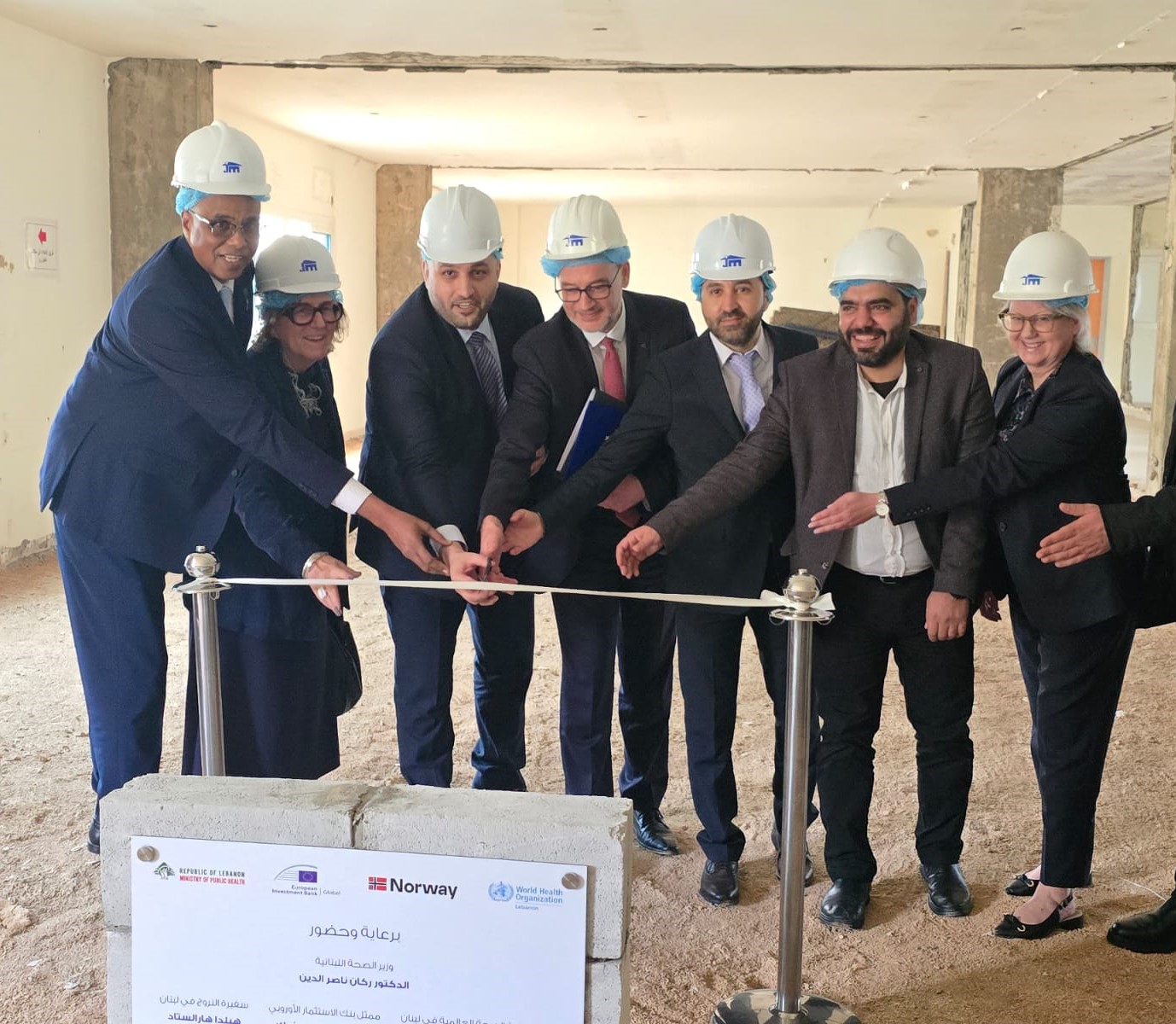
Beirut 12 February 2026: The Ministry of Public Health, in partnership with the World Health Organization (WHO), and with a EUR 10 million grant from the European Investment Bank (EIB) under the Economic Resilience Initiative, alongside support from the Norwegian Embassy, today launched the renovation works for the National Central Public Health Laboratory for Emerging and Re-emerging Infectious Diseases.
The launch ceremony marks a critical milestone in restoring the Lebanon’s public health infrastructure and strengthening essential national capacities for disease surveillance, early detection, and emergency preparedness amid ongoing economic and social challenges.
The Minister of Public Health, Dr. Rakan Nasser El-Deen, stated: “The Central Public Health Laboratory is a strategic national investment that will restore Lebanon’s capacity to detect and respond to health threats, protect communities, and reinforce public confidence in the health system.”
Strategic Investment in Resilience and Preparedness
The Central Public Health Laboratory (CPHL) is a core capacity under the International Health Regulations (IHR 2005) and will serve as Lebanon’s national reference laboratory, supporting timely confirmation of priority infectious diseases, outbreak investigations, and evidence-based public health decision-making across the country.
The renovated laboratory facility will consist of a basement, ground floor, three upper floors, and a rooftop, covering a total area of approximately 3,000 square meters. Once operational, the laboratory is expected to conduct 4,000–4,500 diagnostic tests annually, reinforcing national surveillance systems and strengthening coordination across the public health laboratory network.
This investment responds directly to lessons learned from the COVID-19 pandemic, underscoring the critical role of functional national laboratories in pandemic preparedness, health system resilience, and public trust.
Donor’s Role in Health System Recovery
Through its financing, the European Investment Bank, along with key co-financing by the Norwegian Embassy, is making a tangible contribution to Lebanon’s recovery and long-term health system strengthening, ensuring that critical public institutions remain functional and sustainable despite prolonged crises.
The project extends well beyond physical rehabilitation. Alongside civil works, it will strengthen Lebanon’s public health laboratory system through biosafety-compliant design and infrastructure upgrades, procurement and installation of specialized equipment, workforce capacity building, and the integration of the Central Public Health Laboratory within the national laboratory network, ensuring long-term functionality, quality, and resilience.
Strong governance and oversight mechanisms are being established under the leadership of the Ministry of Public Health, with technical supervision from WHO, to ensure transparency, accountability, and alignment with international standards throughout implementation.
“The inauguration of the Central Public Health Laboratory marks an important milestone in strengthening Lebanon’s public health capacities. The European Investment Bank is proud to support this initiative alongside WHO and our Team Europe partners. By reinforcing essential laboratory services and disease surveillance, we are collectively investing in stronger, more resilient health systems that can better protect all communities across the country,” said Ulrich Brunnhuber, EIB Head of the Middle East and North Africa Public Sector Division.
Meanwhile, the representative of the Norwegian embassy noted “This initiative reflects the importance of sustained international partnerships in strengthening public institutions and safeguarding population health. We commend the joint efforts to advance the goals of the Lebanon National Health Strategy.”
Looking ahead, the WHO Representative emphasized importance of “revitalization of the Central Public Health Laboratory is not simply an infrastructure project; it is an investment in resilience. By aligning development financing with national priorities and technical expertise, this partnership demonstrates how sustainable impact can be achieved even in the most challenging contexts.”
As Lebanon continues to navigate compounded crises, the Central Public Health Laboratory stands as a critical investment in national health security, institutional resilience, and preparedness for future pandemics and emergencies. The project reflects a shared commitment by national authorities and international partners to protect public health and strengthen essential state functions for the long term.