
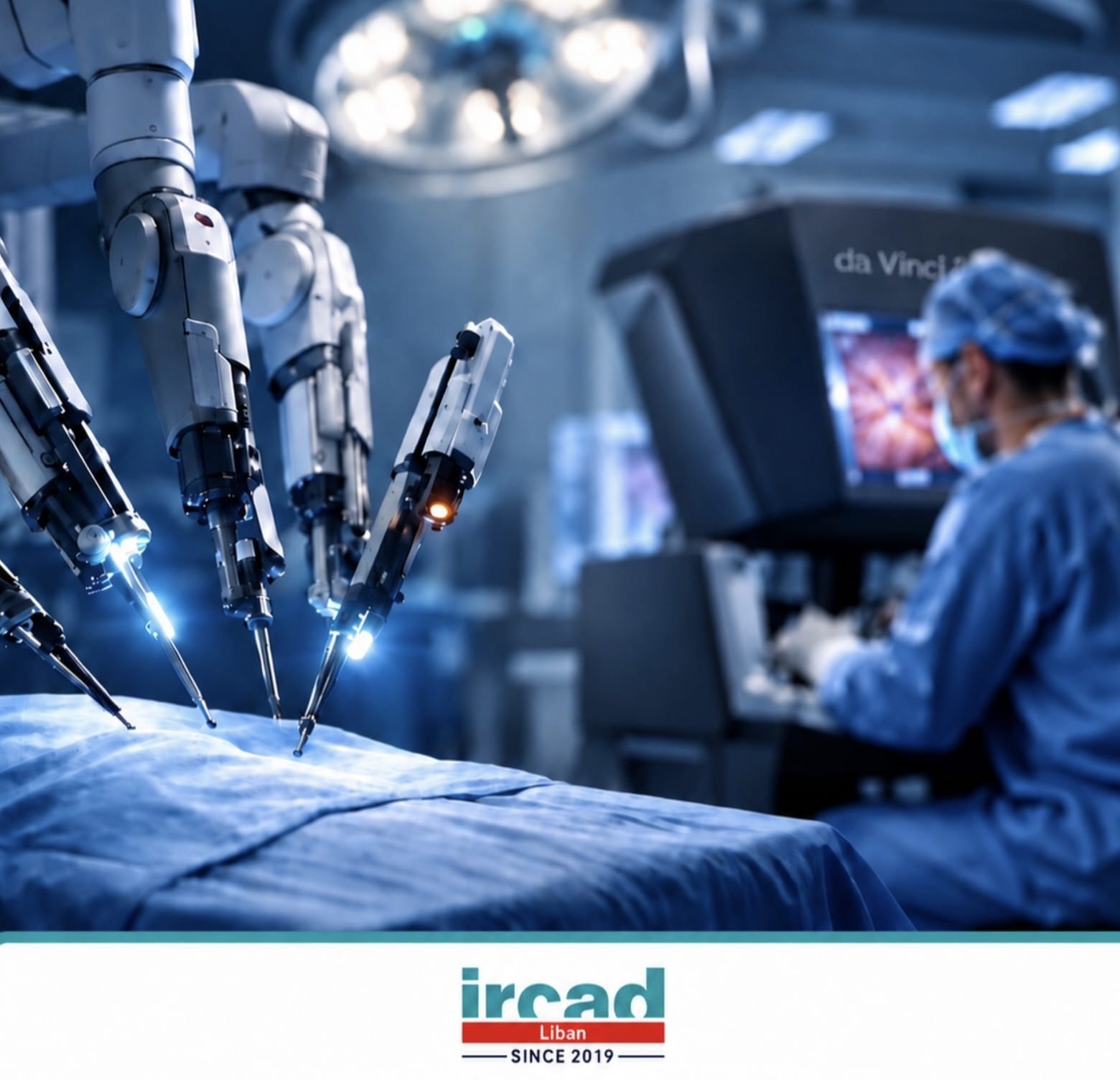
IRCAD Liban Hosts an Exceptional Event: Live Robotic Surgeries and New Horizons Extending to Cardiac and Thoracic Surgery
IRCAD Liban at Hôpital Français du Levant hosted an exceptional medical and scientific event dedicated to the latest developments in robotic surgery, held under the patronage of Minister of Public Health Dr. Rakan Nassereddine, represented by Dr. Joseph Helou, and in the presence of Professor Jacques Marescaux, Founder and President of IRCAD, alongside more than 200 physicians, surgeons, specialists, medical students, and healthcare professionals.
Attendance extended well beyond Lebanon, bringing together physicians and medical and academic figures from Syria, Jordan, and several Arab countries. This regional participation gave the gathering a clear regional dimension and reflected IRCAD Liban’s efforts to consolidate Lebanon’s position as an advanced hub for surgical education and medical innovation across the region, rather than solely at the national level.
Among those attending were Brigadier General Dr. Fahd Abdallah, representing the Commander of the Lebanese Armed Forces; Beirut Governor Marwan Abboud; representatives of the Consulate General of France in Lebanon; Chairman of the Board of the National Social Security Fund Dr. Bechara Asmar; and NSSF Director General Mohamad Karaki, alongside representatives of universities and medical, security, and professional institutions.
Also participating were Professor Pierre Yared, President of the Syndicate of Hospitals in Lebanon; Dr. Nizar Al Madani, President of the Council of the Syrian Order of Physicians; and Brigadier General Bachar Al Khatib, President of the Health Council of the Internal Security Forces, in addition to Lebanese and Arab medical and academic figures.
The event was held in collaboration with the Lebanese Pulmonary Society, the Lebanese Society for General Surgery, and the Lebanese Society of Medical Oncology, highlighting the multidisciplinary approach that brings together surgery, pulmonology, and oncology within a unified scientific framework.
Maalouf: Lebanon Must Remain a Medical, Scientific and Human Beacon
In a speech combining both scientific and human dimensions, Dr. Antoine Maalouf, President of IRCAD Liban and CEO of Hôpital Français du Levant, stressed that the world goes through times when certainties are shaken and doubt grows, yet one thing cannot be taken away: the will to keep moving forward.
He said that wars may reshape borders and crises may disrupt people’s lives, but they should never have the final word, emphasizing that Lebanon, despite all the storms it has endured, remains capable of persevering, progressing, and innovating.
Maalouf expressed his pleasure at hosting what he described as a first in Lebanon, and perhaps in the Near East: robotic thoracic surgery and robot-guided interventional bronchoscopy, with the participation of two leading European experts in the field, Professor Jalal Assouad and Professor A. Hanna, who came to Lebanon to share their expertise and knowledge with the medical community and participants.
He noted that both experts originally come from the Near East, a region that has endured and continues to endure crises, considering their medical and scientific achievements further proof that Lebanon must remain “a medical beacon, a scientific beacon, and a human beacon,” through medicine founded on excellence, knowledge, and humanity.
Maalouf also paid tribute to all the physicians, professors, and hospital directors who have contributed to the development and expansion of robotic surgery in Lebanon and to placing these technologies at the service of more precise and efficient healthcare.
Marescaux: The Friend Who Accompanied the Project Until It Became a Reality
Maalouf placed particular emphasis on the role played by Professor Jacques Marescaux, Founder and President of IRCAD, in the establishment and development of IRCAD Liban. He noted that some applaud success once the road has already been paved, while others walk beside you when the road is still being built.
He described Marescaux as a true friend and a brother who remained by his side and never stopped believing in the possibility of carrying the project through to completion, adding that what has been achieved in Lebanon clearly bears his imprint.
Addressing Marescaux, Maalouf said that his presence and support went far beyond simply accompanying the initiative; they helped sustain the project and transform it from a dream into a reality, inviting the audience to salute him as a true friend of Lebanon.
The Latest Surgical Technologies: From Strasbourg to Beirut
The presence of Professor Jacques Marescaux, Founder and President of IRCAD and founder of its center in Strasbourg, was one of the scientific highlights of the gathering.
Marescaux provided an extensive overview of the latest developments in surgery, particularly robotic surgery and telesurgery, and the new possibilities offered by modern technology for transferring expertise, advancing training, connecting medical and surgical centers, and opening new horizons for advanced procedures.
Marescaux’s presence in Beirut carries particular significance given his relationship with IRCAD Liban and Dr. Antoine Maalouf, as well as the role he has played in supporting the center’s establishment and development and connecting it to the international IRCAD network. This contributes to Lebanon’s ability to attract advanced surgical expertise and technologies and make them accessible to physicians, surgeons, and medical students.
Live Robotic Surgery Before More Than 200 Participants
The scientific centerpiece of the event was a live robotic thoracic surgical procedure performed by Professor Jalal Assouad, Head of Thoracic Surgery at Hôpital Tenon in Paris, alongside the presentation of advanced robot-guided interventional bronchoscopy techniques, with the participation of Professor A. Hanna, Director of Interventional Pulmonology at Hôpital Marie-Lannelongue in Paris.
The experience enabled physicians, surgeons, and students to follow the procedures live, interact with the experts, and discuss the technologies used, patient-selection criteria, and indications for intervention, within an educational model combining theoretical knowledge, live practice, and advanced technology.
The meeting also provided a platform for scientific exchange across multiple specialties, from thoracic surgery to pulmonology, oncology, and surgery, reflecting the importance of integrated medical collaboration in identifying appropriate cases and making use of the possibilities offered by robotic surgery.
The Next Step: Cardiac, ENT and Gynecologic Oncology Robotic Surgery
Maalouf stressed that what has been achieved does not represent the end of the project, but rather the beginning of a new phase, announcing additional areas that IRCAD Liban is working to develop in Lebanon.
He said upcoming programs will include the development of robotic cardiac surgery, robotic surgery in ENT, and robotic gynecologic oncology surgery, expanding the application of robotic technology into new surgical specialties.
He also announced that leading international experts will participate in programs in November and December, with this momentum continuing throughout 2027, setting a clear objective for the next phase: not to be satisfied with what has already been achieved, but to continue advancing and building the surgery of tomorrow.
From Lebanon to the Region: A Regional Dimension for the Future of Surgery
One of the most significant aspects of the event was that attendance was not limited to Lebanon. Physicians, specialists, and medical and academic figures from Syria, Jordan, and several Arab countries took part in the gathering.
This participation gave the event a distinctly regional dimension, turning Beirut into a meeting point for Lebanese, Arab, and international expertise and highlighting the role Lebanon can play in attracting advanced medical knowledge and surgical technologies and making them accessible to the medical community across the region.
This direction lies at the heart of IRCAD Liban’s vision to establish Lebanon as a regional platform for advanced surgical education, ensuring that the benefits of international programs and expertise are not limited to Lebanese physicians and students but extend to surgeons and specialists from neighboring Arab countries.
From robotic thoracic surgery to robotic cardiac surgery, and from telesurgery to the new specialties the center is preparing to develop, the event outlined a new chapter through which IRCAD Liban seeks to strengthen Lebanon’s position at the forefront of surgical education and medical technology in the region.
As Dr. Antoine Maalouf summarized the center’s vision, the collective ambition is not to be satisfied with what already exists, but always to remain one step ahead in building the surgery of tomorrow.