
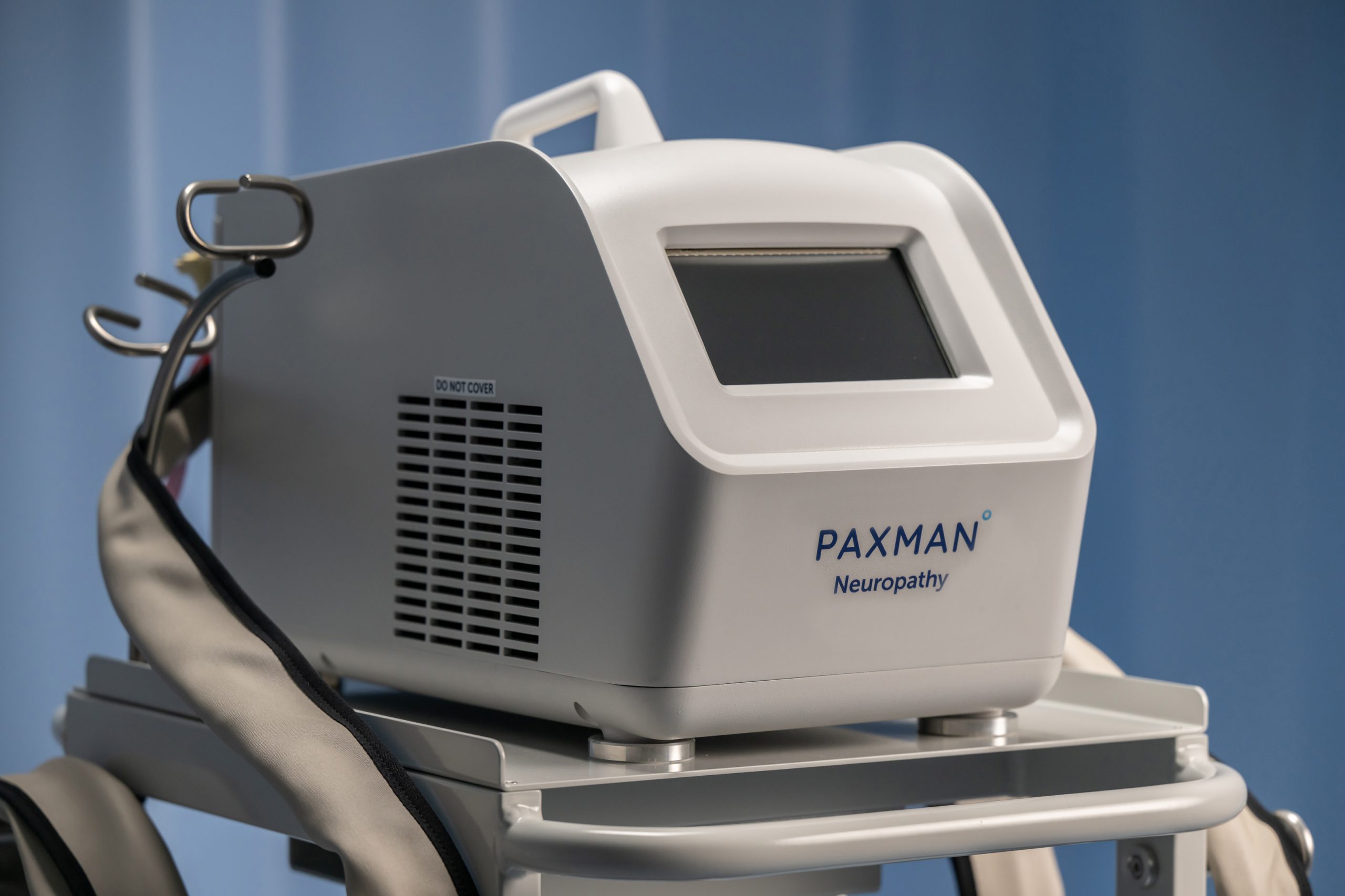
Supported by published Phase I/II clinical data, the new system aims to reduce the risk of lasting nerve damage from chemotherapy.
Paxman has launched the Paxman Neuropathy System, a groundbreaking cryocompression device that uses cooling and compression to help reduce the risk and severity of nerve damage caused by chemotherapy. Known as chemotherapy-induced peripheral neuropathy (CIPN), this common side effect can cause numbness, pain, tingling and loss of feeling in the hands and feet.
The launch marks Paxman’s first major expansion beyond scalp cooling, which helps reduce hair loss during chemotherapy. Nerve damage remains a major challenge in cancer care, with no established treatment routinely used to prevent it. Symptoms can last long after treatment, affect everyday activities and sometimes mean patients need a lower chemotherapy dose, a delay in treatment or to stop treatment altogether.
The announcement marks an important milestone for Paxman, which has spent more than 25 years establishing itself as the global leader in scalp cooling, a position strengthened by the 2025 acquisition of Dignitana. With the addition of the Paxman Neuropathy System to the product portfolio, Paxman is expanding its focus beyond its pioneering expertise in scalp cooling to address additional treatment-related side effects that can have a lasting impact on patients’ lives, broadening its leadership in innovative side effect management technologies in oncology.
CIPN affects millions of cancer patients worldwide every year and can significantly impact quality of life, making everyday activities such as walking, writing, dressing and sleeping difficult. In some cases, symptoms can persist long after treatment has finished and may even lead to chemotherapy being delayed, reduced or stopped altogether.
The innovative cryocompression technology harnessed in the Paxman Neuropathy has the potential to redefine what is possible in side effect management, addressing this significant unmet need in cancer care, helping to reduce the risk and severity of CIPN, and enabling more patients to remain on their prescribed treatment regimens.
The commercial launch coincides with the publication of clinical data from a prospective multicentre Phase I/II study in JCO Oncology Advances. The study evaluated the Paxman Neuropathy System in patients receiving taxane-based chemotherapy and found the device was safe, well tolerated and associated with low rates of CIPN.
Among 146 evaluable patients, no participants developed severe neuropathy, while patient-reported clinically significant sensory symptoms remained low throughout follow-up. The findings add to growing evidence supporting cryocompression as a potential approach to reducing the burden of CIPN.
The launch also aligns with the publication of a major scientific review in Therapeutic Advances in Medical Oncology, which explores the causes, impact and potential prevention strategies for CIPN.
The review highlights the substantial burden CIPN places on patients and healthcare systems and emphasises the importance of identifying effective preventive approaches. Among the most promising emerging interventions reviewed were cryotherapy and cryocompression technologies.
“This product launch marks a new chapter for Paxman. For more than two decades, our mission has been to improve quality of life for people undergoing cancer treatment, through our scalp cooling system to manage the side effect of chemotherapy-induced hair loss.” said Richard Paxman OBE, CEO of Paxman.
“Our mission is now expanded to address additional treatment-related side effects. Chemotherapy-induced peripheral neuropathy can have a profound and lasting impact on patients, yet there are currently very few options available to help prevent it. The launch of the Paxman Neuropathy System represents an exciting step forward and reflects our commitment to bringing innovative technologies to patients facing the challenges of cancer, giving them a degree of control over their treatment.”
Following recent regulatory approvals, the Paxman Neuropathy System is launching in the UK, France, Germany, the Netherlands, Spain and Italy. Pilot programmes of the technology are already underway in the UK, with expansion into additional centres expected across Europe in the coming months.
The newly published findings add to a growing body of evidence supporting cryocompression in CIPN prevention. Further research is continuing through the ongoing randomized SWOG S2205 ICE COMPRESS study in the United States, as well as an additional clinical trial underway at the Dana-Farber Cancer Institute evaluating the Paxman Neuropathy System.
NOTES TO EDITOR
The Unmet Need: Why CIPN Matters
Chemotherapy-induced peripheral neuropathy (CIPN) affects an estimated 3 million patients globally every year.
It is one of the most common and debilitating side effects of cancer treatment, affecting mobility, balance, dexterity and quality of life.
For many patients, symptoms can persist long after treatment ends, with some experiencing long-term or permanent effects.
Despite its prevalence and impact, there is currently no established standard preventative therapy, making CIPN one of the most significant unmet needs in oncology side effect management.
The Human Impact
CIPN is not simply numbness or tingling.
It can affect a person’s ability to work, drive, exercise, maintain independence and perform everyday tasks.
Patients with CIPN are approximately three times more likely to experience falls and related injuries.
Importantly, CIPN can also influence treatment decisions, creating difficult choices for both patients and clinicians.
Why Prevention Matters
Up to one in five patients may require chemotherapy dose modification or discontinuation due to CIPN.
This presents a major challenge: balancing effective cancer treatment against the risk of long-term neuropathy.
Prevention has the potential to improve both quality of life and treatment adherence.
Introducing the Paxman Neuropathy System
The Paxman Neuropathy System is an innovative cryocompression technology designed to provide controlled cooling and cyclic compression to the hands and feet during chemotherapy.
It is the only clinically validated solution combining both cooling and compression in a single integrated system.
The technology has been developed specifically for busy oncology environments, with simple setup, automated protocols and minimal staff intervention
Unlike frozen gloves or other manual approaches, the Paxman Neuropathy System delivers:
- Controlled, reproducible temperatures
- Continuous cooling
- Cyclic compression for improved tolerability
- Real-time monitoring and safety features
- Seamless integration into clinical workflows
- The goal is not simply cooling, but cooling delivered in a controlled, safe and consistent way.
A compact, miniaturised design allows two systems to be used at once on the accompanying trolley – a Paxman Scalp Cooling System or another Paxman Neuropathy device. Ideal for infusion sites where space is at a premium.
Paxman Neuropathy System Product Brochure
Clinical Evidence
In a Phase I/II study involving 150 patients receiving taxane chemotherapy, the Paxman Neuropathy system demonstrated:
- 95% relative reduction in Grade 2 or higher CIPN risk, helping continuation of the patient’s chemotherapy treatment cycle without dose modification
- 70% reduction in overall CIPN incidence
- 84% patient tolerability
- No high-grade cold-related adverse events reported
These results represent a potentially transformative advancement in the prevention of CIPN
How cryocompression protects peripheral nerves
Paxman Neuropathy System Clinical Evidence Brochure
Published Clinical Data
Ongoing Clinical Trials
ICE COMPRESS: Randomized Trial of Limb Cryocompression versus Continuous Compression Versus Low Cyclic Compression for the Prevention of Taxane-Induced Peripheral Neuroropathy Evaluating the use of limb cryocompression to reduce taxane-induced peripheral neuropathy