
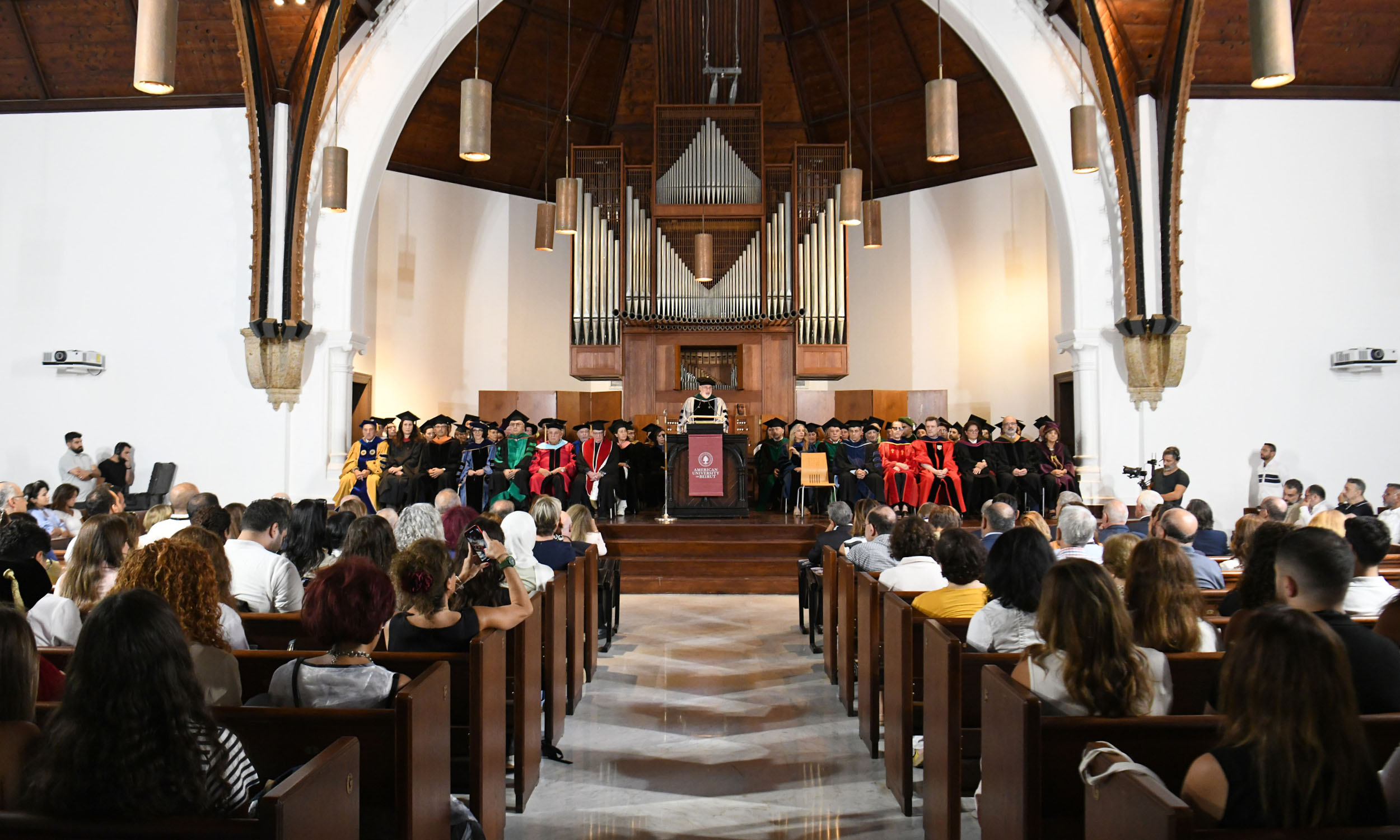
The American University of Beirut (AUB) inaugurated its new academic year with its annual opening ceremony on Monday, September 7, 2026. Trustees, faculty, staff, students, alumni, and friends of the university gathered in the historical Assembly Hall to mark the start of another year of scholarship, service, and discovery.
Following the official processional, Dr. Fadlo Khuri, AUB president, delivered his Opening Ceremony address, titled “Of Travails and Tipping Points.” Ranging from the university’s 1866 founding to the rise of artificial intelligence, the address returned repeatedly to a single idea—that each generation at AUB must become literate in the language of its own time.
Reaching back to the university’s beginnings, Khuri recalled that founding president Daniel Bliss launched the first class of the Syrian Protestant College, which would later become AUB, on December 3, 1866, with sixteen eager students. Arabic was then the language of instruction, as the region’s lingua franca, though students were also required to be fluent in Ottoman Turkish or French, as well as English. “From its beginnings,” he said, “AUB, understood something that remains true today: the languages of education change, but the need to learn the languages of one’s time does not.”
The language of this moment, Khuri argued, is artificial intelligence, and the university’s task is to help its community become fluent in it. AI and computing, he said, “like design, the fine arts, and humanities, are becoming essential languages for the human experience.” He framed the point not as a matter of efficiency but of literacy, and made it personal: in his seventh decade, he told the audience, he is “forcing myself to learn these new and, I am confident, enduring languages,” currently working through “The AI Starter Kit,” a certificate course developed by the Al Ghurair Hub for Digital Teaching and Learning at AUB’s Maroun Semaan Faculty of Engineering and Architecture (MSFEA). The reason, he said, is what the university owes those it teaches: “If one is to help guide our students, faculty, and staff through a transformative and emancipating AUB experience, the least we owe them is to be literate in the lingua franca of our times, as Bliss required his students to be in theirs.”
If AI is one language, reading remains another. Recounting a summer spent with more than a half-dozen books and more than 150 articles read the “old-fashioned way,” Khuri argued that reading offers “a unique combination of insight, satisfaction, guilt, and anticipation” that no technology-based summary can replicate.
From there the address turned to what Khuri called the central charge facing students. Critical thinking, he said, is “the Holy Grail of higher education, perhaps even the raison d’être of the academy.” As information grows easier to obtain in the age of AI, he argued, what matters is “not simply learning more, but learning how to think with what you learn.” He noted that no single field agrees on what critical thinking requires, concluding that it is “very much in the eye of the beholder.”
To illustrate how such capacities take hold, he drew on Malcolm Gladwell’s Revenge of the Tipping Point and its idea that a “certain critical mass is necessary to create a breakthrough.” Students, too, would reach such a point, he suggested, “be it in your numbers, knowledge, or confidence,” arriving at “that point of professional satisfaction where your competencies intersect with your passions.”
The address built toward Homer, and to a model for critical thinking drawn from The Odyssey. What he most admires in Odysseus, Khuri said, is “not simply his cleverness,” but “his capacity to endure a long, uncertain, and often difficult journey without losing sight of where he was trying to go.” He turned to the ancient Greek concept of metis, the ability “to read circumstances, improvise, recognize opportunity, and change strategy when circumstances demand it,” offering it as an image of what an AUB education should cultivate. “That is one of the gifts I hope an AUB education will give you,” he said: “not a fixed map of the world, but the ability to navigate a rapidly evolving world.”
Khuri closed by turning outward to the community and the year ahead. It would be one, he said, that students, faculty, staff, alumni, and friends would all experience through “your individual quests, full of gods, monsters, heroes, villains, tragedies, and triumphs.” Each would emerge “wearier and wiser,” he added, but “the better for that pilgrimage.” Borrowing Bob Dylan’s words to Woody Guthrie, he wished the community “a healthy, immersive, exhilarating, exhausting, and ultimately magnificent academic year ahead, full of some of that ‘hard traveling too.'”
About AUB
Founded in 1866, the American University of Beirut bases its educational philosophy, standards, and practices on the American liberal arts model of higher education. A teaching-centered research university, AUB has more than 790 full-time faculty members and a student body of over 9000 students. AUB currently offers more than 140 programs leading to bachelor’s, master’s, MD, and PhD degrees. It provides medical education and training to students from throughout the region at its Medical Center that includes a full-service 365-bed hospital.
Stay up to date on AUB news and events.
aub.edu.lb | Facebook | X