
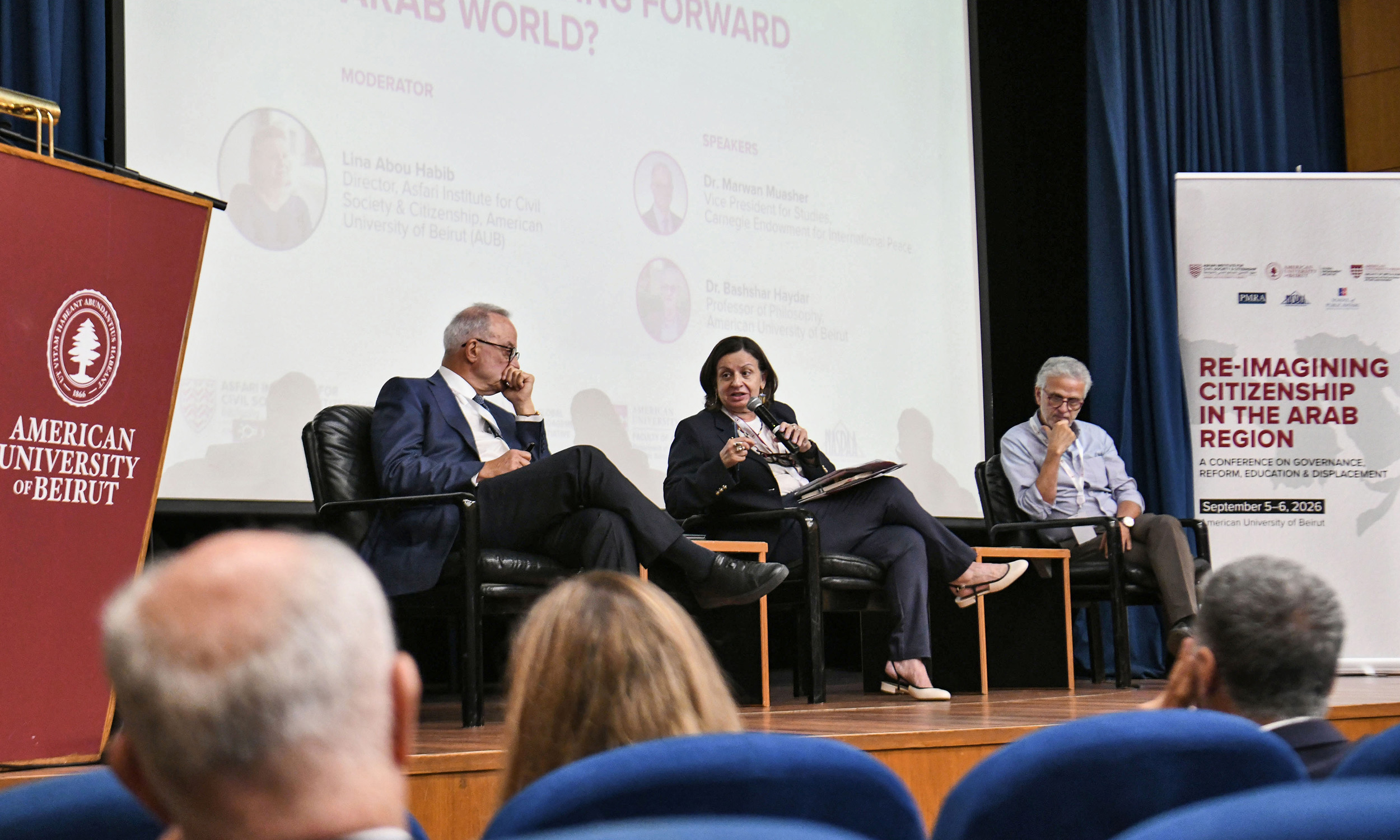
The American University of Beirut (AUB) hosted “Re-Imagining Citizenship in the Arab Region,” bringing together scholars, policymakers, educators, civil society practitioners, and students. The conference examined how governance, reform, education, and displacement shape rights, belonging, and participation in public life.
Held at AUB’s West Hall, the conference was convened by the Asfari Institute for Civil Society and Citizenship, the Department of Political Studies and Public Administration, and the Global Engagement Initiative at AUB. International partners included the School of Public Affairs at American University; the Network of Schools of Public Policy, Affairs, and Administration; and the Public Management Research Association.
Lina Abou-Habib, director of the Asfari Institute for Civil Society and Citizenship, stressed the urgency of creating conditions in which people can exercise their rights and help shape their societies.
“This conference comes at a time when the mere concept of citizenship is contested. Citizens in the region have yet to experience and enjoy rights as citizens as well as actively engage and participate in matters that shape their lives and societies. In a region marred by wars, instability, and poor examples of democracy, participation, and inclusion, owning the meaning and practice of citizenship is perhaps the only way forward toward just and inclusive societies,” she said.
In his opening remarks, Dr. Fadlo Khuri, AUB president, emphasized the importance of free discourse, trust in public institutions, and fair access to education, healthcare, public services, and economic opportunity.
“It is a lived relationship between individuals, their communities, and the institutions around them; it is about that feeling of belonging, knowing our rights are recognized and protected, understanding our responsibilities, and having a voice in public life,” Khuri said of citizenship.
He highlighted the university’s responsibility to provide spaces for open debate and to help students develop the critical thinking needed to assess information, question assumptions, and participate in public affairs.
The relationship between institutional responsibility and national belonging was also central to the keynote address by Dr. Marwan Muasher, chair of the Asfari Institute’s International Advisory Board and vice president for studies at the Carnegie Endowment for International Peace. In “Rethinking Citizenship in the Arab World: Bridging Traditional Affiliations and National Identity,” Muasher examined why tribal and religious communities often command greater trust than state institutions.
“If states expect their citizens to develop national identities and loyalties, they must undertake serious institutional reforms,” he said.
Muasher called for equal protection under the law, an independent judiciary, meaningful political participation, and gender equality. He argued that national identities should accommodate diverse religious and tribal affiliations while providing the rights, security, and opportunities that give people confidence in their institutions. Education, he emphasized, has a central role in developing critical thinking and an inclusive understanding of citizenship.
Plenary discussions explored the trajectory of citizenship in the Arab world; the roles of education, peacebuilding, and civil society in Lebanon; and the relationship between higher education and public decision-making. Research panels on governance and political reform examined constitutional reform, public trust, institutional design, the erosion of public wages and pensions, and the implications of artificial intelligence for public services and citizen engagement.
Questions of inclusion extended to refugees, migrants, and displaced persons. Presentations examined refugee financing and governance, how gender and health shape migrants’ experiences of citizenship, and the legal and social exclusion experienced by migrant domestic workers in Lebanon. Research on grassroots responses to crisis considered how community organizing, volunteering, and networks of solidarity can support civic participation amid limited institutional capacity.
Education sessions connected these concerns to classroom practice and policy. Presenters explored citizenship curricula, teacher training, media literacy, and volunteering, as well as the challenges of sustaining equitable education systems in contexts affected by conflict and instability.
The program also included a LEGO Serious Play workshop. Using co-design, systems thinking, and gamification, the workshop invited participants to explore how citizens and public institutions can collaboratively shape policies and services.
The conference was complemented by pre- and post-conference events supporting research and public affairs education. The pre-conference Academic Publishing Workshop on Public Management in the Middle East, supported scholars in developing their research and publishing in international public management and administration journals. The post-conference Leadership Forum on Public Affairs Education, focused on strengthening public affairs programs in the Middle East through curriculum development, student support, faculty development, and engagement with employers and other stakeholders.
Looking beyond the conference, Khuri expressed the hope that its discussions would lead to further research, teaching initiatives, partnerships, and policy ideas responsive to the region’s realities. He emphasized that these efforts should advance a more inclusive understanding of citizenship in which vulnerable people enjoy equal rights.
About AUB
Founded in 1866, the American University of Beirut bases its educational philosophy, standards, and practices on the American liberal arts model of higher education. A teaching-centered research university, AUB has more than 800 full-time faculty members and a student body of over 9,700 students. AUB currently offers more than 140 programs leading to bachelor’s, master’s, MD, and PhD degrees. It provides medical education and training to students from throughout the region at its Medical Center, which includes a full-service 365-bed hospital.
Stay up to date on AUB news and events.
aub.edu.lb |Facebook |X