
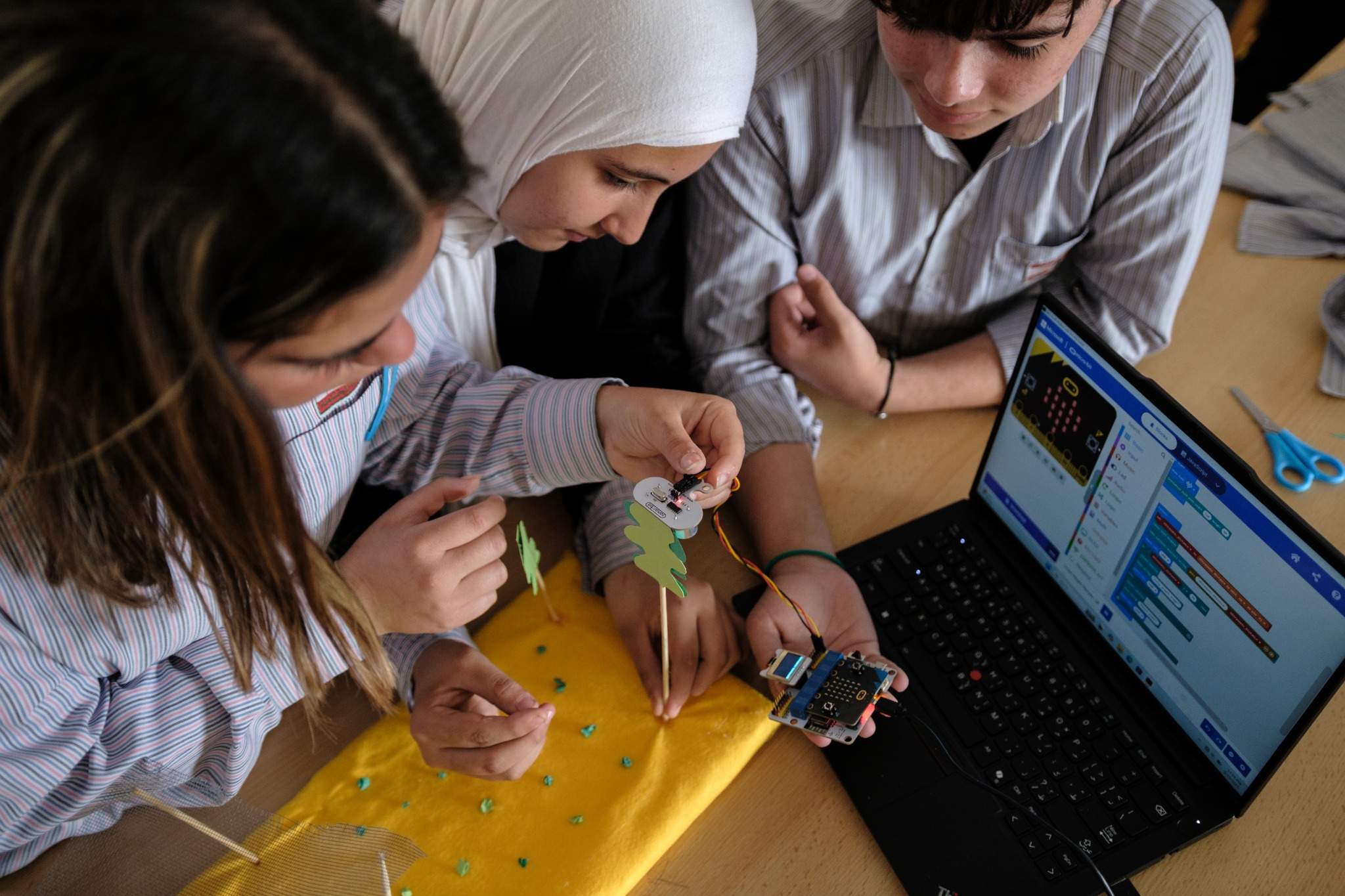
On March 17, Ali, a 16-year-old student displaced from the South, submitted his final CodeBrave project. His father had driven back home a week into the conflict to retrieve his laptop, allowing him to continue working from a shelter. Two weeks after his displacement, Ali was accepted into The Junior Academy at the New York Academy of Sciences, where he is now collaborating with international peers on real-world problem-solving through technology. “Nothing will affect our growth, neither war nor displacement,” he said.
Amal, 17, remained in the South with her family. She continued her online Web Development and AI classes, completing a project that generates dessert recipes from ingredients users have at home while studying for her official baccalaureate exams.
Their determination reflects a broader reality: Lebanon’s human capital development cannot wait for stability. It never has.
Both students are enrolled in CodeBrave’s Future Builders programme, which focuses on web development and AI. Across the country, students continued learning from wherever they could maintain a connection, using AI tools to generate code and build digital products that address everyday problems. The programme concludes with a three-month internship working alongside real clients, a direct pipeline from the classroom to the workforce.
The numbers behind that pipeline are significant. Since its founding in 2018, CodeBrave has reached 10,000+ students across Lebanon. In the 2024–25 academic year alone, more than 5,600 students learnt Computer Science and AI, while 107 public school teachers across 40 schools were trained to deliver the curriculum independently through its School Upskilling programme.
That matters in a country where NGO-led education initiatives have often struggled to outlast their funding cycles. CodeBrave’s delivery model, which embeds trained teachers directly into public schools, is built to compound over time.
“Computer Science and AI education can no longer be treated as an elective; it is foundational literacy. Ensuring young people understand how technology works is essential to building the talent base Lebanon needs. Reaching more than 10,000 students shows how expanding access to these skills can create new pathways for the next generation and how critical those pathways are, especially today,” said Eliana Sleiman, Co-Director and Head of Programmes at CodeBrave.
CodeBrave’s next milestone is reaching all of Lebanon’s public schools by 2030, an ambition that carries real economic weight. The country’s reconstruction and reform agenda will depend heavily on a digitally literate workforce.
Amal, for her part, is focused on July. “Wearing my graduation cap, that moment alone would make everything worth it,” she said. “Learning is not a luxury. Continuing to learn means reclaiming my future.”
In Lebanon, that sentence lands as both personal testimony and policy argument.
About CodeBrave
CodeBrave is a non-profit organisation embedding Computer Science and AI education inside Lebanon’s public and underserved schools. Designed and delivered by experienced educators, child psychology experts, and technologists, CodeBrave’s STEM.org-accredited programmes are learner-centred, engaging, and grounded in real-world problem-solving, fostering a love of learning alongside future skills.
Instagram: @codebrave