
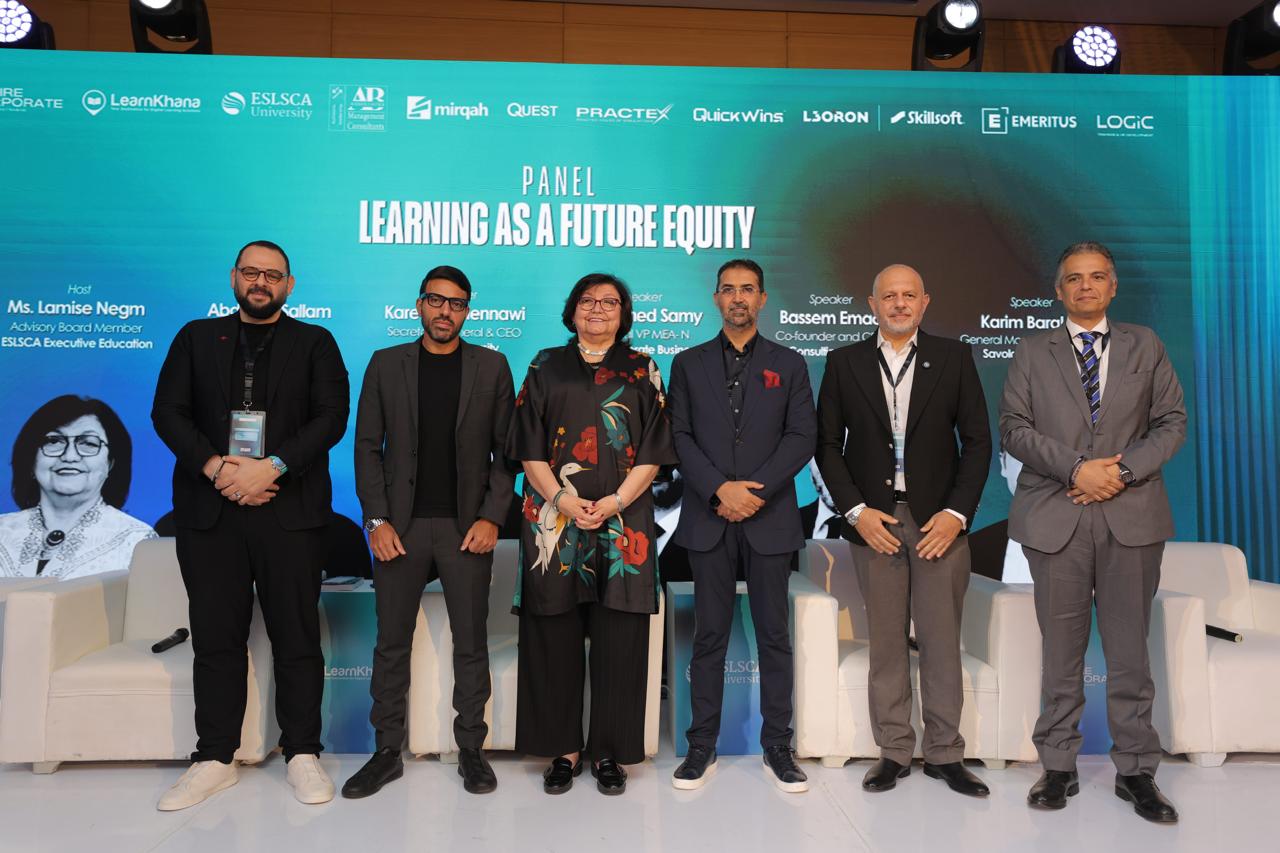
Cairo, 14 June 2026: The panel discussion “Learning as a Future Equity” took center stage at L&D Hub 2026, organized by The Trainer, bringing together prominent business, L&D, and HR leaders to explore the growing importance of learning and development as a strategic investment that strengthens organizational competitiveness and prepares human capital for the future.
The panel was moderated by Ms. Lamise Negm, Advisory Board Member, ESLSCA Executive Education, and featured a distinguished lineup of speakers, including Abdallah Sallam, President & CEO of Madinet Masr; Kareem ElHennawi, Secretary General & CEO of ESLSCA University; Mohamed Samy, Regional VP MEA-N, SAP Corporate Business; Bassem Emad, Co-founder and CEO of Aspire Consulting International; and Karim Baraka, General Manager Egypt OU, Savola Foods Egypt.
Opening the panel, Lamise Negm emphasized that organizations are no longer measured solely by the size of their physical assets or financial investments, but increasingly by their ability to build knowledge, develop capabilities, and prepare talent to navigate rapid economic and technological change.
She highlighted that learning has become a core pillar of modern growth strategies, noting that organizations investing consistently in employee development are better positioned to adapt to technological transformation, seize emerging opportunities, and achieve sustainable growth.
For his part, Abdallah Sallam, President & CEO of Madinet Masr, highlighted that people will remain the most influential factor in organizational success regardless of how technology evolves or business models change. He noted that investing in talent development is ultimately an investment in a company’s future resilience and long-term success.
Sallam added that successful organizations view learning as a continuous journey rather than a temporary initiative, emphasizing that fostering a culture of development and knowledge acquisition enhances innovation, improves performance, and drives long-term business outcomes.
Meanwhile, Kareem ElHennawi, Secretary General & CEO of ESLSCA University, highlighted the profound transformation taking place in the relationship between learning and the labor market. He explained that educational institutions are increasingly expected to equip graduates with practical skills and leadership capabilities aligned with the evolving needs of modern economies.
He further underscored the importance of stronger collaboration between universities and the business community, noting that such partnerships are essential for developing human capital through educational programs that are closely connected to real-world challenges and capable of nurturing innovation, critical thinking, and future leadership.
Mohamed Samy, Regional VP MEA-N at SAP Corporate Business, pointed out that digital transformation and artificial intelligence are fundamentally reshaping jobs and the skills required within organizations, making continuous learning and reskilling an imperative rather than an option.
He noted that technology today offers unprecedented opportunities to personalize learning experiences, identify training needs, and measure learning impact, enabling organizations to build more capable, agile, and future-ready workforces that can deliver tangible business results.
Bassem Emad, Co-founder and CEO of Aspire Consulting International, emphasized that many organizations still treat training as a standalone activity disconnected from broader business objectives. However, he noted that modern learning strategies increasingly focus on linking learning initiatives directly to performance outcomes and organizational goals.
Karim Baraka, General Manager Egypt OU at Savola Foods Egypt, highlighted that building a culture of continuous learning is no longer an organizational luxury but a necessity driven by rapidly changing markets, evolving consumer behaviors, and shifting workplace demands.
He explained that organizations that successfully embed sustainable learning practices across their workforce are better equipped to navigate challenges and capitalize on new opportunities, adding that investing in human capability development consistently delivers one of the highest long-term returns on investment.
He added that the true value of any learning or development program lies in its ability to improve performance, solve business challenges, and contribute to strategic objectives, stressing that continuous learning ecosystems have become a critical driver of organizational competitiveness.
The panel featured an engaging panel on redefining learning as a long-term strategic investment and explored its role in enhancing productivity, driving innovation, and strengthening organizational readiness amid accelerating economic and technological change. Participants also shared practical experiences and insights on developing future-ready human capital.
Organized by The Trainer, L&D Hub 2026 serves as a strategic platform that brings together learning and development professionals, HR leaders, and training providers to explore the latest trends, methodologies, and technologies shaping the future of talent development. This year’s edition is structured around three main tracks: L&D Back to Basics, AI-Driven Learning Impact, and Well-being From Metrics to Mindfulness, featuring leading experts and industry pioneers from across sectors.