
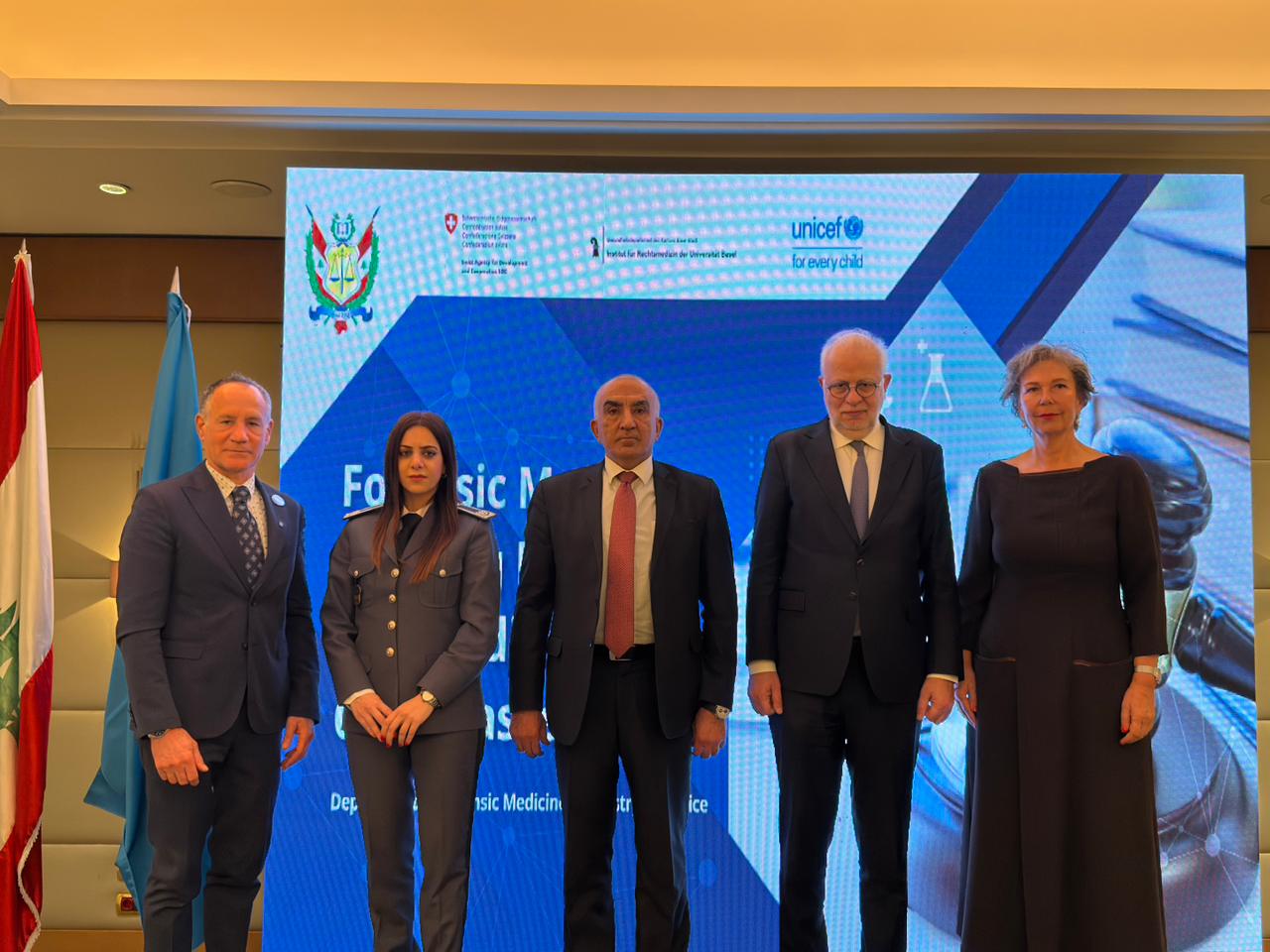
Friday, 30 January 2026- Beirut, Lebanon – The Ministry of Justice, in partnership with the United Nations Children’s Fund (UNICEF) and with support from the Swiss Agency for Development and Cooperation (SDC), today launched the Forensic Medicine Training Programme focusing on child cases to strengthen Lebanon’s capacity to provide a specialized and safe judicial and forensic response that upholds children’s rights and places their best interests at the center of all procedures.
The programme builds on in-depth discussions in 2022 around the situation of forensic practices, which identified critical gaps and highlighted the urgent need to strengthen institutional and technical capacities for handling cases involving children in the justice system. Developed in collaboration with the Ministry of Justice’s Forensic Medicine Department, representatives of judges and forensic doctors, UNICEF, and international experts from the University of Basel’s Institute of Forensic Medicine, the programme aligns national priorities with international child‑rights standards and global best practices to better protect children whether they are in conflict with the law, at risk, victims of crime, or witnesses.
Minister of Justice Adil Nassar said in his speech: “Crimes committed against individuals have not changed significantly since the dawn of history. What has changed, however, are the methods used to commit them, and therefore the tools for uncovering crimes and conducting investigations must evolve as well. Justice must defend and protect, beginning with the most vulnerable, those whose voices go unheard and who may be subjected to the gravest violation.” He added: “Today, we are adults discussing issues that concern children. This recalls a quote by the French writer Antoine de Saint-Exupéry, who said: ‘All grown-ups were once children, but only few of them remember it.’ Therefore, when we address cases involving children, we must reconnect with the child within each of us.” On the importance of launching this programme, he stated: “Today, law and medicine come together in the service of the best interests of the child. Without an integrated and specialized forensic medicine system, and without an effective and constructive partnership between judges and doctors, justice will continue to struggle to reach the truth. Lebanon will increasingly face cases of miscarriages of justice and unresolved crimes, particularly those in which children are the victims, often silent victims of fear and pain”. “We express our deep gratitude to UNICEF, whose outreach and support have been a fundamental pillar in strengthening forensic medicine as part of the effort to build a child justice system in Lebanon.” He concluded.
The launch builds on the longstanding partnership between the Ministry of Justice and UNICEF since 2018 to strengthen Lebanon’s child justice system through policy development, capacity‑building, and legal reform. These efforts aim to ensure that children’s rights to protection, dignity, and fair treatment are fulfilled before, during, and after any contact with the justice system, in line with national and international obligations.
“Today’s launch is not only about a manual or a training. It is about supporting efforts to reinforce a justice system that is responsive to the needs of children. Switzerland remains committed to working with the Government of Lebanon, the Ministry of Justice and other ministries, UNICEF, and all national and international partners. Together, we aim to strengthen a justice system that promotes children’s rights and ensures their protection,” said Dr. Marion Weichelt, Ambassador of Switzerland in Lebanon.
Marco Luigi Corsi, UNICEF Representative in Lebanon, said: “When children come into contact with the justice system, especially under difficult circumstances, their protection and dignity must always come first. This programme ensures that children’s needs and rights are considered at every stage and places their best interests at the heart of forensic practice. By strengthening the capacities of all actors and standardizing procedures, we work to protect children from additional harm and ensure they can access justice safely, fairly, and with respect.”
The programme includes the development of a training manual on forensic medicine examinations involving children, as well as an intensive six‑day training for 125 judges and 40 forensic doctors to strengthen technical competencies in child‑sensitive forensic examinations, high‑quality documentation and interpretation of medico‑legal evidence, and the effective application of medical findings within judicial proceedings. Anchored in international child‑rights standards, the training prioritizes access to justice, the prevention of secondary trauma and reinforces protection for all children, ensuring that justice systems treat children first and foremost as children, with their rights and best interests fully upheld.
About UNICEF
Working in Lebanon for over 70 years, UNICEF works in some of the world’s toughest places, to reach the world’s most disadvantaged children. Across more than 190 countries and territories, we work for every child, everywhere, to build a better world for everyone
For more information about UNICEF Lebanon and our work for children, visit www.unicef.org/lebanon/ or follow us on Twitter, Facebook, Instagram and YouTube