
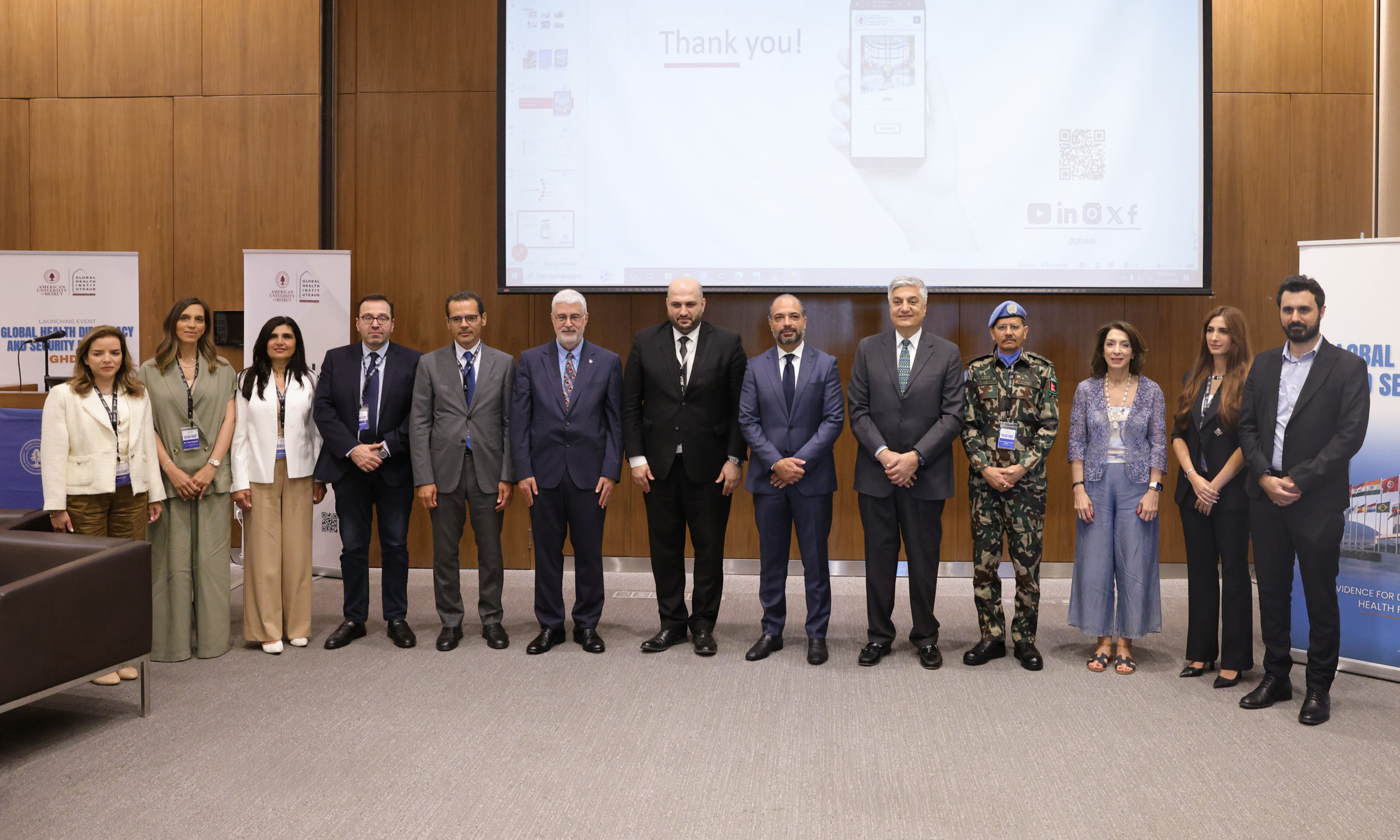
The Global Health Institute (GHI) at the American University of Beirut (AUB) officially launched the Global Health Diplomacy and Security Program (GHDP), a new initiative with strong regional and global reach dedicated to advancing research, dialogue, and capacity strengthening at the intersection of health, diplomacy, and security. The launch event brought together senior government officials, diplomats, global health leaders, policymakers, academics, and practitioners to explore the growing role of global health diplomacy in addressing complex regional and global challenges.
Delivering the ministerial address, Dr. Rakan Nassereddine, Lebanon’s minister of public health, emphasized the importance of respectful dialogue, evidence, and constructive engagement across political and disciplinary divides in advancing global health priorities. Drawing on his experience representing Lebanon on the international stage, he highlighted how diplomacy can transform documented realities into concrete decisions that protect healthcare workers and support future accountability. He also described AUB as a testament to this approach, where diverse perspectives are brought together through open discussion and mutual respect.
Opening the event, Dr. Fadlo Khuri, AUB president, emphasized that clinical excellence alone is insufficient to address today’s global health challenges. He highlighted the importance of evidence-based policy, trust, and dialogue, noting that health can serve as a common language capable of bridging divides and strengthening cooperation. Dr. Khuri also underscored Lebanon’s social fabric as a source of resilience and called for elevating global health diplomacy as an urgent priority in an increasingly fragmented world.
In his opening remarks, Dr. Shadi Saleh, founding director of AUB GHI, stressed that health diplomacy is not only a public health concern but also a strategic national interest and a pillar of global security. He called for a more equitable model of global health cooperation in which countries of the Global South play an equal role in shaping priorities and solutions. Dr. Saleh emphasized that sustainable progress depends on collaboration, shared knowledge, and the ability to transform crises into opportunities for innovation and leadership.
Delivering the keynote address, Dr. Hanan Balkhy, regional director of the World Health Organization’s Regional Office for the Eastern Mediterranean (WHO EMRO), emphasized that the decisions shaping health outcomes today are no longer made solely in hospitals, laboratories, or ministries of health. Rather, they are increasingly influenced by diplomatic negotiations, climate discussions, financial decision-making, and responses to crises that transcend borders. She underscored the importance of science-based diplomacy, evidence-informed policymaking, and strengthening the region’s voice in global health governance to advance equitable access to health tools and address ongoing global health challenges.
The event also featured a high-level panel discussion titled “Shaping the Future of Global Health Diplomacy: Leveraging Knowledge and Evidence,” moderated by Yara Mourad, assistant director at the Issam Fares Institute at AUB.
Ambassador Luís de Almeida Sampaio, distinguished diplomat, president of the Strategic Council of Coimbra Health, and member of the Executive Committee of the Academic Alliance of the World Health Summit, emphasized that health has become a strategic component of global policy and security. He highlighted the importance of strengthening institutional networks that connect health expertise with diplomatic processes, noting that effective global health governance depends on sustained collaboration across countries and sectors.
MP Fadi Alame, chairman of the Foreign Relations Committee, member of the Parliamentary Health, Labor and Social Affairs Committee, and president of the Arab Hospitals Federation, stressed that health diplomacy in Lebanon is already reflected in decades of international cooperation and engagement with regional and global partners. He underscored the need to strengthen these efforts through a national health diplomacy strategy and enhanced cross-sector coordination.
Dr. Theresa Madubuko, lead for the Doha Health Initiative at the Middle East Council on Global Affairs, highlighted that evidence alone is not sufficient unless it informs decision-making and drives meaningful action. She emphasized the importance of knowledge exchange, peer learning, and investing in future generations of global health leaders.
The panel concluded by reiterating the need to strengthen the link between health and diplomacy and to ensure evidence and academic knowledge more effectively inform policy and action. It underscored the importance of sustained cooperation and shared accountability to address emerging challenges, including health inequities, artificial intelligence, and future epidemic threats, through resilient and forward-looking governance.
About AUB
Founded in 1866, the American University of Beirut bases its educational philosophy, standards, and practices on the American liberal arts model of higher education. A teaching-centered research university, AUB has more than 790 full-time faculty members and a student body of over 9000 students. AUB currently offers more than 140 programs leading to bachelor’s, master’s, MD, and PhD degrees. It provides medical education and training to students from throughout the region at its Medical Center that includes a full-service 365-bed hospital.
Stay up to date on AUB news and events.
aub.edu.lb |Facebook |X
About GHI
The Global Health Institute (GHI) at the American University of Beirut (AUB) addresses global health challenges with a focus on context and sustainable impact through an interdisciplinary approach. GHI is structured into three divisions: the Programs Division, which leads research, policy, and advocacy efforts; the Academy Division, which provides capacity-building initiatives for diverse populations; and the ASSIST Division, which supports community-level actors, particularly nongovernmental organizations, through a range of services and resources.
About the Global Health Diplomacy and Security Program (GHDP)
The Global Health Diplomacy and Security Program (GHDP) at the Global Health Institute (GHI) at the American University of Beirut (AUB) advances research, dialogue, and capacity strengthening at the intersection of health, diplomacy, and security. The program focuses on generating policy-relevant evidence, fostering collaboration among researchers, policymakers, diplomats, and health professionals, and strengthening the role of the Global South in shaping global health governance. Through interdisciplinary partnerships and evidence-informed approaches, GHDP seeks to advance diplomacy for health, health for peace and prosperity, and more inclusive global health cooperation.
To learn more about the Global Health Diplomacy and Security Program (GHDP) at GHI, visit https://ghi.aub.edu.lb/ghdp/
The full event video is available at https://youtu.be/4e2x9xJ8-CI