
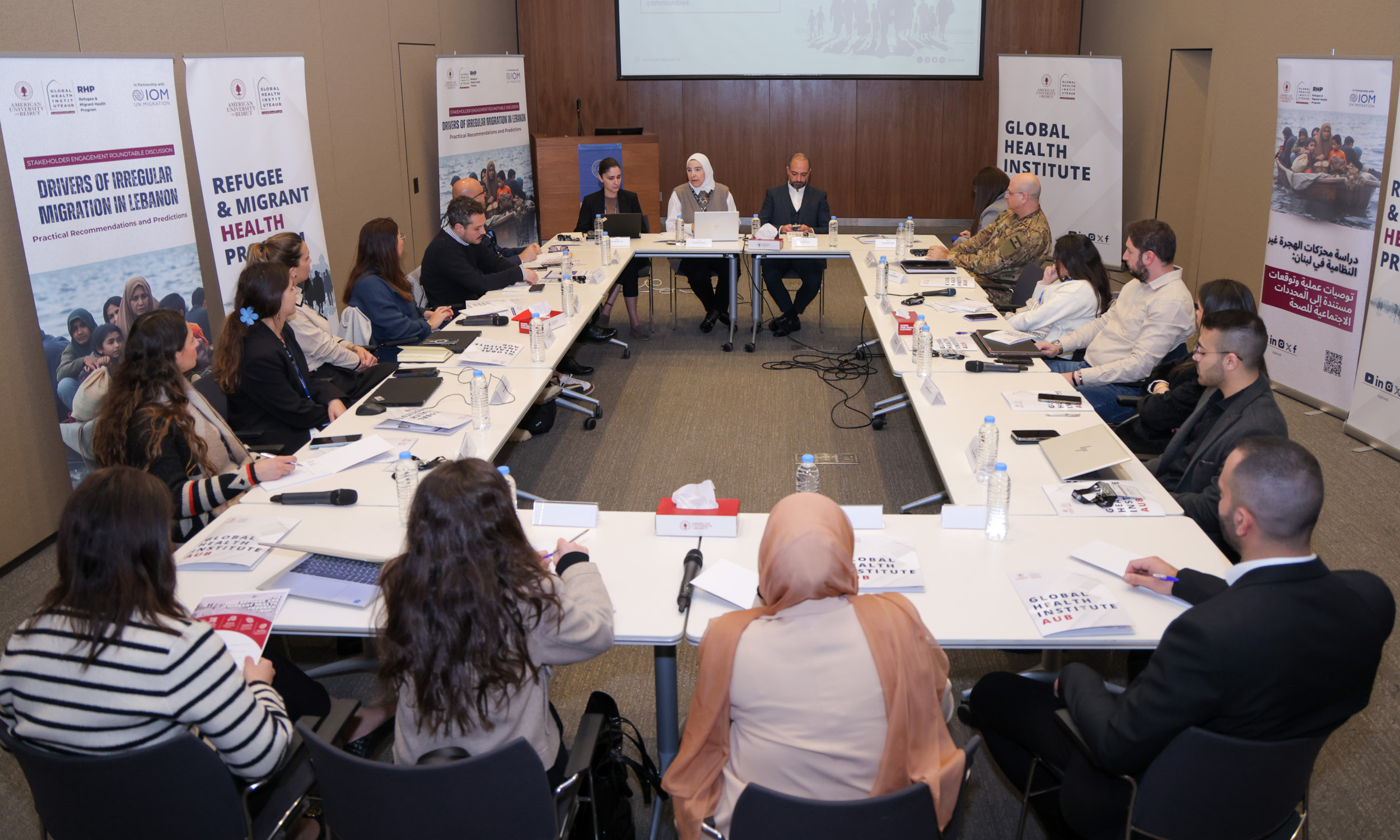
The Global Health Institute (GHI) at the American University of Beirut (AUB) convened a closed roundtable discussion, to examine the drivers of irregular migration in Lebanon, with a particular focus on the role of social determinants of health. The discussion is part of an ongoing research study led by the Refugee and Migrant Health Program at GHI and funded by the UK Foreign, Commonwealth, and Development Office (FCDO) through the International Organization for Migration (IOM).
The meeting opened with remarks by Dr. Shadi Saleh, founding director of the AUB GHI. Dr. Saleh welcomed the participating stakeholders and expressed appreciation for the strong partnership with IOM Lebanon in advancing this important work. He emphasized the importance of engaging diverse stakeholders and gathering their insights, noting that feedback from practitioners and institutions working directly in the field is essential to complement the study’s findings with practical experience and grounded observations.
Lidya Bou Teen, data analysis and reporting associate at IOM Lebanon, underscored the importance of the partnership between IOM and AUB GHI, and highlighted how collaboration with an academic institution strengthens the rigor and credibility of the evidence being generated, ensuring that findings are grounded in robust research methodologies and informed analysis.
Nour El Arnaout, associate director at GHI, welcomed the attendees and presented the study’s preliminary findings. Conducted in Akkar and Tripoli, the research examined migration-related decision-making among Lebanese and displaced communities, focusing on living conditions, access to healthcare and mental health services, perceptions of well-being, and broader socio-economic vulnerabilities. El Arnaout emphasized the importance of stakeholder engagement in validating and contextualizing the findings.
The roundtable brought together representatives from the Lebanese Army, the General Security, international and local nongovernmental organizations, and academia, all of whom are heavily involved in the field of migration. Their diverse expertise and field-based insights contributed to a rich discussion on emerging trends, gaps, and policy considerations that enrich and complement the findings of the study.
About AUB
Founded in 1866, the American University of Beirut bases its educational philosophy, standards, and practices on the American liberal arts model of higher education. A teaching-centered research university, AUB has more than 790 full-time faculty members and a student body of over 9000 students. AUB currently offers more than 140 programs leading to bachelor’s, master’s, MD, and PhD degrees. It provides medical education and training to students from throughout the region at its Medical Center that includes a full-service 365-bed hospital.
Stay up to date on AUB news and events.
aub.edu.lb |Facebook |X
About GHI
The Global Health Institute (GHI) at the American University of Beirut (AUB) addresses global health challenges with a focus on context and sustainable impact by employing an interdisciplinary approach. GHI is structured into three divisions: the Programs Division, which leads research, policy, and advocacy efforts; the Academy Division, which provides capacity-building initiatives for diverse populations; and the ASSIST Division, which supports community-level actors, particularly non-governmental organizations, with a range of services and resources.
About RHP
The Refugee and Migrant Health Program (RHP) at the Global Health Institute (GHI) at the American University of Beirut (AUB) is a multidisciplinary program targeting refugee and migrant health from a global health perspective. The program constitutes a platform for active researchers to consolidate efforts in exploring the impact of protracted crises on the health and well-being of displaced populations and their host communities in the Global South. Launched in 2017, the program aims to combine the academic and practical expertise on global health, refugee, migrant, and community health, and medicine to generate contextualized knowledge, as well as outreach and capacity-building activities that serve the needs of the targeted populations.