
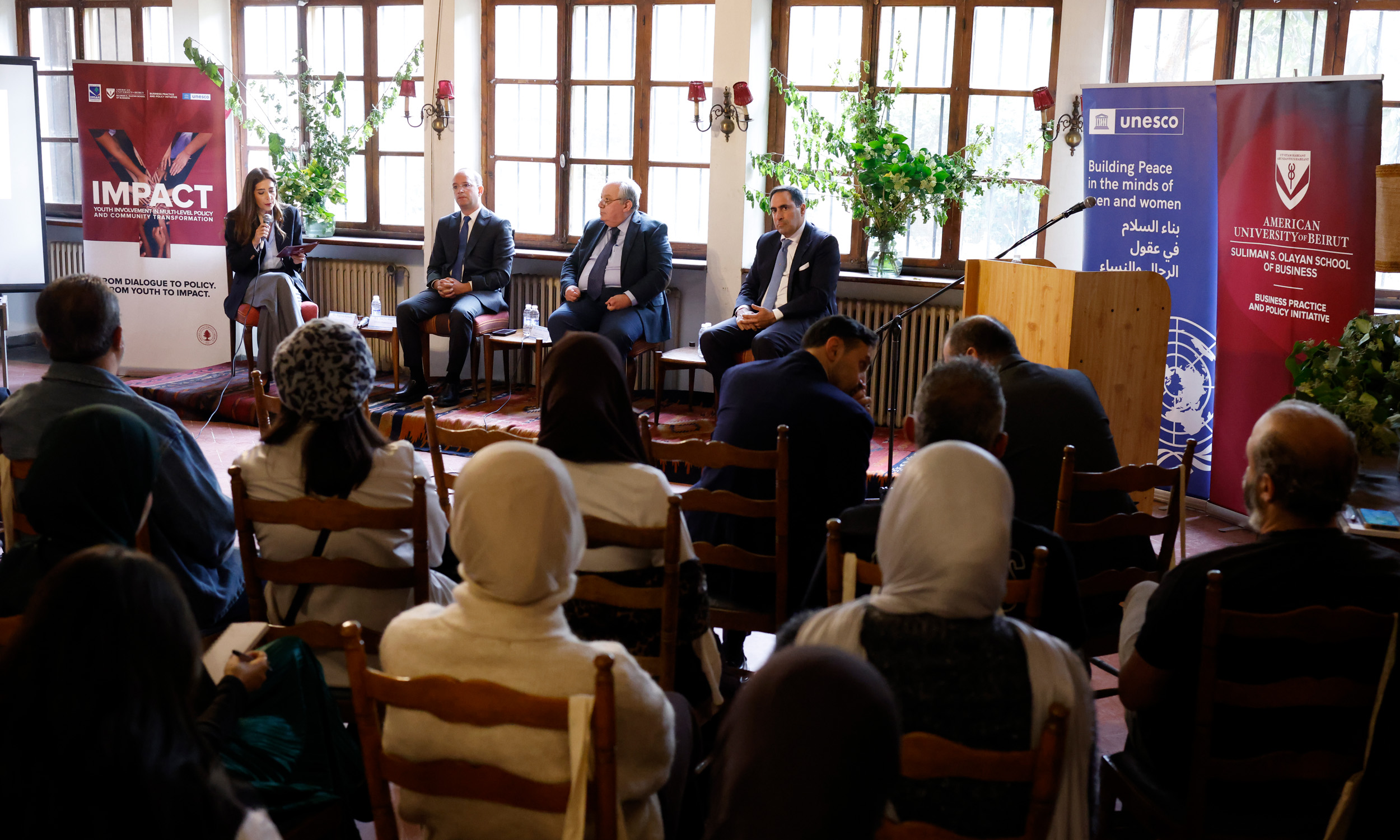
The Business Practice and Policy Initiative (BPPI) at the Suliman S. Olayan School of Business (OSB) at the American University of Beirut (AUB) held three regional events for youth policy dialogue and training in South Lebanon, the Bekaa, and Baalbek–Hermel. Organized in collaboration with the UNESCO Office in Beirut and in strategic partnership with the Office of the Minister of State for Administrative Reform (OMSAR), the events were part of the Youth Involvement in Multi-Level Policy and Community Transformation (Y-IMPACT) initiative.
The events brought together 81 young people from across Lebanon, along with government officials, academics, and experts, to discuss pressing local challenges, strengthen youth participation in governance, and promote evidence-based public policymaking.
Held under the theme “From Local Challenges to National Reform: Advancing Policy Transformation through Youth, Institutions, and Academia,” each event focused on a key development priority specific to its host region. Raghda Kawass, knowledge and public policy specialist at BPPI, moderated all three panel discussions.
The first event took place at the Serail in Saida and focused on “Waste Management and Sustainable Solutions in South Lebanon.” Kawass delivered opening remarks alongside Assem Abi Ali, education program coordinator at UNESCO, and Mansour Daou, governor of South Lebanon. Daou was joined on the panel by Dr. Abdul Rahman El Bizri, member of parliament; Raphael Debbaneh, chairman of Debbaneh Group; and Malek Ghandour, president of the Lebanese Environment Forum. The panel discussed sustainable waste management approaches and the importance of institutional and community collaboration in developing effective solutions to this challenge.
The second event, “Sustainable Development in the Bekaa: Youth, Agriculture, and Water,” explored challenges in sustainable water resource management and agricultural development, as well as opportunities to strengthen youth engagement in addressing the region’s development priorities. The panel featured Judge Kamal Abou Jaoude, governor of the Bekaa; Antoun Maakaroun, chairman of the board and director general of the Bekaa Water Establishment; Nicolas Haddad, director of AUB’s Agricultural Research and Education Center; and Mounir Teeni, president of the Chamber of Commerce, Industry, and Agriculture in Zahle and the Bekaa.
The series concludedin Baalbek with “Electricity Decentralization in Baalbek–Hermel: Technical and Financial Solutions to the Energy Crisis.” The panel featured Bachir Khodr, governor of Baalbek–Hermel; Ghassan Baydoun, a public finance and budgeting expert; and Albert Khoury, chairman of Shams Baalbeck. Panelists discussed sustainable local solutions to the electricity crisis, potential financing mechanisms, and the importance of institutional cooperation in addressing energy sector challenges.
Each event included interactive youth dialogues, policy training sessions, and Youth Policy Labs. Through these activities, participants could engage directly with decision-makers and strengthen their skills in analyzing public policy challenges and developing policy proposals.
Together, the three events contributed to Y-IMPACT’s objectives of bridging the gap between youth, institutions, and decision-makers while reinforcing the principles of inclusive and participatory governance. Building on these dialogues and training sessions, participating young people will continue developing policy papers aimed at translating local challenges and community needs into practical, evidence-based recommendations that can inform public policymaking and support sustainable development across Lebanon.
About AUB
Founded in 1866, the American University of Beirut bases its educational philosophy, standards, and practices on the American liberal arts model of higher education. A teaching-centered research university, AUB has more than 800 full-time faculty members and a student body of over 9,700 students. AUB currently offers more than 140 programs leading to bachelor’s, master’s, MD, and PhD degrees. It provides medical education and training to students from throughout the region at its Medical Center, which includes a full-service 365-bed hospital.
Stay up to date on AUB news and events.
aub.edu.lb |Facebook |X