
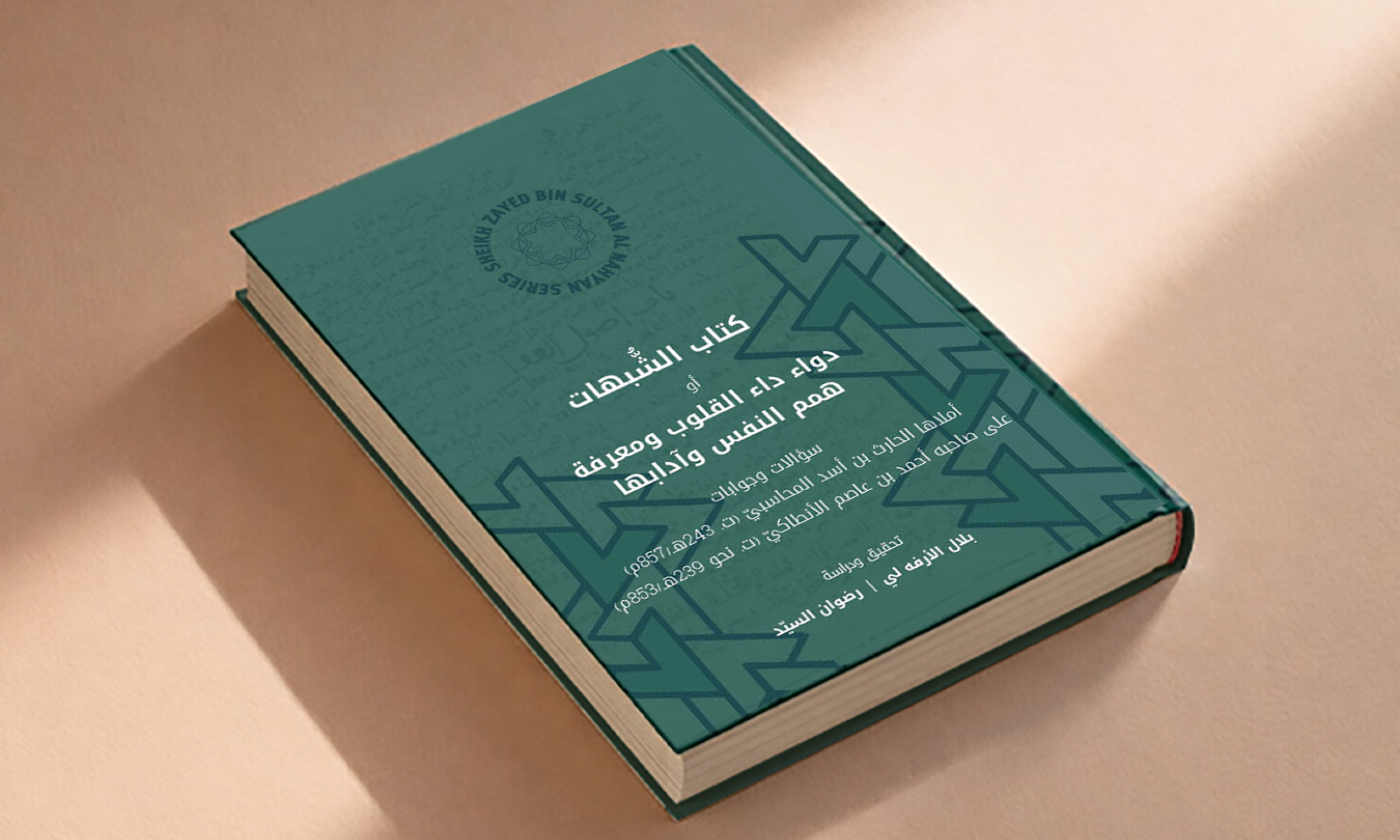
The American University of Beirut (AUB) Press announced the release of Kitāb al-Shubuhāt (The Book of Doubts): A Critical Edition and Study, edited by Professor Bilal Orfali and Professor Ridwan al-Sayyid. Published under the Sheikh Zayed Bin Sultan Al Nahyan Series for Arabic and Islamic Texts and Studies, the new book represents a major contribution to Islamic intellectual history and classical Arabic thought. It introduces a long-lost masterpiece of early Islamic spirituality to modern audiences, combining a meticulously edited Arabic text with a rigorous analytical study by the editors in one volume.
Originally composed in the ninth century by the renowned Islamic thinker al-Ḥārith ibn Asad al-Muḥāsibī (d. 857 CE), Kitāb al-Shubuhāt is a unique work structured in a dynamic question-and-answer format. In this text, al-Muḥāsibī engages in a dialogue with his disciple, Aḥmad ibn ʿĀṣim al-Anṭākī. Together, they explore profound ethical and existential questions that challenged spiritual seekers of their time. The conversation guides readers from doubt and confusion toward certainty and tranquility, reflecting the intellectual and spiritual ethos of early Islamic mysticism. By reviving this text after centuries of obscurity, the new edition fills a crucial gap in early Sufi literature and ascetic thought, shedding fresh light on how classical Muslim scholars grappled with questions of faith, doubt, and moral self-awareness.
This critical edition, prepared through meticulous manuscript scholarship, relies on the sole known manuscript of Kitāb al-Shubuhāt–a Fatimid-era copy (fifth-century Hijri, eleventh-century CE) preserved in AUB’s archives. The manuscript’s provenance and rediscovery add a fascinating historical dimension: it remained hidden in the university’s collection until Professor Orfali identified it in 2009, sparking the sixteen-year journey of research that culminated in this book. In addition to establishing a reliable Arabic text from this rare source, the editors provide an extensive scholarly introduction that examines al-Muḥāsibī’s life and era, unpacks the work’s themes and stylistic nuances, and situates the text within the broader historical context of Islamic thought. The result is a volume that offers both an authoritative edition of the original text and a comprehensive analysis of its significance, underscoring the importance of preserving and critically examining primary manuscripts in advancing our understanding of Islamic heritage.
Equally noteworthy are the scholars behind the publication. Professor Bilal Orfali, Sheikh Zayed Chair of Arabic and Islamic Studies at AUB, is a leading scholar on classical Arabic literature and manuscript culture. Professor Ridwan al-Sayyid is one of the Arab world’s preeminent scholars of Islamic intellectual history, known for his extensive work on the development of Islamic religious and political thought. Together, their complementary expertise—textual analysis and historical interpretation—has ensured that this critical edition meets the highest academic standards. Their collaboration exemplifies the rigorous, cross-disciplinary approach championed by AUB Press in preserving and elucidating Islamic heritage.
The release of Kitāb al-Shubuhāt coincides with a resurgence of scholarly interest in Islamic studies, intellectual history, and textual scholarship. As academics worldwide re-examine foundational texts to better understand the evolution of Islamic thought, this publication serves as a timely and valuable resource. It speaks directly to contemporary debates on early Islamic mysticism and theology, the transmission of knowledge through manuscripts, and the modern interpretation of classical works. With its blend of historical depth and accessible analysis, Kitāb al-Shubuhāt is poised to engage audiences across academia, cultural institutions, libraries, and informed general readers interested in the rich heritage of classical Arabic thought. Through this landmark contribution, AUB Press reaffirms its commitment to enriching global discourse by bringing forth critical editions that bridge the past and the present, ensuring that pivotal works of Islamic intellectual heritage continue to educate and inspire.
About AUB
Founded in 1866, the American University of Beirut bases its educational philosophy, standards, and practices on the American liberal arts model of higher education. A teaching-centered research university, AUB has more than 790 full-time faculty members and a student body of over 9000 students. AUB currently offers more than 140 programs leading to bachelor’s, master’s, MD, and PhD degrees. It provides medical education and training to students from throughout the region at its Medical Center that includes a full-service 365-bed hospital.
Stay up to date on AUB news and events.
aub.edu.lb |Facebook |X