
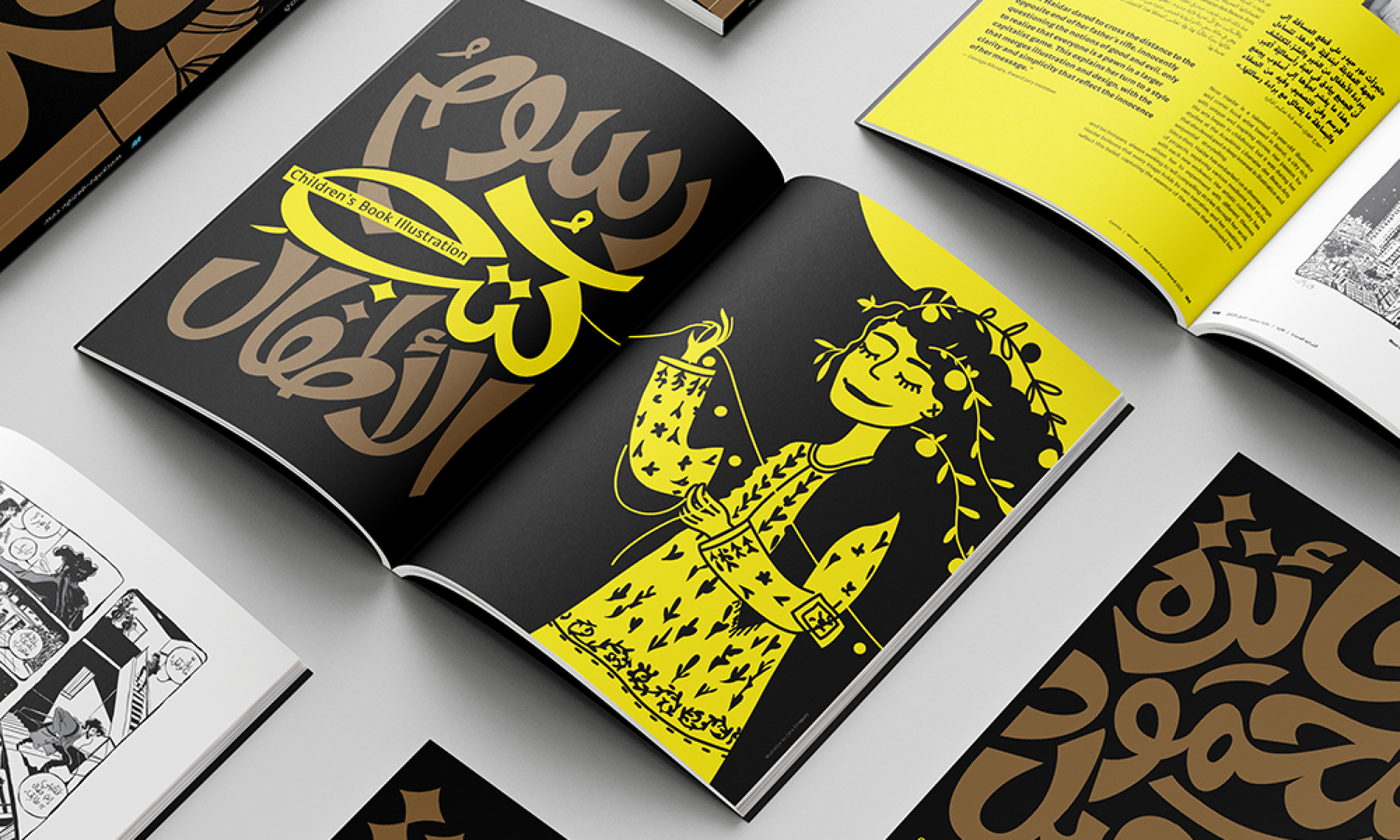
The book and poster series marking the 10th edition of the Mahmoud Kahil Award have won four awards from three of the design world’s leading bodies, recognition that arrives roughly a year after production under wartime conditions in Lebanon.
The Mahmoud Kahil Award is an annual award administered by the Rada and Mutaz Sawaf Center for Arab Comics Studies at the American University of Beirut (AUB), which honors excellence across comics, cartooning, illustration, and children’s book illustration in the Arab world. The 10th edition marked a decade of the award.
The book received a Wooden Pencil from D&AD (Design and Art Direction) in London for its type design and lettering; two awards from Communication Arts, the design and visual arts journal, for the poster series and the book design; and a silver in the Type Directors Club’s newly introduced Type-High Awards in New York, for lettering and book design.
The lead designer was Tarek Atrissi, an AUB graphic design graduate who now runs his own studio in Barcelona and Amsterdam, and whose work includes the visual identity for the Grand Egyptian Museum. The awarded book and poster series were written and edited by Dr. Lina Ghaibeh, comics and animation artist, tenured professor at the School of Architecture and Design at AUB, and founding director of the Rada and Mutaz Sawaf Center for Arab Comics Studies.
Atrissi, who returned to AUB as a visiting professor in 2024, described the edition as a deeply personal project. “It was very special to return to the department where I had studied, this time as a teacher, and to collaborate with Professor Lina Ghaibeh, who had once been my teacher,” he said. “Designing an anniversary edition for AUB carried a great deal of emotional significance, and we approached it with the care and commitment we would give to a project of our own.”
Ghaibeh noted that the D&AD Wooden Pencil award is regarded globally as an elite, rigorous competition with a highly selective judging process, so receiving it is considered a mark of prestige. She also singled out the Communication Arts recognition as particularly meaningful. “It has a very minimal fee to join, which means everybody can apply—you’re competing in the tens of thousands of applicants,” she said. “That’s what makes it such a real honor. It’s the Oscars of design. The more expensive awards mean only big, wealthy companies can apply, but this one is far more democratic—and with that many entries, the final selection is a genuine distinction.”
The recognition is also notable in part because of the circumstances under which the book was made. Production coincided with the escalation of the war in Lebanon in September 2024, during the period when work on the anniversary volume would normally begin. The design was completed on schedule by a distributed team working across Brazil and Europe in continuous cycles across the time zones.
“The war happened in September, October, November—exactly when we would normally be starting the book,” Ghaibeh said. “Because the team had people in Brazil and in Europe, they were working around the clock: half the day here, and then overnight the work would move forward. That’s how we were able to catch up and finish on time, in the middle of everything.”
The 10th edition also departed visually from previous years. Earlier books used a distinct visual identity created by Ghaibeh as the award’s creative director, across all its years—Arabic lettering drawn from the region’s design heritage, paired with a contrasting black and yellow palette. For the anniversary edition, the team introduced gold to mark ten years, while keeping Arabic lettering and calligraphy at the center of the design.
The identity’s central tension lives in a recurring image: the hand. “On the front cover, two raised hands form the number ten and create a celebratory gesture,” Atrissi said. “On the back cover and throughout the book, this is contrasted with the image of a severed hand, reflecting the injuries suffered by children as a result of the war.”
For Ghaibeh, the contrast was deliberate. “We were celebrating, but we were in the middle of a genocide in Palestine, and war across the region. Celebration alone wasn’t enough,” she said. “We’re celebrating, but we’re still mourning.”
Atrissi added that the international recognition mattered especially given where the work was made. “It was particularly gratifying to see work created in Beirut, and rooted so strongly in Arabic visual culture, recognized alongside some of the best design work produced by leading agencies around the world.”
Looking ahead, the 11th edition’s winners will be celebrated at the CairoComix Festival in November 2026, an event postponed from its usual April timing because of the war. The Center is currently open to submissions for the 12th edition of the award.
The 10th Mahmoud Kahil Award book is available at selected bookstores in Lebanon and can be ordered internationally through the AUB Press e-store.
About AUB
Founded in 1866, the American University of Beirut bases its educational philosophy, standards, and practices on the American liberal arts model of higher education. A teaching-centered research university, AUB has more than 790 full-time faculty members and a student body of over 9000 students. AUB currently offers more than 140 programs leading to bachelor’s, master’s, MD, and PhD degrees. It provides medical education and training to students from throughout the region at its Medical Center that includes a full-service 365-bed hospital.
Stay up to date on AUB news and events.
aub.edu.lb |Facebook |X