
From a Beirut neighborhood to a Damascene family library, and a new home for digital humanities research
AUB Press, the publishing house of the American University of Beirut (AUB), announced seven new titles for 2026 and launched a publicly accessible digital humanities platform that aims to make research more widely available and connect scholarship with cultural life beyond the university.
“A university press is judged by how far its books travel,” said Professor Bilal Orfali, director of AUB Press and Sheikh Zayed Chair for Arabic and Islamic Texts and Studies at AUB. “This season we publish the histories of a neighborhood, a city, a family library, a presidency, and a language. And with the digital humanities platform we begin publishing research in a second form, one that can hold what a printed book cannot.”
The Books
The season’s list runs from the oral memory of a Beirut neighborhood to the shelves of an eighteenth-century Damascene family, and from the state-building experiment of a Lebanese president to the politics of Arabic itself. Taken together, the books reflect what the Press understands its work to be: rigorous scholarship in Arabic and English, rooted in this region and addressed to readers well beyond it.
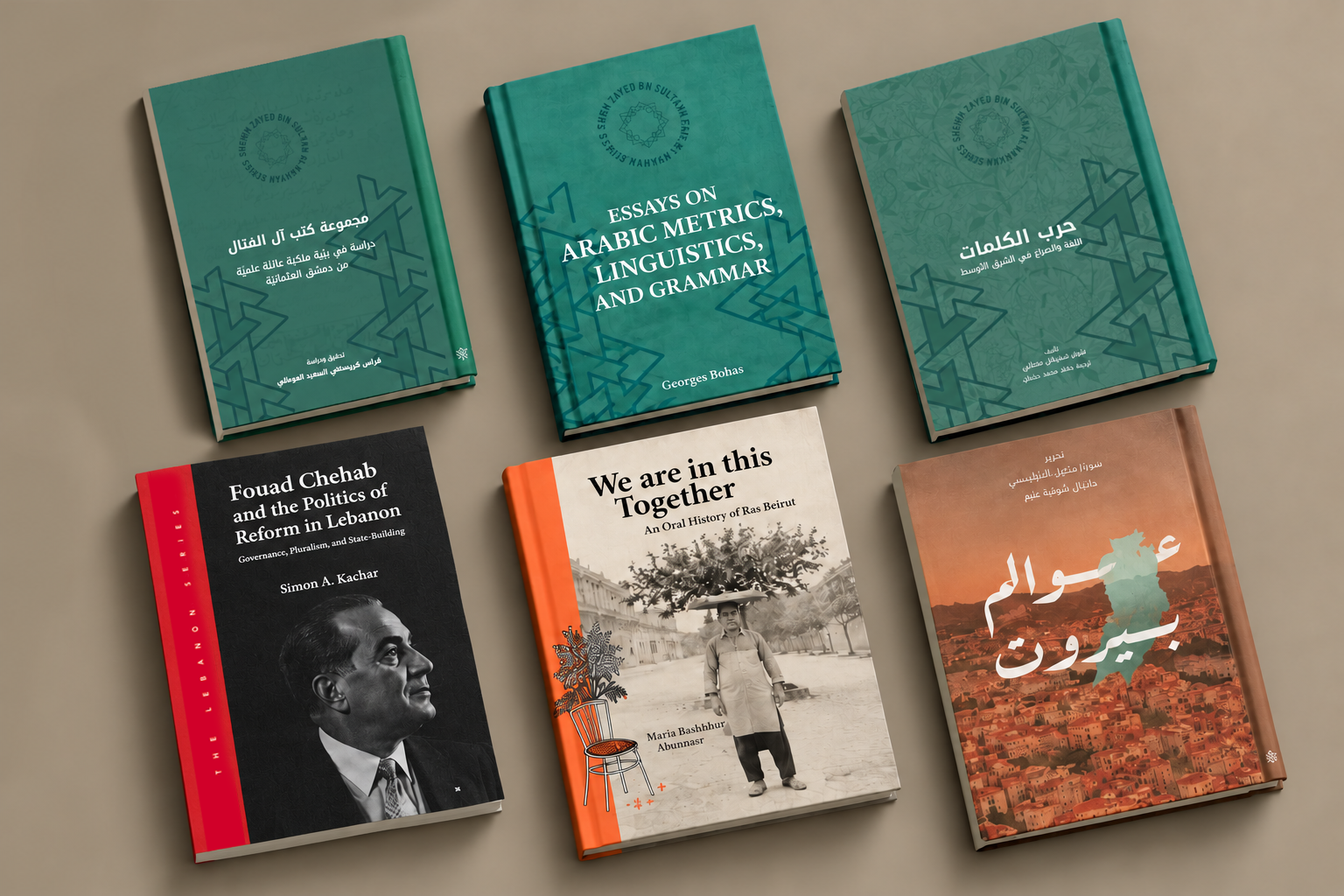
We Are in This Together: An Oral History of Ras Beirut, by Maria Bashshur Abunnasr, gathers a decade of listening. Beginning in 2013, with the support of AUB’s Neighborhood Initiative, Abunnasr recorded the eldest inhabitants of Ras Beirut: shopkeepers, teachers, homemakers, and craftsmen whose memories reach across the twentieth century. The recordings and transcripts now rest in the Archives and Special Collections Department at AUB’s Jafet Library. Twelve chapters move from the days when Ras Beirut was a landscape of orange groves bordered by prickly pear cactus fences with scattered homes overlooking rocky hills. The book interconnected neighbors, housing stories of love and war, stretching from the First World War to the civil war.
ʿAwālim Bayrūt (Worlds of Beirut), edited by Sonja Mejcher-Atassi and Daniel Schönpflug and translated into Arabic by Douraid Rahhal, was first conceived at the Wissenschaftskolleg zu Berlin and now appears in the language of its subject, supported by the Sheikh Zayed Chair for Arabic and Islamic Texts and Studies at AUB. Its chapters hold the many worlds of a city that has never consented to be one thing: Lebanon’s capital, the cultural capital of the wider Arab world, and a place where expression found more room than it found elsewhere. The volume is dedicated to the memory of Elias Khoury. Its cover carries Ibrahim Serbieh’s panoramic view of Beirut from the pine forest, painted in 1867, one year after the University opened its doors.
Fouad Chehab and the Politics of Reform in Lebanon: Governance, Pluralism, and State-Building, by Dr. Simon A. Kachar, appears in the Press’s Lebanon Series. Kachar, lecturer in political studies at AUB and founding director of its Good Governance and Citizenship Observatory, moves past nostalgia and conventional biography to read Chehabism as a working philosophy of government, rooted in the Constitution, strong institutions, citizenship, social justice, balanced development, and respect for Lebanon’s pluralism. Drawing on archival research and interviews with those who knew Chehab, the book follows the story beyond his presidency to Taif and to the constitutional questions the country still lives inside. At its heart is a question as urgent now as it was in 1958: How can a deeply pluralistic society build a strong state without giving up the diversity that defines it?
Essays on Arabic Metrics, Linguistics, and Grammar by Georges Bohas brings together four studies in Arabic linguistics. The first turns to metrics, offering a simple method for identifying the sixteen meters of classical Arabic poetry and surveying the metric sequences of the Qurʾānic text. The second proposes an analysis of hollow and defective verbs built on the concrete stem rather than on the abstract representations of the Arab grammarians. The third and largest sets out the theory of matrices and etymons (TME), demonstrates through Semitic and Romance languages that submorphemic units are not ordered, and shows how TME explains homonymy in the Arabic lexicon. The fourth returns to the Arab grammatical tradition, from Ibn Khaldūn’s account of the linguistic situation of his time to the motivation of the linguistic sign in the work of grammarians, rhetoricians, Qurʾān commentators, and jurists. It argues that the grammarians never developed the concept of the morpheme, and that derivation for them ran from word to word, mingling the concrete with the abstract.
Harb al-Kalimāt is the Arabic translation of A War of Words: Language and Conflict in the Middle East by Yasir Suleiman, Emeritus Sultan Qaboos bin Said Professor of Modern Arabic Studies at the University of Cambridge. First published by Cambridge University Press in 2004, the book asks how language becomes an instrument of political and national conflict: when a standard language meets its challengers, when dialects collide, and when languages confront one another across a contested frontier. Suleiman’s argument reaches Arabic readers here in their own language, which is precisely the point of the book. The translation is by Jihad Hamdan.
Majmūʿat Kutub Āl al-Fattāl (The Book Collection of the Fattāl Family: A Study in the Structure of a Scholarly Family Library in Ottoman Damascus), by Feras Krimisti and Said al-Joumani, reconstructs the library of a Damascene scholarly family across four generations. Its starting point is a single list of roughly 240 volumes endowed by Amīn al-Fattāl, which reached Europe through the Austrian orientalist and diplomat Alfred von Kremer and is edited and published here for the first time. Around that list, the study builds a social history of books: how a teaching family assembled a collection, how the law of endowing books actually worked in Ottoman Ḥanafī practice rather than in pious summary, and where Damascene libraries went when families fell from the scholarly world. The question that drives the book has not lost its force. Several volumes belonging to Khalīl al-Fattāl and his family now sit in the AUB Libraries, alongside the personal library of Saadallah Wannous, brought to Beirut in 2015 to save it from Syria’s war.
The Digital Humanities Platform
Alongside its books, AUB Press launched a digital platform that gathers its digital work into a single open archive. Open to public access, it holds three kinds of material: open-access publications, free to download; a growing multimedia library of recorded talks and workshops; and specialized digital humanities projects. The continuously growing platform is at www.aub.edu.lb/aubpress/Pages/digital.aspx.
The first of its specialized projects is the Mohammad Ramadan Project, devoted to Hajj Muhammad Darwish Ramadan (1918–2000), known across the capital as muqriʾ Bayrūt, the Qurʾān Reciter of Beirut. His life is a story deeply intertwined with Beirut that the city’s written histories have largely passed over. Orphaned young and raised in severe poverty, he taught himself to read before completing the memorization of the Qurʾān. He rose from work as a plumber to become a successful businessman, and spent what he earned building and restoring the city’s mosques. He then gave himself to teaching, instructing hundreds of students in Qurʾānic recitation and refusing payment from any of them. Generations of Beirut’s memorizers and leading sheikhs passed through his lessons. He was known for his Naqshbandī devotion and for a personal discipline his students still describe, and after his death his children carried the work forward in the Islamic sciences and in medicine, serving those in need.
The project is an audio archive: Its recordings are semantically indexed and digitally searchable, preserving the living voice, with the emotional nuance that text alone cannot carry, and keeping these primary sources discoverable to scholars worldwide. It sits on the platform alongside the Press’s open-access titles and recorded events, and can be consulted at www.aub.edu.lb/aubpress/Pages/m_ramadan.aspx.
The Press’s reasoning is simple. Not every form of knowledge fits a printed book, and some of what matters most in a city’s life was never written down in the first place. A recitation, a teaching lineage, a photograph, a voice: These are records too, and a university press has a duty to keep them.
About AUB
Founded in 1866, the American University of Beirut bases its educational philosophy, standards, and practices on the American liberal arts model of higher education. A teaching-centered research university, AUB has more than 800 full-time faculty members and a student body of over 9,700 students. AUB currently offers more than 140 programs leading to bachelor’s, master’s, MD, and PhD degrees. It provides medical education and training to students from throughout the region at its Medical Center, which includes a full-service 365-bed hospital.
Stay up to date on AUB news and events.
aub.edu.lb |Facebook |X
About AUB Press
AUB Press is the publishing arm of the American University of Beirut, founded in 1866. It publishes scholarship in Arabic and English across literature, history, and the arts and sciences, including the Sheikh Zayed Series for Arabic and Islamic Texts and Studies, the Sheikh Zayed Series on Art in the Arab and Islamic Worlds, as well as the Comics and Graphic Narrative from the Arab World Series. It publishes the journal al-Abhāth, in its seventy-sixth year, and the Beirut Art Review. The Press welcomes proposals from scholars, translators, and editors.