
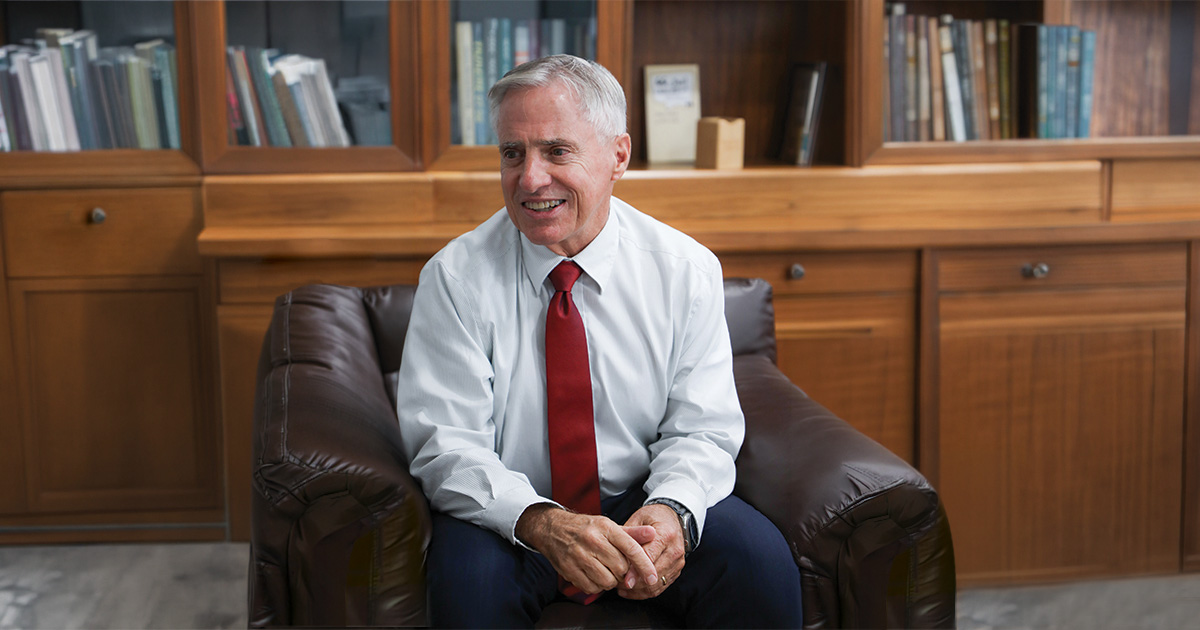
The university’s academic leader on why he chose LAU, what he means by “students first,” the future of research, and the essential tools that need to be embedded in teaching.
When Dr. Gregory L. Heileman talks about why he became LAU’s new Provost and Executive Vice President for Academic Affairs, he does not delve into a strategic plan. He starts with people and impact.
Reflecting on a career that has taken him from the classroom to the research lab, and on to the highest levels of academic administration, he believes that the thread that runs through all of these roles is students.
“My vision for academic leadership is serving our students best by creating an outstanding institution that has value for them while they’re here, but also when they leave.”
Rather a simple idea, but one that Dr. Heileman has built an entire career around, along with a distinctive read on impact, ambition, and what makes a university a launchpad for students’ careers.
Dr. Heileman assumed his role on September 1, 2026, arriving at LAU with more than two decades of academic leadership experience: Most recently as vice provost for Academic Affairs and a professor of Electrical & Computer Engineering at the University of Arizona, where he oversaw undergraduate education and academic affairs since 2019. Before that, he held vice provost and associate provost roles at the University of New Mexico, where he helped drive record retention and graduation rates, and at the University of Kentucky, where he served as the university’s chief Student Affairs officer.
At LAU, he is responsible for elevating research productivity and advancing interdisciplinary initiatives by leading faculty recruitment and development, and steering a digital transformation that integrates AI into learning and research.
Asked why he chose LAU at this moment in his career, Dr. Heileman expressed his hope to finish his career at an institution where he could have an impact.
“[LAU] is a place where the strategies about building a global brand and moving this institution forward make it a unique opportunity for me to have a larger impact,” he said, pointing to LAU’s Board of Trustees as a decisive factor: “The support that they are providing to the university is really creating the conditions to make positive change.”
From an academic standpoint, Dr. Heileman believes that interdisciplinary research is the future, arguing that the era of the single-domain expert has passed.
“One’s ability to communicate with somebody else who has domain knowledge in a different area, and put them together to solve a problem is critical in today’s environment. That is how advances are increasingly being made,” he explained.
This does not come naturally to most researchers, however, and Dr. Heileman sees an opportunity in actively promoting research collaborations and rewarding them through funding.
On AI and the future of teaching, Dr. Heileman rejects the framing of AI as a classroom disruptor.
“The students arriving on campus over the next few years,” he pointed out, “would have never known a world without it. For them, it’s infrastructure. It’s like turning on a light.”
The real challenge, he argued, falls on faculty: “It is really hard [for them] because they are constantly having to change how they teach.” Integrating AI in the curriculum and using it to sharpen LAU’s own operations will be the answer, in his view.
Dr. Heileman is equally direct about experiential learning: “It has to be embedded in the curriculum,” he affirmed, advocating for tracking high-impact practices—such as study abroad, research experience, entrepreneurial ventures, volunteerism, among others—as seriously as GPA.
This reasoning is part of identifying the culture at LAU, and in Lebanon more broadly, as “distinctly entrepreneurial,” and Dr. Heileman sees an opportunity to connect students more directly to mentors, the industry, and the networks that turn a class project into a startup.