
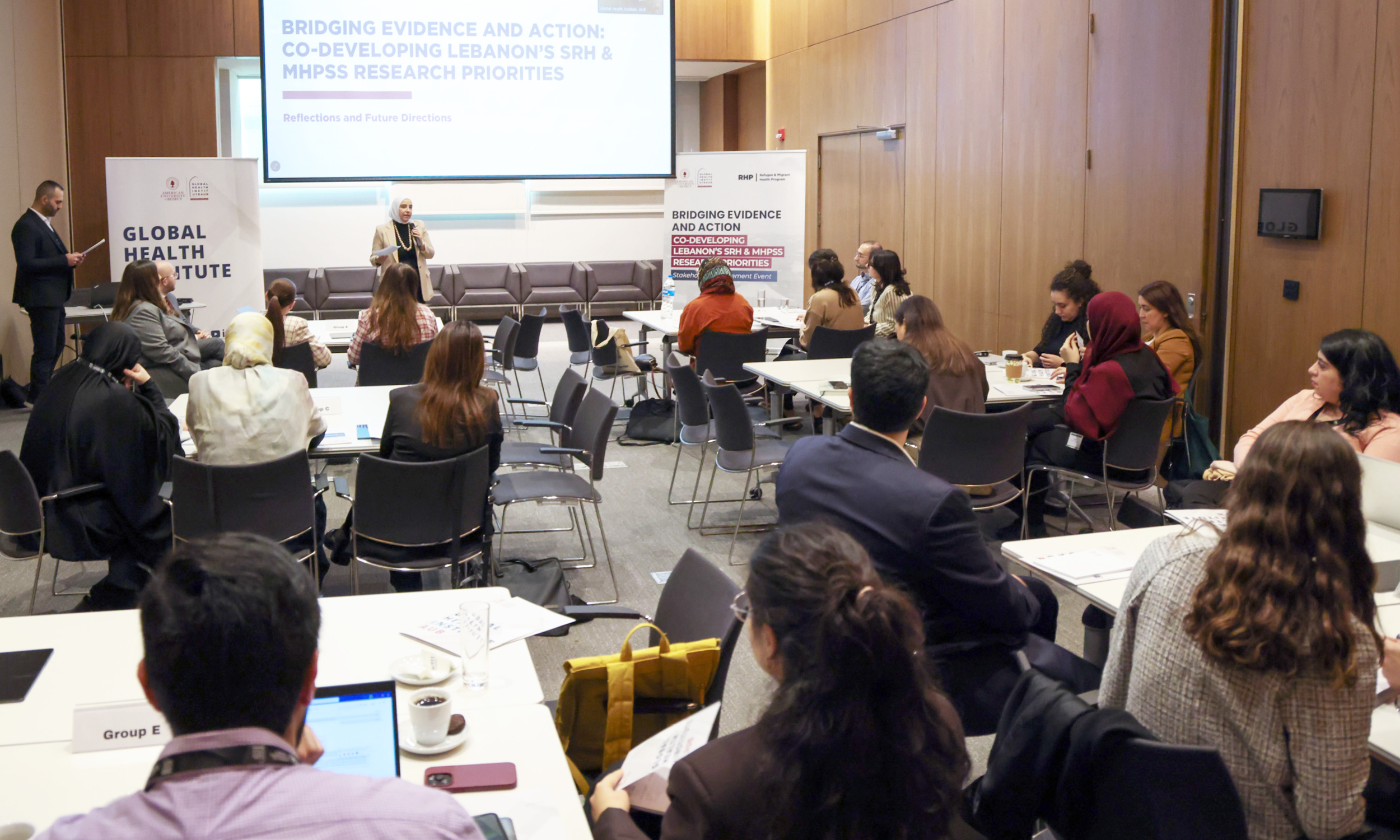
The Refugee and Migrant Health Program at the American University of Beirut (AUB), in collaboration with the World Health Organization (WHO) headquarters, convened a national stakeholder engagement workshop at AUB, bringing together key actors, including representatives from government, nongovernmental organizations, and the research community to strengthen evidence-informed approaches to sexual and reproductive health (SRH) and mental health and psychosocial support (MHPSS) for refugee and migrant populations in Lebanon.
The workshop served as a strategic platform to review current research and programming, including findings from the SEEK trial, and to facilitate cross-sector dialogue on priority gaps, coordination challenges, and opportunities for integration. Participants engaged in structured discussions aimed at aligning research efforts with national health strategies and policy needs, while identifying pathways to enhance the relevance, inclusivity, and sustainability of interventions targeting refugee and migrant populations.
Key discussions underscored the importance of inclusive service design, stronger intersectoral coordination, and improved linkage between community-based interventions and health systems. Stakeholders also emphasized the need for sustained investment in evidence generation, better understanding of community barriers to care, and clearer integration models between SRH and MHPSS services.
The workshop concluded with a set of shared priorities to guide future research, collaboration, and programmatic action, reinforcing a collective commitment to advancing integrated, equitable, and sustainable health responses for vulnerable populations in Lebanon.
About AUB
Founded in 1866, the American University of Beirut bases its educational philosophy, standards, and practices on the American liberal arts model of higher education. A teaching-centered research university, AUB has more than 790 full-time faculty members and a student body of over 9000 students. AUB currently offers more than 140 programs leading to bachelor’s, master’s, MD, and PhD degrees. It provides medical education and training to students from throughout the region at its Medical Center that includes a full-service 365-bed hospital.
Stay up to date on AUB news and events.
aub.edu.lb |Facebook |X
About GHI
The Global Health Institute (GHI) at the American University of Beirut (AUB) addresses global health challenges with a focus on context and sustainable impact by employing an interdisciplinary approach. GHI is structured into three divisions: The Programs Division, which leads research, policy, and advocacy efforts; the Academy Division, which provides capacity-building initiatives for diverse populations; and the ASSIST Division, which supports community-level actors, particularly nongovernmental organizations, with a range of services and resources.