
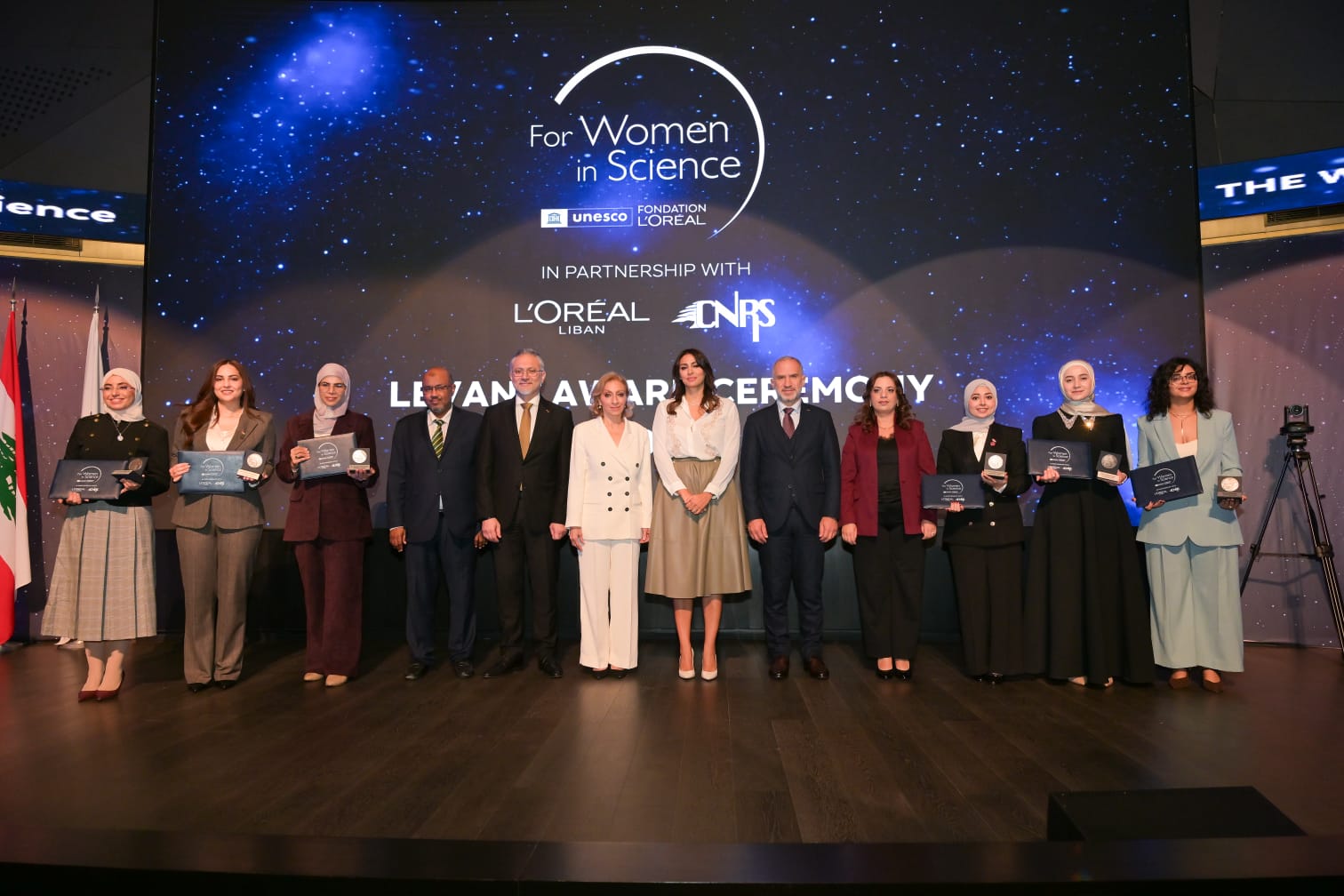
107 Levant women honoured since 1998, including 88 through the regional programme launched in 2014 and 3 Lebanese women honoured as International Laureates in Paris.
Beirut, Lebanon, 12 November 2026 – The L’Oréal-UNESCO For Women in Science Levant programme celebrated its thirteenth edition during an official ceremony hosted at the Middle East Airlines (MEA) Training Center in Beirut. Held for the second consecutive year under the high patronage of Her Excellency Ambassador Sahar Baassiri Salam, the event brought together ministers, ambassadors, academic leaders, and members of the scientific community to honour six visionary Arab women researchers — three postdoctoral fellows and three PhD candidates — whose groundbreaking work is shaping the future of research across the region. The ceremony reaffirmed the programme’s founding conviction: The world needs science, and science needs women.
Speaking at the ceremony, Her Excellency Ambassador Sahar Baassiri Salam, Patron of the edition, stressed that women’s success in science must not remain an exception to be celebrated, but the result of fair opportunities and institutions, stating: “Women’s presence in the history of science in the Arab world is not new — what is new is giving them the place they deserve in its future. We have great scientific talent, but the challenge is investing in it to match that ambition. Applauding our researchers is not enough; we must give them real opportunities to progress. We do not want women simply present in a future others build — we want them as partners in building it, supported by institutions that guarantee fairness in funding, advancement, and leadership. Only then will we stop wondering what women could give the world, and start seeing what they build in it.”
According to UNESCO, women represent 31.1% of researchers worldwide. In the Arab States, that figure rises to 41.4% — up from 36.1% a decade ago — yet even there, true parity remains a distant goal, with women still underrepresented in senior and leadership roles. It is against this backdrop of a persistent global gender gap that the L’Oréal-UNESCO For Women in Science programme, designed by the Fondation L’Oréal and UNESCO since 1998, continues its mission to make women’s scientific excellence visible. To date, the programme has supported more than 5,000 women researchers across over 140 countries.
In the Levant, the dedicated regional track launched in 2014, in partnership with the UNESCO Regional Bureau in Beirut and CNRS-Lebanon, has empowered 88 female researchers across Lebanon, Jordan, Syria, Iraq, and Palestine. Together with researchers honoured earlier through the global programme, 107 Levant scientists have been recognised since 1998, among them 3 Lebanese International Laureates in Paris.
To foster academic autonomy and accelerate their research, the programme awarded direct endowments of €10,000 each to three postdoctoral fellows and €6,000 each to three doctoral candidates, providing critical support at decisive stages of their scientific careers.
Mrs. Emilie Wahab Harb, Managing Director of L’Oréal Liban, stated: “In a region marked by challenges and uncertainty, our women scientists continue to demonstrate that scientific excellence knows no borders, and ambition has no gender. As artificial intelligence and biotechnology reshape our world, women remain underrepresented, accounting for only 22% of professionals in AI and technology. The future of science cannot be built without women, and their talent deserves not only recognition but a place where decisions are made. At L’Oréal Liban, we are proud to have recognized 107 outstanding women scientists across the Levant since the programme’s inception, supporting their research, amplifying their voices, and helping their ambitions become opportunities. Because the world needs science, and science needs women”.
The selection process was conducted with rigorous academic scrutiny by an independent jury of 14 distinguished scholars chaired by Professor Marie Abboud Mehanna, ensuring international standards of excellence and transparency.
Distinguished guests, including Mr. Paolo Fontani, Director of the UNESCO Regional Bureau in Beirut, Dr. Assaad Eid, President of the National Council for Scientific Research in Lebanon (CNRS-Liban), and Dr. Chadi Abdallah, Secretary General of CNRS-Liban, joined the award ceremony, affirming the collaborative spirit behind this initiative. Hosted by Aurore Karam, the evening welcomed over 300 attendees, including diplomatic, social, and economic figures, as well as representatives from academic, scientific, and research institutions.
Meet the 2026 Levant Laureates and their Fields of Research
Postdoctoral Laureates (€10,000 Endowment):
- Dr. Amal Yousfan (Syria) – Al-Andalus University for Medical Sciences, Faculty of Pharmacy: Developing immune-targeted phospholipid nanoparticles and using machine learning to predict their distribution along the lung–spleen axis and their effects on immune responses, while reducing reliance on animal experiments.
- Dr. Rana Elnaklah (Jordan) – Al-Ahliyya Amman University, Faculty of Architecture and Design: Transforming agricultural residues, including olive pomace and wheat straw, into eco-friendly thermal insulation panels for buildings, reducing energy consumption and enhancing indoor air.
- Dr. Sarah Mantash (Lebanon) – American University of Beirut (AUB), Faculty of Medicine: Investigating how blast-induced neurotrauma alters cellular and epigenetic programs, and whether these changes affect neurological health across generations, to uncover mechanisms of long-term vulnerability and resilience.
PhD Laureates (€6,000 Endowment):
- Rhea Kahale (Lebanon) – Saint Joseph University of Beirut (USJ), Faculty of Science: Reconstructing thousands of years of interaction between people and Mediterranean landscapes to understand how forests and biodiversity withstand climate change and human pressure, and to inform their conservation for future generations.
- Sura Khaled Nashwan (Jordan) – The University of Jordan, Faculty of Science: Pioneering a non-invasive routine blood test for the early detection of lung cancer, eliminating the need for invasive surgical biopsies and opening life-saving diagnostic pathways.
- Dr. Tabarek Al-Rubaye (Iraq) – American University of Iraq–Baghdad, Faculty of Dentistry: Investigating the accuracy of advanced 3D intraoral scanning and photogrammetry techniques to improve treatment outcomes for patients with complete tooth loss receiving implant-supported restorations.