
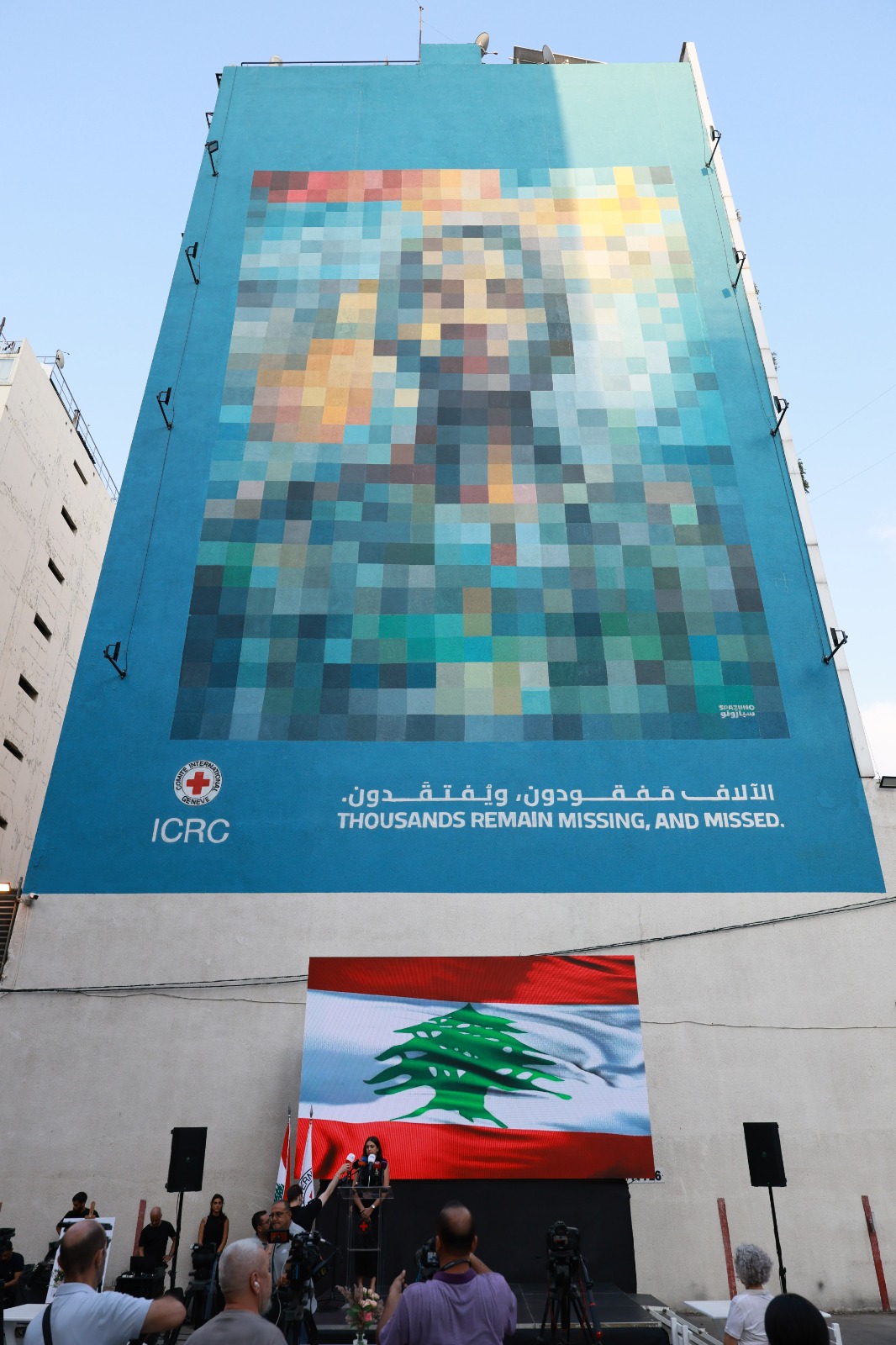
Beirut, 20 August 2026: The International Committee of the Red Cross (ICRC) unveiled a new mural in Beirut on August 19th, 2026, keeping the cause of the missing alive in the collective memory and shedding light on the suffering of thousands of families who, decades later, continue to wait for answers about the fate and whereabouts of their loved ones.
The unveiling took place on World Humanitarian Day, 19 August, as the International Day of the Disappeared-on 30 August approaches. The event brought together representatives of the Committee of the Families of the Kidnapped and Disappeared in Lebanon (CFKDL), the National Commission for the Missing and Forcibly Disappeared, and the ICRC, alongside partners, supporters, guests, media representatives and artists who stand in solidarity with the cause.
The mural captures the profound uncertainty experienced by families of missing persons. Composed of hundreds of colored squares, it forms an almost complete human figure when viewed from a distance, yet appears increasingly fragmented as the viewer draws closer. The visual metaphor reflects the fragile boundary between presence and disappearance, memory and uncertainty, and the families’ ongoing search for information or traces that may finally lead to answers.
Wadad Halawani, President of the Committee of the Families of the Kidnapped and Disappeared in Lebanon, said:
“For four and a half decades, we, the CFKDL, have continued to demand our right to know the fate of our loved ones. Our struggle has made significant progress with the adoption of the Law on Missing and Forcibly Disappeared Persons. What remains crucial now is its implementation, through the dedicated efforts of the National Commission established for this purpose. This right must not remain a demand that concerns us alone. It is a human right, and an essential necessity for confronting the past, learning from it, and ensuring it is never repeated.”
Judge Joseph Samaha, President of the National Commission for the Missing and Forcibly Disappeared, said:
“The work of the National Commission faces a wide range of challenges and difficulties, which the Commission is working to overcome with the assistance of supportive public officials and those engaged in public affairs, as well as social and humanitarian work, both in Lebanon and abroad. It is clear that bringing these efforts together and coordinating them provides a valuable momentum and an added value to the work of the National Commission, while strengthening its efforts to clarify the fate of missing persons.”
Jan Miskoc, Deputy Head of the ICRC Delegation in Lebanon, said:
“The ICRC has worked alongside families of missing persons in Lebanon for decades and remains committed to supporting their search for answers. Today, we continue this work in close cooperation with the families, the Committee of the Families of the Kidnapped and Disappeared in Lebanon, and the National Commission for the Missing and Forcibly Disappeared.”
The mural project was developed in collaboration with a group of graphic design students from the Lebanese American University (LAU), who took part in a creative competition exploring the stories of missing persons and translating them into visual form. Inspired by their work, graffiti artist Spaz created the large-scale mural on the wall of the building housing the ICRC Delegation in Hamra.
For decades, the ICRC has worked alongside families of missing persons in Lebanon and remains committed to supporting them in their search for answers. The ICRC also continues to support efforts to enable the National Commission to effectively fulfil its humanitarian mandate. The adoption of Law 105 and the establishment of the National Commission for the Missing and Forcibly Disappeared represent two important steps towards preserving the families’ right to know the fate of their loved ones.
By placing the mural at the heart of Beirut, the ICRC seeks to ensure that the stories of missing persons and their families remain part of the collective memory, while reminding us that the passage of time does not erase their suffering or diminish their right to answers.
Behind every missing person is a story and a family that is still waiting.