
- Organised by the Department of Culture and Tourism – Abu Dhabi (DCT Abu Dhabi) under the artistic direction of Elvira Dyangani Ose, the Biennial’s second edition, Home: A Glossary for a Communal Sense of Place, opens in Al Ain on 23 October 2026.
- On view – 4 new site-specific commissions by M‘barek Bouhchichi, Reena Saini Kallat, Asunción Molinos Gordo and Roudhah Al Mazrouei, ahead of the opening in Abu Dhabi on 15 November.
Al Ain, UAE – 26 October 2026: The second edition of the Public Art Abu Dhabi Biennial, organised by the Department of Culture and Tourism – Abu Dhabi (DCT Abu Dhabi), has opened in Al Ain. Presented under the theme Home: A Glossary for a Communal Sense of Place, the Al Ain chapter brings four newly commissioned works to Al Qattara Oasis, part of the UNESCO World Heritage cultural landscape of Al Ain, and to Al Towayya Roundabout, placing contemporary art within working farms, historic irrigation networks and the everyday routes of the city. The Al Ain works remain on view until 15 February 2027, with the Biennial opening across Abu Dhabi on 15 November 2026.
Under the artistic direction of Elvira Dyangani Ose, Artistic Director of Zeitz Museum of Contemporary Art Africa (MOCAA), the second edition approaches the concept of ‘home’ as an evolving, collective and plural condition rather than a static geographic site. Through distributed commissions, research-led practices and public encounters, the Biennial prioritises sustained engagement, inviting audiences to interact with art in their everyday spaces. The title proposes that what communities share in relation to Abu Dhabi is not the place itself, but the capacity to construct meaning in relation to it, through the diverse vocabularies, practices and forms of knowledge that the glossary is designed to hold.
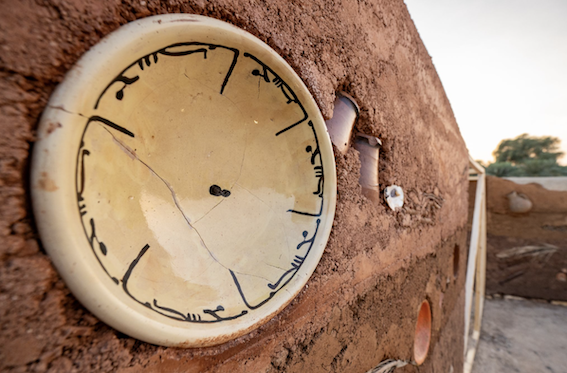
At Al Qattara Oasis, Moroccan artist M‘barek Bouhchichi presents ‘I am not the stone thrown into the water, but the seed sown in the field’ (2026), a stainless-steel work that reimagines the pigeon tower, a vernacular architecture found from North Africa to the Emirates, as a space of refuge and passage. Taking its title from Tayeb Salih’s Season of Migration to the North, the work carries a poem from Al Nahma, the traditional Emirati sea shanties sung by sailors, rendered in Braille across its structures. Nearby, Indian artist Reena Saini Kallat’s Thresholds: Requiem (The Last Call) (2026) reimagines twentieth-century acoustic locators, once designed to detect distant aircraft, as vessels for the calls of extinct and critically endangered bird species, several of which are native to, or migrate through, the UAE and the Arabian Peninsula. Spanish artist Asunción Molinos Gordo’s Bil Hana wa Al Afia (2026) centres on Al Aflaj, the traditional irrigation systems that originated during the Iron Age and continue to support shared water distribution among farmers in the Emirates. Built from rammed-earth walls arranged in a root-like form, its seven stratigraphic layers incorporate pottery, artefacts and other material traces from different historical periods, set among the working farms of the oasis.
At Al Towayya Roundabout, Emirati artist Roudhah Al Mazrouei, born in Al Ain, presents Tassa (2026), an 80-metre-diameter sculpture that reimagines the traditional Emirati gold headpiece as a monumental public landscape. Drawing on heirloom jewellery passed down through generations, the work transforms its cascading chains, curved forms and ornamental details into an immersive environment. Developed through conversations and workshops with children, Tassa proposes heritage as something lived, shared and continually reimagined.
Elvira Dyangani Ose, Artistic Director, Public Art Abu Dhabi Biennial 2026–27, said: “What do we mean when we say home? It is one of the most used terms in any language, and yet many aspects of it often go unexamined. Home is not only a location. It is a condition: felt before it is understood, carried in the body before it is articulated in language. Al Ain is where this edition begins, in an oasis landscape shaped over millennia by cooperation, shared water and collective care. We offer this Biennial as a glossary, not as a guide to correct interpretations but as a set of terms to think with. The definitions are partial by design, and yours to complete.”
The Al Ain chapter inaugurates the Biennial’s second edition, which continues across Abu Dhabi from 15 November 2026 with further commissions, research-led projects and a public programme, details of which will be announced in the coming weeks. The second edition builds on the inaugural Public Art Abu Dhabi Biennial, Public Matter (2024–25), which presented site-specific commissions by artists from the UAE and around the world. Several works from the first edition have since been acquired or retained as long-term installations, contributing to the emirate’s growing public art collection.
The Public Art Abu Dhabi Biennial is on view in Al Ain from 23 October 2026 to 15 February 2027 and in Abu Dhabi from 15 November 2026 to 15 February 2027. All works are free to visit.
About Public Art Abu Dhabi
Public Art Abu Dhabi is the Department of Culture and Tourism – Abu Dhabi (DCT Abu Dhabi)’s initiative under its ongoing commitment to commissioning public art for the emirate. Integral to this initiative is its community engagement efforts. The initiative advances the creative legacy, cultural infrastructure, liveability, and well-being of the UAE capital’s residents through placemaking and collective memory. The initiative is anchored by two flagship programmes: the Public Art Abu Dhabi Biennial and MANAR Abu Dhabi.
The 2026–2027 edition brings together 21 visionary artists presenting public artwork installations that explore urbanscapes, collective memory, material culture and civic participation through monumental, interactive and multi-sensory works.
Bringing together prominent Emirati and International artists, the roster includes – Akram Zaatari, Asunción Molinos Gordo, blaxTARLINES, Céleste Boursier-Mougenot, Elena del Rivero, Ibrahim Mahama, Iván Argote, Jean-Marie Appriou, Kapwani Kiwanga, Khalid Al Banna, Laure Prouvost, Marinella Senatore, M’barek Bouhchichi, Mercedes Azpilicueta, Nari Ward, Reena Saini Kallat, Roudhah Al Mazrouei, Shama Al Hamed, Serge Attukwei Clottey, Vica Pacheco, and Yinka Shonibare.
Across Abu Dhabi and Al Ain, the Biennial will unfold across a range of public and cultural locations, including Mina Zayed (MiZa), Souq Al Mina, Saadiyat Cultural District (the park between Zayed National Museum and Louvre Abu Dhabi), Hidd Al Saadiyat and selected locations across Al Ain, embedding contemporary art within the emirate’s diverse urban and cultural landscapes.
For more information please visit: paad.ae
About the Department of Culture and Tourism – Abu Dhabi
The Department of Culture and Tourism – Abu Dhabi preserves, protects, and promotes the emirate’s cultural heritage while fostering creativity and innovation across the cultural and creative industries. Through its initiatives and partnerships, DCT Abu Dhabi supports cultural development, strengthens identity, and positions Abu Dhabi as a global cultural destination.
For more information about the Department of Culture and Tourism – Abu Dhabi and the destination, please visit: dct.gov.ae and abudhabiculture.ae
Annex A: List of Participating Artists, Al Ain
Al Qattara Oasis
M’barek Bouhchichi (b. 1975, Akka, Morocco. Lives and works in Tahannaout, Morocco)
Reena Saini Kallat (b. 1973, New Delhi, India. Lives and works in Mumbai, India)
Asunción Molinos Gordo (b. 1979, Guzmán, Burgos, Spain. Lives and works between Egypt, Oman and Spain)
Al Towayya Roundabout
Roudhah Al Mazrouei (b. 2003, Al Ain, UAE. Lives and works in Abu Dhabi, UAE)
Annex B: Artist Biographies and Artwork Descriptions
Al Qattara Oasis
M’barek Bouhchichi (b. 1975, Akka, Morocco. Lives and works in Tahannaout, Morocco)
M’barek Bouhchichi’s practice explores identity, memory, and overlooked histories through forms that foreground visibility, heritage, and belonging.
‘I am not the stone thrown into the water, but the seed sown in the field’
2026. Stainless steel, 0.96 × 1.93 × 5 metres. Commissioned by the Department of Culture and Tourism – Abu Dhabi for the Public Art Abu Dhabi Biennial 2026–2027. Courtesy of the artist and Selma Feriani Gallery.
‘I am not the stone thrown into the water, but the seed sown in the field’ (2026) reimagines the pigeon tower, vernacular architecture found from North Africa to the Emirates, as a space of refuge and passage.
Borrowing its title from Tayeb Salih’s Season of Migration to the North, the work reflects on movement and memory, treating the past as material for imagining the future. A poem from Al Nahma, traditional Emirati sea shanties, or work songs sung by sailors, unfolds in Braille through holes and wooden logs across the structures, translating maritime oral heritage into a tactile language of memory and movement.
Reena Saini Kallat (b. 1973, New Delhi, India. Lives and works in Mumbai, India)
Reena Saini Kallat’s multidisciplinary practice explores borders, memory, migration, and ecological interdependence through works that connect personal histories with broader social and environmental questions.
Thresholds: Requiem (The Last Call)
2026. Lacquered mild-steel sculpture, two-channel audio (3 minutes each). Sculpture 1: 4.8 × 2 × 2.1 metres; Sculpture 2: 3.6 × 8.1 × 1.7 metres. Courtesy of the artist.
Thresholds: Requiem (The Last Call) (2026) reimagines twentieth-century acoustic locators, once designed to detect distant aircraft, as vessels for the calls of extinct and critically endangered bird species. Several of the species are native to, or migrate through, the UAE and the Arabian Peninsula.
Situated within Al Qattara Oasis, part of Al Ain’s UNESCO World Heritage cultural landscape, the installation transforms a surveillance device into an act of listening, reflecting on ecological memory, loss, and our shared responsibility to care for the environments we call home. The work evokes the fragile threshold between survival and extinction, recalling what has already been lost while drawing attention to lives that may yet be protected.
Asunción Molinos Gordo (b. 1979, Guzmán, Burgos, Spain. Lives and works between Egypt, Oman and Spain)
Asunción Molinos Gordo’s research-based practice draws on anthropology and sociology to explore contemporary rural life and the knowledge embedded within farming communities.
Bil Hana wa Al Afia
2026. Rammed earth, drystone, mirror, ceramic, artefact, mixed-media object. Dimensions variable. Commissioned by the Department of Culture and Tourism – Abu Dhabi for the Public Art Abu Dhabi Biennial 2026–2027. Courtesy of the artist.
Bil Hana wa Al Afia (2026) centres on Al Aflaj, traditional irrigation systems that originated during the Iron Age and continue to support shared water distribution among farmers in the Emirates. Built from rammed-earth walls arranged in a root-like form, the installation evokes the inner structure of these irrigation networks. Seven stratigraphic layers represent different historical periods, incorporating pottery, artefacts, and other material traces from each era.
Located within Al Qattara Oasis, a component of the UNESCO World Heritage Site of Al Ain, the installation coexists with working farms and daily irrigation practices, paying tribute to a living waterscape shaped by cooperation, equitable access, and collective care.
Al Towayya Roundabout
Roudhah Al Mazrouei (b. 2003, Al Ain, UAE. Lives and works in Abu Dhabi, UAE)
Roudhah Al Mazrouei’s practice explores cultural memory and ecological heritage through forms rooted in the landscapes and traditions of the Emirates.
Tassa
2026. Galvanised steel, fibreglass, paint. 80 metres diameter. Commissioned by the Department of Culture and Tourism – Abu Dhabi for the Public Art Abu Dhabi Biennial 2026–2027. Courtesy of the artist.
Tassa (2026) reimagines the traditional Emirati gold headpiece as a monumental public landscape. Drawing on heirloom jewellery passed down generations, the work transforms its cascading chains, curved forms, and ornamental details into an immersive environment that unfolds across an Al Ain roundabout. Rather than preserving these forms as static symbols of heritage, the sculpture invites a renewed encounter through scale, movement, and play.
Developed through conversations and workshops with children, Tassa embraces imagination as a form of cultural continuity, allowing inherited traditions to evolve through new ways of seeing. The work proposes heritage as something lived, shared, and continually reimagined.
Annex C: Artistic Director Biography
Elvira Dyangani Ose
Artistic Director, Public Art Abu Dhabi Biennial 2026–27
Elvira Dyangani Ose is Artistic Director of Zeitz Museum of Contemporary Art Africa, Cape Town, a role she took up in October 2026, and Artistic Director of the second edition of the Public Art Abu Dhabi Biennial. She was previously Director of MACBA (Museu d’Art Contemporani de Barcelona), Director of The Showroom, London, Senior Curator at Creative Time, New York, and Curator, International Art, at Tate Modern, London. She curated the Göteborg International Biennial for Contemporary Art in 2015. Her curatorial practice centres on community-engaged public space, collective authorship and the histories and futures of African and diasporic art.