
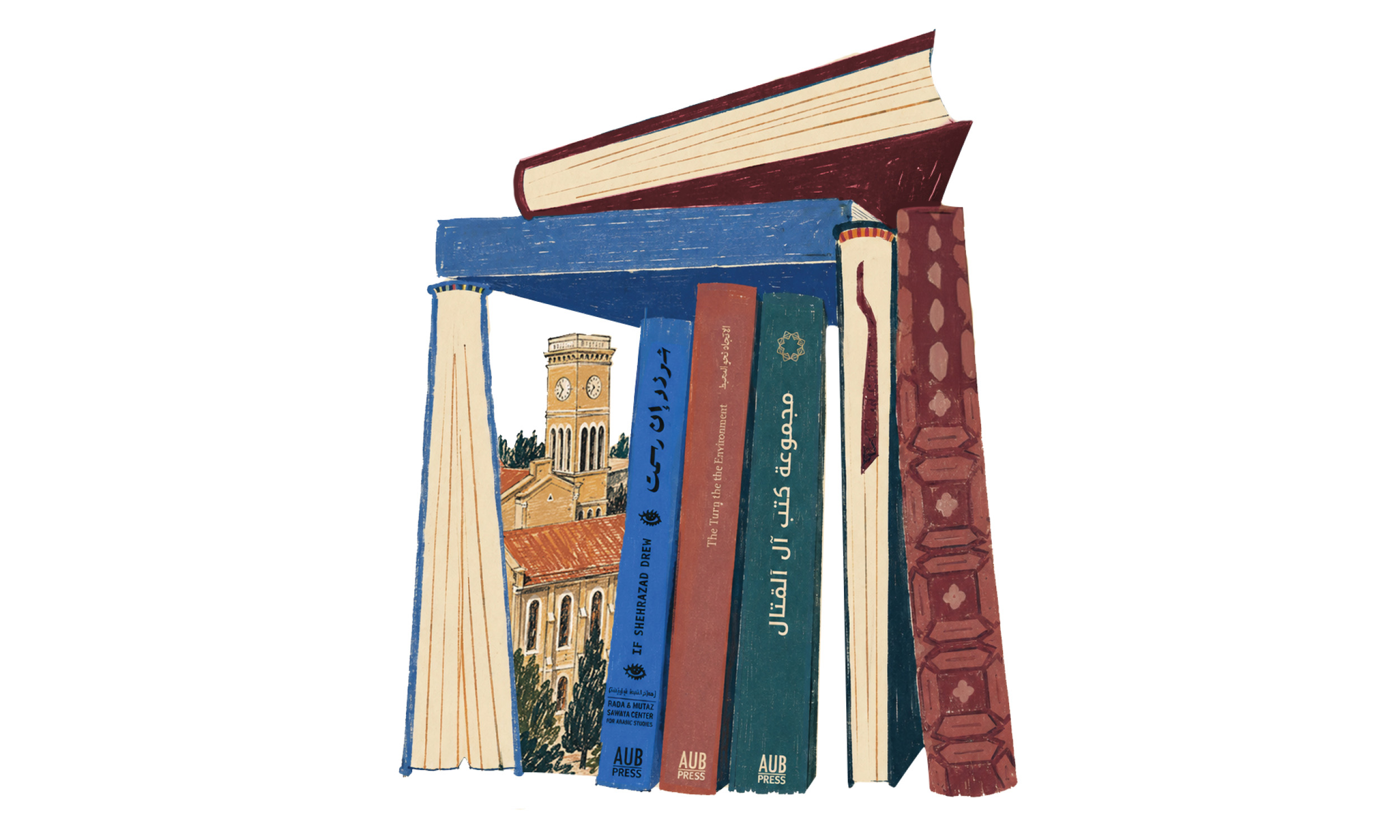
The Sheikh Zayed Bin Sultan Al-Nahyan Chair for Arabic and Islamic Studies at the American University of Beirut (AUB), together with AUB Press and the university’s Faculty of Arts and Sciences, presents a program of eighteen sessions at the 67th Beirut Arab International Book Fair.
The program rests on a simple conviction: a university in Beirut belongs in the public cultural life of its city, and the Beirut Arab International Book Fair, one of the oldest in the Arab world, is where that life is most visible. Over eight days, novelists, poets, critics, publishers, physicians, and university leaders from Lebanon, Algeria, Morocco, Tunisia, Egypt, Jordan, and Oman meet Beirut’s readers in open conversation. Many of the sessions are moderated by AUB faculty and by recent graduates of the university’s Arabic program, so that established writers are questioned by a new generation of scholars trained in Beirut.
History and its retelling run through much of the week. The Algerian novelist Waciny Laredj, in conversation with Dr. Tarek El-Ariss, James Wright Professor and chair of Middle Eastern Studies at Dartmouth College, discusses how the Emir Abdelkader, Granada, and Algeria’s memory of colonial rule and civil war become a living narrative. Reem Bassiouney presents Kōm al-Nūr, her new novel on Khedive Abbas Hilmi II, the last khedive of Egypt, and the Moroccan novelist Tarik Bakkari speaks about identity, Amazigh heritage, and the Years of Lead in his fiction. Abdelilah Benarafa introduces his new novel from Dar al-Adab, The Night His Excellency Disappeared, a political thriller that follows his long cycle of Sufi novels, and Rachid El Daif’s latest trilogy is the occasion for a panel on what happens to myth when it moves to the center of the modern Arabic novel.
Other sessions turn to the institutions that shape Arabic literature. Waciny Laredj, winner of the Sheikh Zayed Book Award, and Jalal Barjas, winner of the International Prize for Arabic Fiction, ask what prizes do to a text and to its author. Najwa Barakat reflects on her workshop “How to Write a Novel?”, launched in Beirut in 2009, which has produced more than twenty published novels. Dar al-Adab CEO Rana Idris revisits the history of the publishing house, founded by her father Suheil Idris in 1956, and her memories of the writers it published, from Ghassan Kanafani to Hoda Barakat. Tunisian novelist Habib Selmi and Jordanian novelist Jalal Barjas each discuss a body of work built over decades. Omani poet Aisha Al-Saifi, the first woman to win the title “Prince of Poets,” gives a poetry reading, and singer Rima Khcheich, accompanied by Juan Rodríguez on piano, opens the program with an evening of tarab and muwashshaḥāt. Another session explores Mahmoud Darwish’s poetic narrative through the biography of a single, evolving poem.
The program also reaches beyond literature. Neurosurgeon George Haddad reads masterpieces of European painting through a physician’s eye, exploring depictions of diseases recorded by artists centuries before medicine named them. Professor Zaher Dawy, AUB provost, and Professor Richard Maroun, vice-rector for academic affairs at Saint Joseph University of Beirut, debate the future of higher education in the Arab world. Dr. Tarek El-Ariss speaks about Water on Fire, his Arabic memoir of a childhood in Beirut during the Lebanese Civil War. Dr. Simon A. Kachar, founding director of the Good Governance and Citizenship Observatory at AUB, presents his book on Fouad Chehab and the politics of reform in Lebanon, and the week closes with We’re in This Together, the new AUB Press volume of sixty oral-history interviews with residents of Ras Beirut who grew up in the neighborhood before the civil war, presented by historian Maria Abunnasr and Mona El Hallak, director of the Neighborhood Initiative at AUB. The sessions on Kachar’s book and We’re in This Together are each followed by a book signing.
“Beirut has always argued about books in public, and the fair is where that happens,” said Professor Bilal Orfali, Sheikh Zayed Chair for Arabic and Islamic Studies at AUB. “We wanted the university to take part as a host, bringing writers from across the Arab world into conversation with our faculty, our graduates, and the readers of this city.”
The program runs from October 9 to 16, 2026, with all sessions taking place at the Seaside Arena on the Beirut Waterfront. The full schedule is available on this link.
About AUB
Founded in 1866, the American University of Beirut bases its educational philosophy, standards, and practices on the American liberal arts model of higher education. A teaching-centered research university, AUB has more than 790 full-time faculty members and a student body of over 9000 students. AUB currently offers more than 140 programs leading to bachelor’s, master’s, MD, and PhD degrees. It provides medical education and training to students from throughout the region at its Medical Center that includes a full-service 365-bed hospital.
Stay up to date on AUB news and events.
aub.edu.lb |Facebook |X