
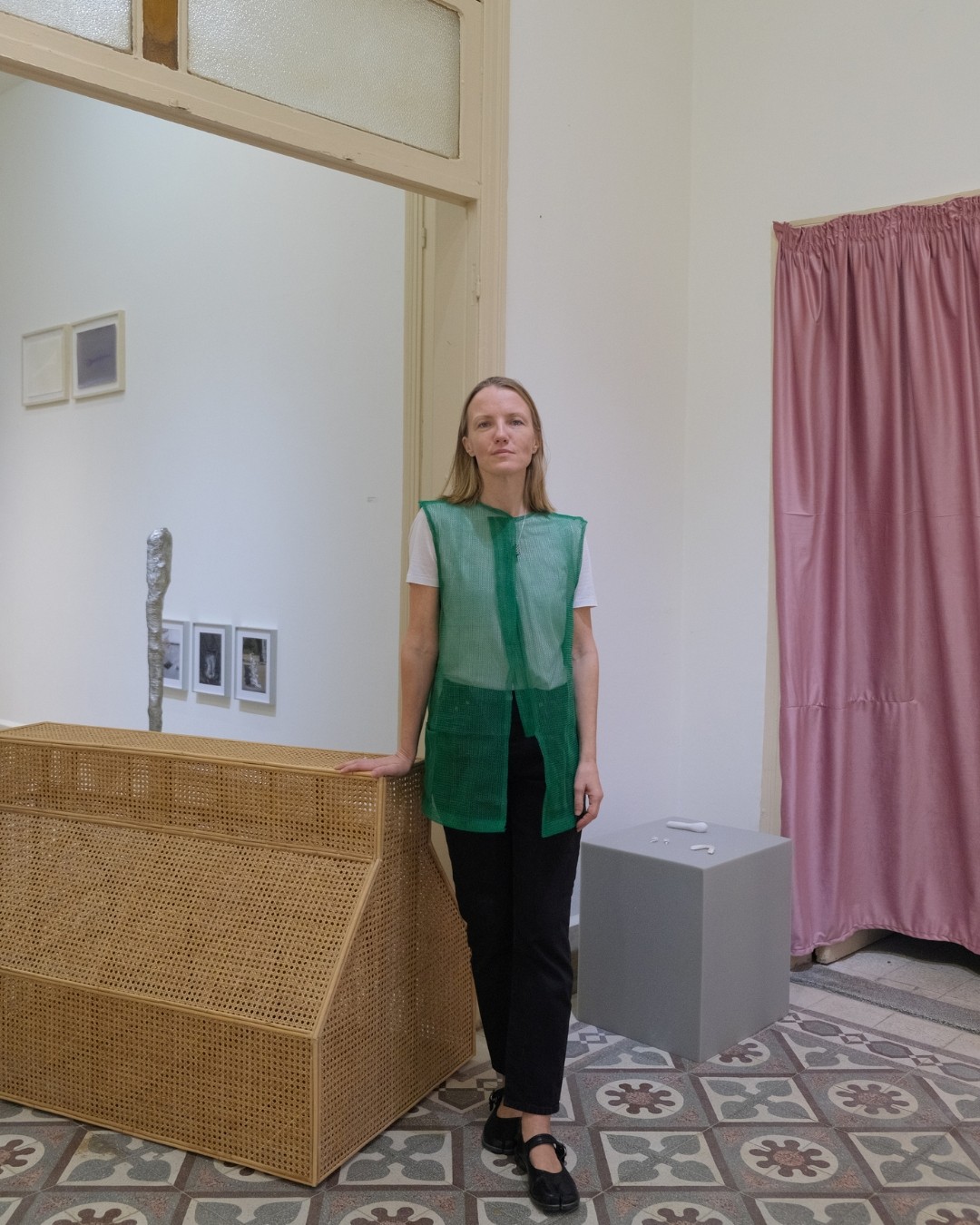
Artist Ieva Saudargaitė Douaihi – Photo by Fatima Elie
What happens when life is still, and when it still continues?
This question sits at the centre of STILL LIFE, a solo exhibition by Ieva Saudargaitė Douaihi, presented across two levels of the artist’s studio in Beirut. Working across sculpture, photography, installation and sound, the exhibition brings together objects, materials and elements of everyday life, transformed through processes of collecting, altering, assembling and reinterpreting. Through these gestures, the artist examines what ordinary things absorb, preserve and reveal about the conditions in which we live.
Taking its title from the art-historical genre associated with the representation of inanimate objects, STILL LIFE explores the tension between life that persists and life that is suspended or interrupted. In Beirut, these questions carry particular weight. Seven years of successive economic, (geo)political and social crises have profoundly altered the rhythms and material conditions of everyday existence. Yet the relationship between our surroundings and ourselves is never one-directional: the environments and conditions we inhabit also inhabit us, while our memories, anxieties, desires and inner worlds shape how we experience and respond to them. At this particular moment and place, the boundaries between the external and internal, the individual and collective, are increasingly entangled.
Some of the works in STILL LIFE have been gestating for years, accumulating meaning alongside the circumstances that eventually brought them into being. Seven years into a period of profound personal and collective upheaval, an urgency emerged to bring this body of work into the world. The exhibition is neither a retrospective account nor an attempt at closure, but an opportunity to share and reassess a body of work shaped by time, experience and the changing conditions of living and making in Beirut.
Saudargaitė Douaihi stated: “For seven years, these works have felt pregnant, growing alongside everything happening to and around me. Sharing them now feels like a delivery: an opportunity to externalise what has shaped them and to reassess my relationship with the world I inhabit. It is not about reaching a conclusion, but about making space for what comes next.”
The exhibition unfolds through a series of rooms, extending into the studio’s garden and onto its upper level. Visitors encounter sculptural works, clay objects, aluminium casts derived from improvised street constructions, sound installations, textiles and collections of found fragments. These works bring together humble and often overlooked materials, tracing the relationships between objects, bodies, labour and the built environment. In the garden, a mirror structure introduces another point of encounter between the exhibition and its surroundings. Upstairs, a double camera obscura shifts the experience towards light, perception and the ways in which the exterior world penetrates and inhabits the interior.
The making of STILL LIFE has itself been a collective undertaking, developed with fabricators, craftspeople and technicians, and informed by exchanges with friends and colleagues. The studio, a place of production, accumulation and adaptation, is integral to the exhibition. Opening it to the public brings the conditions of making into view, drawing attention to the labour, resources and relationships required to sustain artistic practice. In Lebanon, where institutional infrastructure and support for independent production remain limited, artists are often required to create their own conditions for working and exhibiting. Her founding of Takeover, an artist-led project space in Beirut, grew out of this need to create spaces for artistic production and exchange.
The exhibition is accompanied by a curatorial text written by author Shalmali Shetty, which can be read here.