
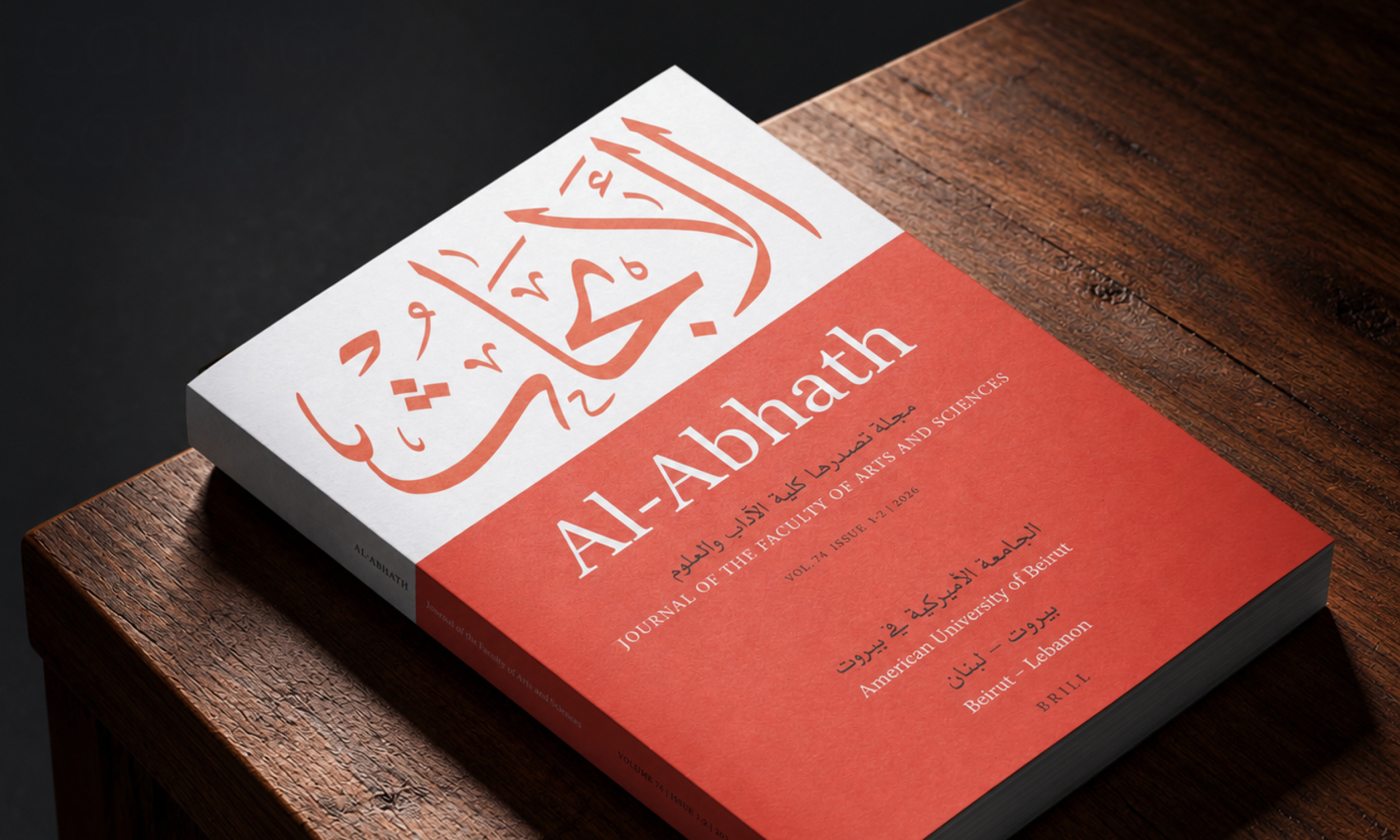
Al-Abhath, the journal of the Faculty of Arts and Sciences at the American University of Beirut (AUB), has released volume 74 (2026). Published by Brill in Leiden and Boston, the issue carries eight peer-reviewed articles in Arabic and English and three book reviews.
The volume spans a wide range of periods and places, with contributors from across the Middle East, North Africa, Europe, the United States, and Nigeria. Its subjects run from first/seventh-century Egypt to contemporary Arabic literature written during wartime.
“What holds this volume together is not a theme but a standard,” said Professor Ramzi Baalbaki, Margaret Weyerhaeuser Jewett Chair of Arabic at AUB and co-editor of Al-Abhath. “A study of the grammarians’ technical vocabulary sits beside a reading of a contemporary novel, and both are held to the same demand: work closely with the text, argue from the evidence, and say something that was not known before. That is what a journal is for. We have kept to it for more than seven decades, through conditions that made keeping to anything difficult.”
“Look at where the contributors write from,” said Professor Bilal Orfali, Sheikh Zayed Chair for Arabic and Islamic Studies at AUB and co-editor of the journal. “Doha, Madaba, Sharjah, Muscat, Kairouan, Jena, Bologna, Chicago, Ibadan. And one of the articles publishes two maqāmāt written in Nigeria in our own century, still in manuscript, in the tradition of al-Hamadhānī. Arabic scholarship is not produced in one place, and Al-Abhath publishes in Arabic and in English because the field actually works in both. Our job is to keep the conversation open in either direction.”
In this issue, Wadad Kadi from the University of Chicago examines the tenth-century Egyptian historian Ibn Yūnus al-Ṣadafī’s use of documentary evidence. Ibn Yūnus’s two histories of Egypt are lost, surviving only in citations. Kadi isolates the passages where he states that he is copying from documents: funerary inscriptions, buildings he saw himself in Fusṭāṭ, a waqf deed, witness testimony, and dīwān registers still extant in his day. The registers yield new information on the military draft of 126/744 and on the administrative ties between Egypt and Ifrīqiya in the late Umayyad period.
Turning from historical documentation to advice on governance, Enrico Boccaccini from the University of Jena reads gender in twenty-five Arabic and Persian mirrors for princes—texts offering advice to rulers—from the ninth to the fourteenth century. Women appear first as distractions from the business of rule, but the texts turn out to give them far more: they act as rulers, advisers, and exemplary figures. Gender itself becomes a device for making ethical and political arguments.
Two further studies turn to contemporary Arabic literature. Jokha al-Harthi from Sultan Qaboos University and Muḥammad ʿAbd Allāh Zarrūq from the University of Kairouan study the narration of detail in Adania Shibli’s novel Minor Detail, where small and seemingly insignificant details accumulate until they carry the weight of what they describe. In a study of another novel, Shahla Ujayli from the American University of Madaba distinguishes metaphorical exile from the geographical kind, taking Jannat al-barābira as her case: the estrangement that comes not from leaving home but from remaining in it through war, when habits, routes, and familiar things all change their function.
The volume also explores the continuation of classical literary traditions in contemporary writing. Sulaiman Adewale Alagunfon from Ibadan publishes and analyzes two Nigerian maqāmāt that survive only in manuscript, written in the tradition of al-Hamadhānī and al-Ḥarīrī by authors of the present century. His article includes the full text of both works.
Questions of intellectual reform are the focus of a study by Ines Peta from the University of Bologna. She reconsiders Aḥmad Amīn’s trilogy on the dawn, forenoon, and noon of Islam, and his reassessment of the Muʿtazila, against the orientalist framing of Islam and the simplifying oppositions of tradition and modernity that have shaped how projects of intellectual reform are read.
Two studies address questions of language and grammar. Mahdi Arar from the Doha Institute for Graduate Studies analyzes syntactic ambiguity in written media language, working from al-Jazeera Net and the newspaper al-Quds, and identifies eight recurring sites where the ambiguity arises. Turning to grammatical theory, Sayf al-Dīn al-Fuqarāʾ and Mariam Balʿajīd from the University of Sharjah trace the grammarians’ notion of inḥiṭāṭ al-martaba al-naḥwiyya, the descent of a construction from its original rank, and the normative judgments that the term carried.
Alongside the eight studies, the volume includes three book reviews. Hany Ramadan reviews Poetry and Spiritual Insights, the first critical edition of Abū Naṣr al-Qushayrī’s Kitāb al-Shawāhid wa-l-amthāl (AUB Press, 2025), edited by Bilal Orfali, Ramzi Baalbaki, and Francesco Chiabotti. Kirill Dmitriev reviews Andrew Marsham’s The Umayyad Empire (Edinburgh University Press, 2024), while Bilal Orfali reviews ʿAlī bin Tamīm’s ʿUyūn al-ʿajāʾib fī mā awradahu al-Mutanabbī min ikhtirāʿāt wa-gharāʾib (Abu Dhabi Arabic Language Centre, 2024), on al-Mutanabbī’s poetic invention.
Review copies, author interviews, and cover images are available on request at [email protected].
About AUB
Founded in 1866, the American University of Beirut bases its educational philosophy, standards, and practices on the American liberal arts model of higher education. A teaching-centered research university, AUB has more than 800 full-time faculty members and a student body of over 9,700 students. AUB currently offers more than 140 programs leading to bachelor’s, master’s, MD, and PhD degrees. It provides medical education and training to students from throughout the region at its Medical Center, which includes a full-service 365-bed hospital.
Stay up to date on AUB news and events.
aub.edu.lb |Facebook |X
About Al-Abhath
Al-Abhath is the journal of the Faculty of Arts and Sciences at the American University of Beirut, published by Brill. It welcomes articles in Arabic and English in Arab and Middle Eastern studies, and all submissions are peer reviewed with the anonymity of authors and readers preserved. The journal is indexed in Scopus. Volume 74 is available at brill.com/alab. Submissions and inquiries: [email protected].