
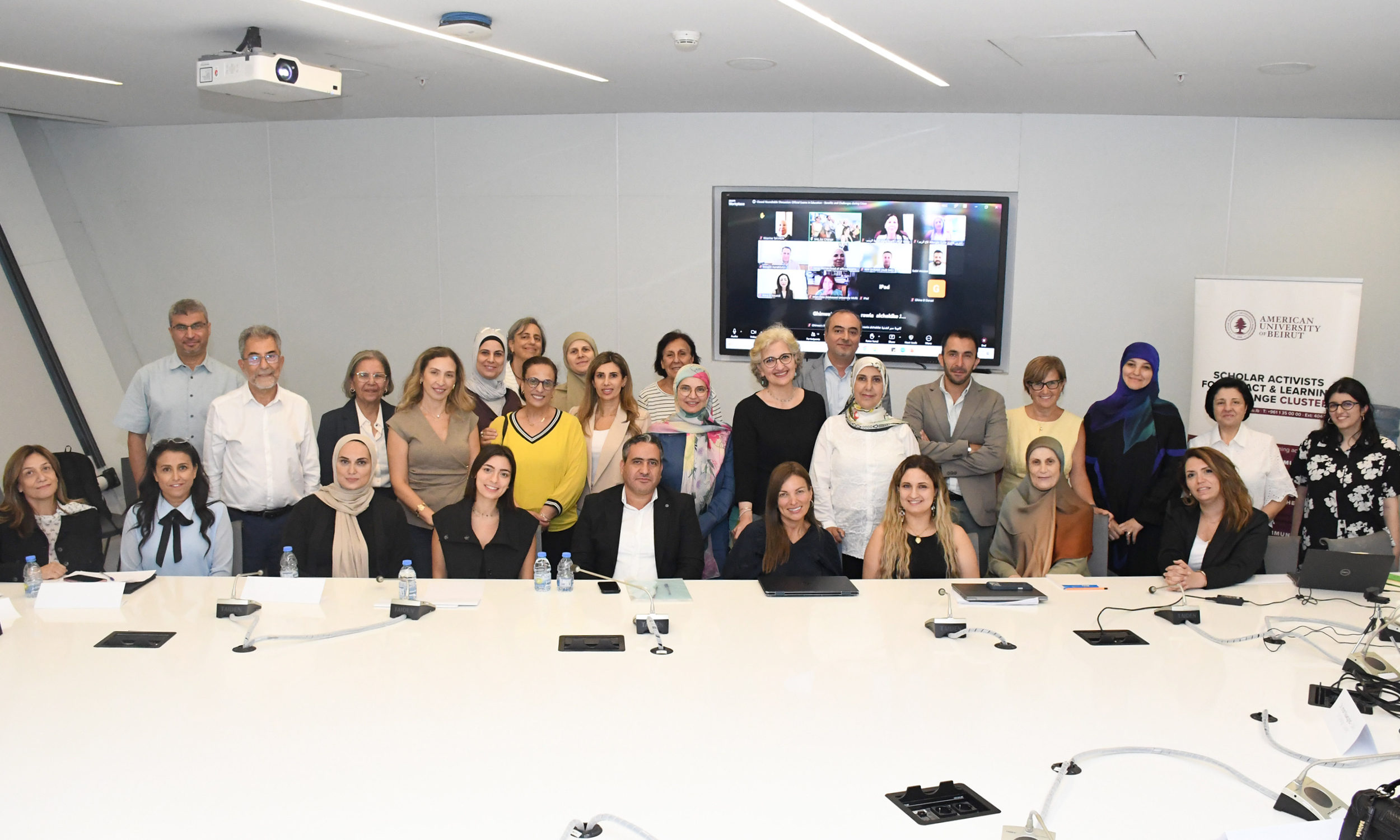
The SAIL for Change Cluster at the American University of Beirut (AUB) convened a closed roundtable discussion on “Official Exams in Education: Benefits and Challenges During Crises,” bringing together a diverse group of education stakeholders to examine how Lebanon’s assessment system can maintain academic standards while responding to prolonged disruption and unequal learning opportunities.
Participants included representatives from public and private schools, universities and university education departments, education organizations and associations supporting students and teachers, and parent committees. Also taking part were Dr. Rima Karami, minister of education and higher education, and Dr. Najat Aoun Saliba, a member of parliament, both members of the SAIL for Change Cluster team.
The roundtable was moderated by Dr. Nuhad Yazbik-Dumit, professor of nursing and founding director of the SAIL for Change Cluster, and Dr. Iman Nuwayhid, professor of public health and leader of the environmental health initiative at the SAIL for Change Cluster.
A central question guided the exchange: “How can Lebanon preserve the value, credibility, and national role of official examinations while ensuring that students are not unfairly disadvantaged by circumstances beyond their control?”
Participants broadly agreed on the continuing importance of official examinations as a national reference point, a recognized certification mechanism, and a means of maintaining comparable standards across students and regions.
They highlighted the limitations of relying on a single examination, particularly during periods of prolonged disruption, when students may have experienced unequal instructional time, displacement, interrupted schooling, limited access to technology and academic support, and significant differences in their learning conditions.
A recurring theme was the need to distinguish between maintaining standards and maintaining a particular examination format. Participants discussed the importance of preserving the functions served by official examinations while examining whether their design and implementation remain appropriate under crisis conditions.
The conversation explored several possible directions for further work, including developing a national framework or protocol for assessment during crises, with clearly defined levels of disruption and corresponding responses; strengthening the relationship between curriculum, competencies, and assessment, particularly as Lebanon moves toward a more competency-based educational system; and considering how continuous and cumulative assessment could complement national examinations.
Further proposals included strengthening the use of diagnostic assessment and learning-loss data to identify gaps and inform targeted academic support; ensuring that crisis-related adaptations promote equity without lowering academic expectations; and strengthening psychosocial and academic support for students affected by prolonged disruption.
Other areas for further work included improving coordination among the ministry, schools, universities, and education organizations and examining how assessment at the end of secondary education connects with university readiness and the transition to higher education.
The group called for reliable assessment that provides information about what students have learned, where gaps remain, and what support may be required.
The discussion also raised broader questions about the credibility and interpretation of examination results. Participants noted the importance of reliable national data, transparent procedures, clear communication with students and families, quality assurance, and public trust in assessment outcomes.
The closing discussion highlighted the need to address assessment challenges beyond a single decision about whether to hold or cancel an examination. Addressing these challenges requires a broader consideration of what the education system seeks to measure, how learning is assessed, how standards are protected, and how students are supported when disruption affects their opportunity to learn.
Dr. Nuhad Yazbik-Dumit noted in her closing remarks, “The contributions around this table are a wealth that we can draw on to strengthen our education sector. While we may approach the challenges from different perspectives, we share one common concern: ensuring that our students receive what they need to learn, grow, and move forward.”
Those who attended had the opportunity to submit additional reflections and recommendations. These contributions will be consolidated with the points raised during the roundtable discussion to identify areas for further dialogue and potential practical policy recommendations.
The roundtable reflects the broader approach of the SAIL for Change Cluster, which brings together academic knowledge, local experience, and the perspectives of communities and institutions to cocreate solutions responsive to local needs. Across its six initiatives, SAIL for Change applies an agile, evidence-based, inclusive, and holistic approach, with a focus on social justice, strengthening public institutions, codesigning best practices, and creating opportunities that contribute to the wellbeing and dignity of people in Lebanon.
About AUB
Founded in 1866, the American University of Beirut bases its educational philosophy, standards, and practices on the American liberal arts model of higher education. A teaching-centered research university, AUB has more than 800 full-time faculty members and a student body of over 9,700 students. AUB currently offers more than 140 programs leading to bachelor’s, master’s, MD, and PhD degrees. It provides medical education and training to students from throughout the region at its Medical Center, which includes a full-service 365-bed hospital.
Stay up to date on AUB news and events.
aub.edu.lb |Facebook |X