
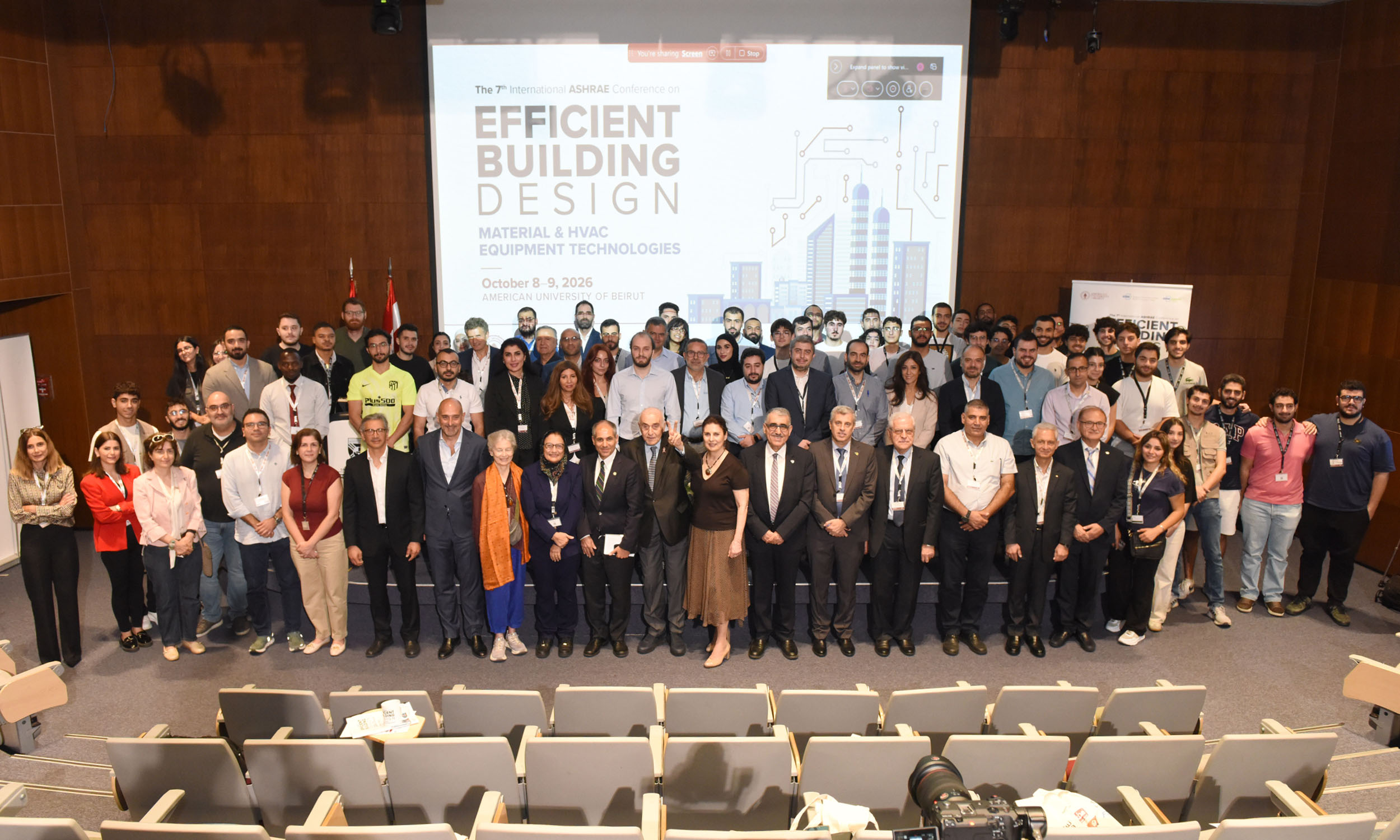
Researchers, engineers, industry professionals, and practitioners gathered to explore emerging solutions for more efficient, sustainable, and resilient buildings and cities at the 7th International Conference on Efficient Building Design–Materials and HVAC (heating, ventilation, and air conditioning) Equipment Technologies.
The event was organized by the Munib & Angela Masri Institute of Energy and Natural Resources at the American University of Beirut (AUB), the American Society of Heating, Refrigerating and Air-Conditioning Engineers (ASHRAE), the ASHRAE Lebanese Chapter, and the Department of Mechanical Engineering at the Maroun Semaan Faculty of Engineering and Architecture (MSFEA) at AUB.
Held biennially at AUB, the conference has become a platform for exchange between academia and industry, addressing the evolving challenges facing the built environment. This year’s program examined smart and energy-efficient buildings, advanced HVAC technologies, sustainable design, indoor air quality and thermal comfort, urban energy, and city resilience, with particular attention to emerging digital and AI-driven solutions.
With more than 300 participants registered, the two-day conference featured four international keynote speakers, five technical sessions, a panel discussion, and an industrial session, bringing together local and international expertise across research and professional practice. Keynote speakers included Dolaana Khovalyg, assistant professor and head of the Laboratory of Integrated Comfort Engineering at the École Polytechnique Fédérale de Lausanne; Muhyiddine Jradi, associate professor of energy engineering at the University of Southern Denmark; Assaad Zoughaib, professor and head of the master’s program in energy at Mines Paris–PSL; and Alessia Arteconi, associate professor in applied mechanics and energy conversion at KU Leuven. Their presentations addressed topics ranging from smart buildings and digital solutions to heating and cooling innovation and energy flexibility.
Opening the conference, Dr. Nesreen Ghaddar, conference chair and director of the Munib & Angela Masri Institute of Energy and Natural Resources at AUB, highlighted the collaborative effort behind the event, noting, “Conferences like this do not happen on their own. They happen because people are willing to contribute their time, expertise, and energy.”
ASHRAE President Sarah Maston emphasized the importance of equipping and inspiring the next generation of professionals in heating, ventilation, air conditioning, refrigeration, and the wider building industry through education, training, and knowledge exchange. She described the conference as an “ideal space for industry leaders to share ideas and technologies that inspire our current and next generation workforce, ultimately bringing global benefits.”
In his address, AUB Provost Dr. Zaher Dawy said, “For generations, the American University of Beirut has served as a living lab for innovation and human advancement, as a meeting point between Lebanon, the Arab world, and the wider international community.” He added, “At a time when the world is facing considerable challenges, our responsibility is not only to generate knowledge, but to translate that knowledge into action to help build a better tomorrow.”
“Perhaps the Middle East can become a laboratory for solutions the world will increasingly need: extreme-heat design, efficient cooling, distributed energy, thermal storage, microgrids and climate-resilient buildings,” said Omar Masri, member of the advisory council for the Masri Institute. He added, “The building of the future will not simply use less energy. It will increasingly know when to use energy, when to store it, when to generate it, and how to respond to changing conditions.”
In his closing remarks, Professor Alan Shihadeh, MSFEA dean, said, “We are gathering while Lebanon and our region are once again living through war. The causes of conflict are complex, but the extraction, movement, control, and security of energy resources have been woven into the geopolitics of this region for generations. The work we are considering today bears directly on that reality.”
He continued, “Saved energy starves the war engine,” explaining, “That may sound like an outsized claim for a better façade, a more efficient chiller, or a smarter control algorithm. But every joule that intelligent design makes unnecessary is a joule that does not have to be generated or extracted. It does not have to be transported, traded across volatile markets, or financed. And it does not become something militaries are called upon to secure.”
The conference program also included a panel on urban energy planning and city resilience and an industrial session highlighting practical perspectives and innovations from the field. Together, the sessions provided opportunities to exchange knowledge, examine emerging technologies, and explore pathways toward more efficient and resilient built environments.
About AUB
Founded in 1866, the American University of Beirut bases its educational philosophy, standards, and practices on the American liberal arts model of higher education. A teaching-centered research university, AUB has more than 800 full-time faculty members and a student body of over 9,700 students. AUB currently offers more than 140 programs leading to bachelor’s, master’s, MD, and PhD degrees. It provides medical education and training to students from throughout the region at its Medical Center, which includes a full-service 365-bed hospital.
Stay up to date on AUB news and events.
aub.edu.lb |Facebook |X