
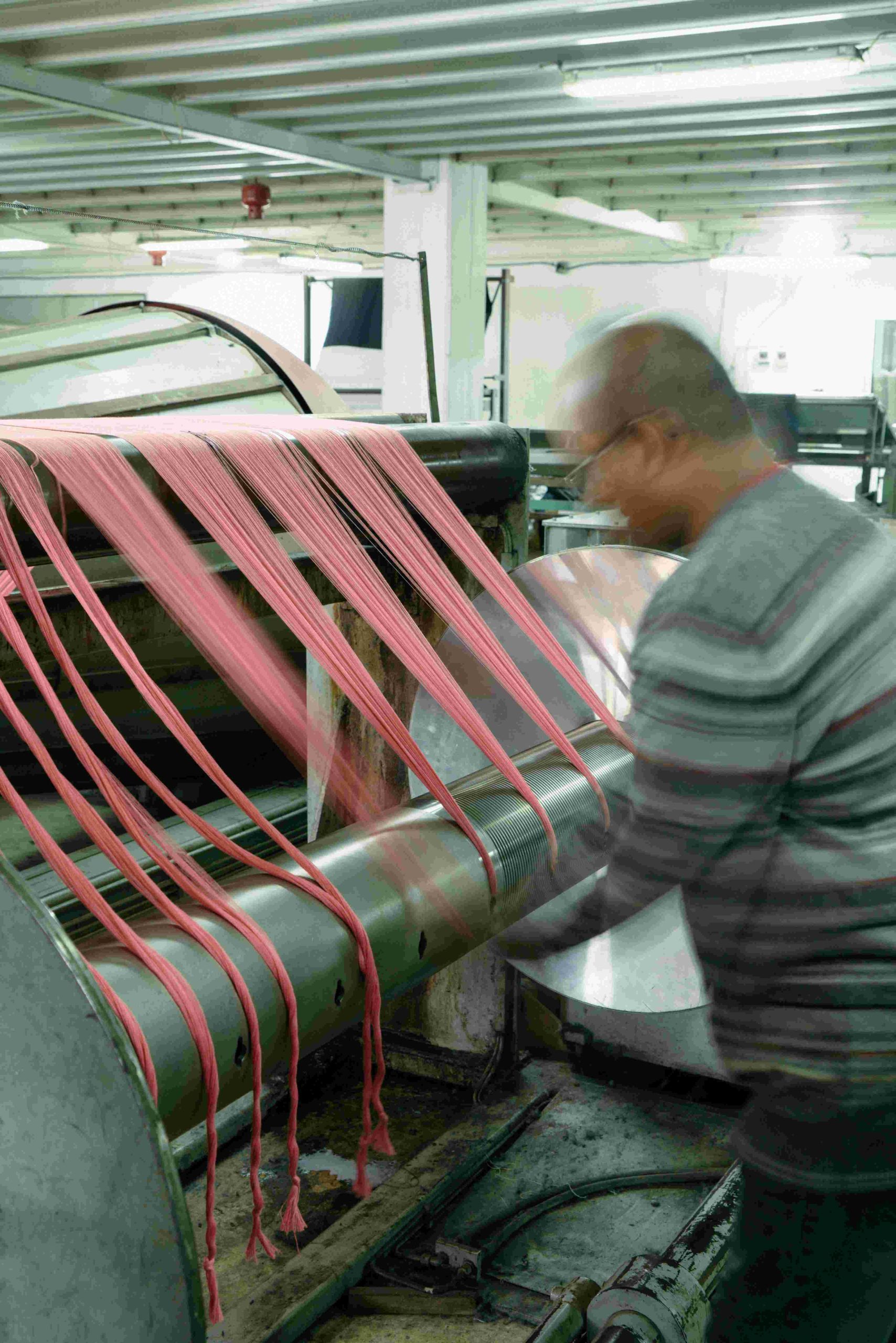
Ahead of its November exhibition, Qamīs: Fragments of Dress opens with a gathering inside Katbe, the country’s last working textile mill.
BEIRUT, LEBANON Fragmenta, an independent cultural platform exploring material culture, knowledge and making, today announces its second edition, Qamīs: Fragments of Dress. Taking the shirt as its starting point, Qamīs traces the material, industrial and human knowledge held within one of the most familiar objects in everyday life, opening a wider conversation about making, memory, labor and Lebanon’s relationship with textiles.
Before its exhibition opens in November, Qamīs begins inside a factory. On Friday, 18 September 2026, Fragmenta convenes figures from Lebanon’s textile, industrial and cultural worlds at Katbe Textile Factory in Hadath for Threads of Knowledge: A Fragmenta Gathering, under the patronage of Lebanon’s Ministry of Culture.
At the centre of the gathering is Threads of Knowledge, a conversation about what Lebanon’s textile industry once was, what changed, what remains and what might happen next.
Hosted by Nour Najem and Guilaine Elias, co-founders of Fragmenta, the conversation brings together Tony Katbe, Owner and Director of Katbe Textile Factory and Zuher Debs, former Chairman and Managing Director of Lanatex S.A.L. once one of Lebanon’s leading thread and textile manufacturers and representatives of Lebanon’s cultural and industrial sectors.
Rather than treating textile production solely as history, the gathering asks what can be learned from what remains: what knowledge survives when the structures that carried it disappear, and how does it change in the process? Who holds it? And how can it shape what Lebanon chooses to make next?
Katbe carries forward an industrial legacy that once anchored a significant part of Lebanon’s economy. While much of Lebanon’s textile industry has since wound down, at Katbe the machines still run, fabric is still made, and the knowledge behind it is still held by people who know how to make it.
“This started with my grandfather, and I have proudly kept it because I believe it matters giving people here the stability and dignity of knowing they can provide for their families. When you invest in people, you are not just running a factory, you are holding a community together.”
Tony Katbe, Owner and Director of Katbe Textile Factory
“Katbe has gone from Gabriel, to Antoine, to my father Elie, and now to me. We are not preserving the past, we are finding the courage to keep evolving it. Fragmenta’s presence here means this story gets told while the people who lived it are still here to tell it.”
Katbe
“We wanted to begin Qamīs somewhere that could not be separated from the questions the platform raises. Katbe is living proof; the machines are running, the fabric is being made, and the knowledge is still with people. That changes the conversation.”
Nour Najem and Guilaine Elias, Co-Founders of Fragmenta
From the Shirt to the Industry Behind It
The shirt is an ordinary object, familiar across generations, professions and social worlds. Yet its simplicity conceals an entire chain of knowledge: fibre, thread, fabric, machinery, construction, labour, and the hands that bring it together.
“It’s the most democratic garment there is, a second skin, structured yet soft, and quite architectural.” Nour Najem and Guilaine Elias
The platform follows the shirt beyond the body, into the worlds that make it possible. Qamīs Fragmenta’s second edition opens in November 2026 and unfolds across five.
A Country That Once Made
By the 1970s, manufacturing was deeply woven into Lebanon’s economic and social fabric, accounting for roughly 18% of GDP in 1974, with textile production among the country’s established industries. War, economic transformation, changing markets and the long decline of local manufacturing have since reshaped the country’s industrial base, pressure compounded by Lebanon’s more recent economic crisis and ongoing debate over industrial and tax policy reform.
Katbe offers a rare physical connection to that history: not an archive of a vanished industry, but a place where the work is still happening.
“There is something deeply moving about entering a factory that has survived while so much around it has disappeared. You are not looking at a photograph of Lebanon’s textile history. You are standing inside it.”
“Holding this gathering at Katbe isn’t symbolic, it’s research. We are beginning Qamīs where textile knowledge is still alive: where the machines are still running and the making never stopped.”
Nour Najem and Guilaine Elias
“Holding this gathering at Katbe isn’t symbolic, it’s research. We are beginning Qamīs where textile knowledge is still alive: where the machines are still running and the making never stopped.”
Tony Katbe, Owner and Director of Katbe Textile Factory
For visitors, the factory offers something an exhibition alone cannot: the sound of machinery, the texture of production, and the animated presence of a working industrial environment. It is a process that still starts the same way it always has: with yarn, sourced from certified mills for its quality, wound, woven, washed and finished by hand and machine in sequence, until what begins as thread leaves the floor as cloth, on its way to becoming someone’s shirt.
“A cultural platform like this connects the makers to the craftspeople, the hands behind a shirt most of us wear without ever thinking about how it got made. Every shirt still carries a thread back to a factory floor like ours.” Tony Katbe, Owner and Director of Katbe Textile Factory
Not Nostalgia, But a Question
For Fragmenta, Qamīs is not rooted in nostalgia. The aim is not simply to remember the Lebanon that once was, but to reconnect fragments of history, identity and potential and to ask what can be done with the knowledge that remains.
“The nostalgia is real, but it isn’t the destination. What interests us is what remains after an industry declines the skills, the memories, the materials, the people and whether those fragments can tell us something about what Lebanon can make again.” Nour Najem and Guilaine Elias
This question sits at the heart of Fragmenta’s wider practice. Through Research, Connecting, Collaborating and Activating, the platform carries knowledge beyond the exhibition, connecting researchers with makers, contemporary practitioners with industrial knowledge, and historical memory with future possibility.
“This isn’t only about preservation, it’s about transformation, actualisation and transmission. Memory only matters if it stays active, not static. The question is what knowledge can be carried forward, who carries it, and what new, useful forms it can take so it moves from the margins back to the centre of how Lebanon makes designs and consumes.” Nour Najem and Guilaine Elias
Threads of Knowledge: A Fragmenta Gathering took place on Friday, 18 September 2026 10 AM-12.30 PM at Katbe Textile Factory, Hadath, Lebanon.
The Exhibition
Qamīs: Fragments of Dress opens to the public on Saturday, 28 November 2026 and runs through Tuesday, 5 January 2027, at the Kassem Sugar Refinery, the former Société Libanaise de la Raffinerie du Sucre S.A.L. on the Zalka coastal road in the Metn, near Beirut. Owned by the Kassem family, the abandoned refinery serves as the main venue for the exhibition.
About Katbe Textile Factory
Located in Hadath, Katbe Textile Factory, occupying 2,000 square meters, is widely recognized as Lebanon’s last operating textile factory. Managed by Tony Katbe, the fourth generation of the Katbe family, the factory produces simple-weave fabrics and cotton towels on industrial weaving machinery, with yarn sourced from certified suppliers. Production runs on site from raw yarn through to finished cloth. It remains a working site of production and a rare living repository of textile and industrial knowledge. As of September 2026, shirting fabric accounts for 40% of current production with the remaining 60% spread across the factory’s other products.
About Fragmenta
Fragmenta is a cultural platform rooted in the Eastern Mediterranean. Founded by Nour Najem and Guilaine Elias, it brings together designers, craftspeople, researchers, cultural institutions, industry and communities through exhibitions, research, publications and public programmes. Each edition begins with a single fragment, a material, object or cultural practice from the region, used to trace the wider human, artisanal, industrial and historical knowledge behind it.
About Qamīs: Fragments of Dress
Qamīs is Fragmenta’s second edition. It explores the shirt, from fiber and thread to textile, construction and dress, and the people, places and knowledge behind it. Each Fragmenta edition begins with a fragment. This year, that fragment is the shirt with Qamīs opening November 2026 in Beirut.
About Nour Najem & Guilaine Elias
Nour Najem and Guilaine Elias co-founded Fragmenta and co-curate its editions.
Najem is a designer, creative director and social entrepreneur working across fashion, design and cultural projects. Elias is a Beirut-based interior architect and designer whose practice centres on materiality, space and place, with a particular interest in Levantine craft and heritage.
Together, Najem and Elias develop research-led projects connecting craft, industry, memory and place, bringing researchers, makers, designers, artists and cultural practitioners into conversation around the knowledge embedded in materials and making.
Satellite Locations
Fragmenta’s Qamīs runs across satellite locations alongside the main exhibition at the Kassem Sugar Refinery in Zalka, Beirut, including the Beit Chabeb Jacquard Mills and Maison de l’Artisan in Ain El Mreisseh, Beirut, dedicated to Lebanese craft and artisanal making.
Participants
Qamīs brings together more than 40 Lebanese designers, architects and makers, spanning design and installation work, and three generations of practice from established names to Lebanon’s emerging talent